

Some nights your head just won’t shut up.
You replay a conversation from three weeks ago. You snap at someone over nothing, then wonder why. Journaling for emotional healing sounds almost too simple to touch any of that. Grab a notebook, write down what you feel, and feel better?
But the research backs it up, and it has for almost 40 years. This guide covers what journaling for emotional healing actually means, why it works, 11 methods you can try tonight, and the mistakes that quietly cancel out the benefits.
What is journaling for emotional healing?
Journaling for emotional healing means writing your feelings, memories, and reactions on purpose, so you understand them instead of just carrying them arou nd. It’s not a diary. A diary records what happened. A healing journal asks what it meant to you.
Youdon’tt need nice handwriting or clever sentences. One honest line beats three paragraphs of forced positivity.
Psychologist James Pennebaker started testing this in 1986. He had college students write about a difficult experience for 15 minutes a day, four days straight. The ones who wrote about real emotional events, not neutral topics, visited the health center less often in the months that followed. That single study opened the door to decades of research on what’s now called expressive writing.
A 2005 review in Advances in Psychiatric Treatment by Baikie and Wilhelm found that this kind of writing improves mood, sharpens emotional awareness, and lowers stress in a fairly consistent way across different groups.
How does journaling actually help you heal emotionally?
Short answer: it slows your brain down enough to notice what it’s actually doing. Emotions move fast. Writing forces them onto a page at typing or handwriting speed, which gives you room to look at them instead of just reacting to them.
You separate fact from assumption. “My friend didn’t text back” is a fact. “My friend is mad at me” is a story your brain built on top of it. Writing both down side by side makes the gap obvious.
You also start noticing patterns you’d otherwise miss. Maybe every entry from a hard week mentions the same coworker, or the same 2 am worry. Youcan’tt spot a pattern in your head. You can spot one on paper.
Your body settles a little too. Pennebaker’s later work with immunologists Kiecolt-Glaser and Glaser found that writing about emotional experiences was linked to stronger immune activity, measured through lymphocyte responses, in the weeks that followed. Writing isn’t just a mental exercise. It shows up in the body.
What are the best journaling techniques for emotional healing?
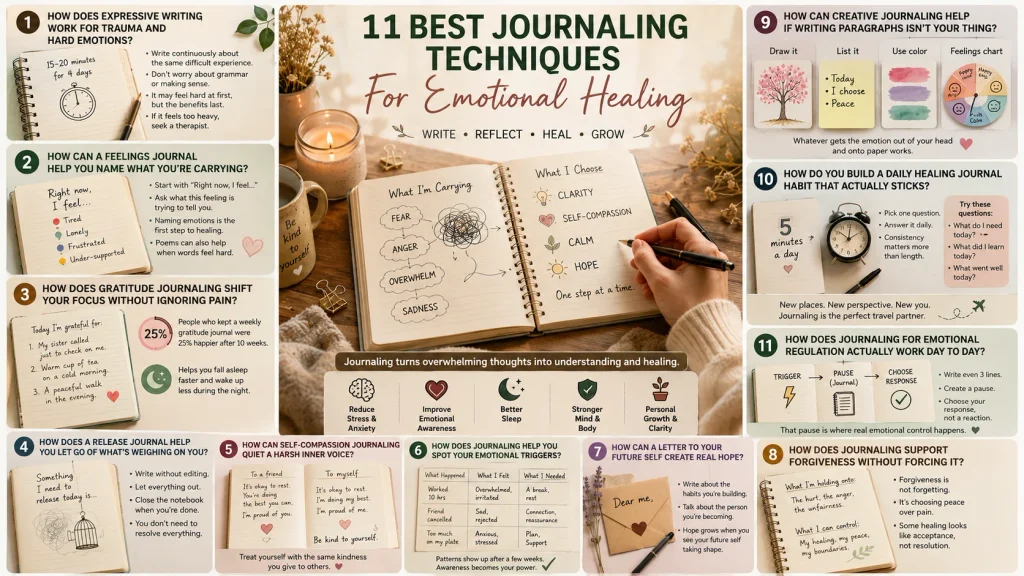
There’s no single right way to do this. Try a few, keep what actually helps, drop what feels like homework.
1. How does expressive writing work for trauma and hard emotions?
This is the original Pennebaker method, andit’ss still the most studied one. Write continuously for 15 to 20 minutes, four days total, about the same difficult experience. Don’t worry about grammar or making sense. Just write what you think and feel.
Expect to feel a little worse right after, for the first day or two. That’s normal, and it passes. Across the 200-plus studies that followedPennebaker’ss original work, the dip in mood was short, and the gains in stress, sleep, and immune markers outlasted it.
If a memory feels too heavy to write about alone, that’s a sign to bring in a therapist rather than push through solo.
2. How can a feelings journal help you name whatyou’ree carrying?
Start with “Right now, I feel…” and finish the sentence honestly. Then ask one more question: what is this feeling trying to tell me? Maybeyou’ree tired, or under-supported, or someone crossed a line you never said out loud.
Naming an emotion is often the first real step toward doing anything about it. Sometimes your own words won’t come, and a poem does that work instead. This piece on finally running out of complaints shows how naming a feeling can be a relief in itself.
3. How does gratitude journaling shift your focus without ignoring pain?
Gratitude journaling doesn’t let grief or anger out. Both can sit on the same page.
Write three specific things, not vague ones. Not “my f”mily,” but “my s”ster called just to check on me.” Emm” ns and McCullough’s study found that people who kept a weekly gratitude journal reported being roughly 25% happier than a comparison group after 10 weeks, and the effect held for months afterward.
There’s a sleep angle too. Several studies, including work by Wood and colleagues, link gratitude journaling with falling asleep faster and waking up less during the night, likely because it helps filter the thoughts running through your head right before bed.
4. How does a release journal help you let what’s weighing on you go?
Write “Something I need to release today is…” and keep going without editing yourself. Close the notebook when you’re done. You don’t have to resolve everything in one sitting.
5. How can self-compassion journaling quiet a harsh inner voice?
Picture a friend going through your exact situation. What would you tell them? Now write those same words to yourself.
Most people are far kinder to their friends than to themselves, and self-compassion journaling exists to close that gap on purpose.
6. How does journaling help you spot your emotional triggers?
Track it in three columns: what happened, what you felt, what you actually needed. After a couple weeks, patterns show up that you’d catch by memory alone. Maybe every “overwhelmed”y follows a day with zero breaks.
7. How can a letter to your future self create real hope?
Write a short letter starting with “Dear me.” Talk about the habits you’re building and the personyou’ree becoming, not a fantasy where every problem is already solved. This works because it pulls your attention past today’s mess toward something you’re actively shaping.
8. How does journaling support forgiveness without forcing it?
Forgiveness doesn’t mean pretending something didn’t happen or excusing harm. Ask yourself whatyou’ree still holding onto, and what part of this you can actually control. Some healing looks like acceptance, not resolution.
If Urdu verses land closer to home than English prose, this shayari on how time quietly changes a person captures that same shift, one line at a time.
9. How can creative journaling help if writing paragraphs isn’t your thing?
Draw a symbol. Make a short list. Use color. A feelings chart works just as well as three pages of prose if it gets the emotion out of your head and onto something you can actually look at.
10. How do you build a daily healing journal habit that actually sticks?
Five minutes beats an houryou’lll skip. Pick one question and answer it each Morning or night: “What do I need today?” or “What did I learn today?” Consistency matters more than length.
Some of the most consistent journalers are solo travelers. New places tend to shake old routines loose, and journaling fills the quiet hours a solo trip hands you. This Portugal solo travel guide is worth a look if a change of scenery is part of your own healing plan.
11. How does journaling for emotional regulation actually work day to day?
Emotional regulation means catching a feeling before it drives your next decision. A quick journal entry, even three lines, creates a pause between the trigger and your reaction. That pause is where most of the actual regulation happens.
What should you write when you feel emotionally overwhelmed?
Don’t aim for deep. Aim for honest. Start with “Right now, everything feels…” and let it run without editing.
Try a 5-minute brain dump: write every thought as it comes, no order, no filter. Then ask three questions: what’s in my control, what isn’t, and what’s one small thing I can do next. That turns one giant problem into a few you can actually move on.
If anxiety is a big part of what you’re carrying, pair journaling with a few calming habits. This guide to natural remedies for anxiety and stress relief covers ones that work well alongside a journaling practice.
If journaling for emotional healing during anxiety or panic makes things feel worse instead of better, stop. Go for a walk, call someone, or come back to the page tomorrow. Writing should never be a requirement to relive pain you’re not ready to relive.
How often should you journal for emotional healing?
There’s no universal number. Three to four sessions a week, 5 to 10 minutes each, is a realistic starting point, close to how most expressive writing studies are actually structured.
Quality beats frequency. A rushed daily entry that says nothing new does less than one honest paragraph written twice a week. If you miss a few days, start again. The streak was never the point.
What mistakes quietly ruin journaling for emotional healing?
A few habits turn a helpful practice into another chore.
Judging your own handwriting or grammar. Nobody’s grading this.
Writing only about what went wrong. Balance the hard stuff with a line about what actually went okay, yo; you’ll train your brain to scan for problems all day.
Using the page to avoid a conversation you actually need to have. Writing can process a feeling. It can’t replace telling someone you’re hurt.
Comparing your healing timeline to someone else’s. Yours doesn’t have to look like theirs, and it won’t.
Can journaling replace therapy for emotional healing?

No. Journaling is a self-reflection tool, not a treatment for clinical depression, PTSD, or an ongoing crisis. If emotional pain is affecting your sleep, work, or relationships for weeks at a time, that’s a signal to talk with a licensed therapist, not just write about it harder.
Plenty of people do both. Bringing a few weeks of journal entries into a therapy session can actually speed things up, since it hands your therapist patterns you’ve already started noticing on your own.
For general, judgment-free information on mental health, the World Health Organization is a solid starting point.
FAQ’s:
Does journaling really help with emotional healing?
Yes. Decades of research on expressive writing show real improvements in mood, stress, and even immune markers. It won’t erase pain overnight, but it consistently helps people process it.
Is journaling better in the morning or at night?
Either works. Morning journaling sets intentions for the day, night journaling helps you process it. Pick whichever time you’ll actually stick with.
What if journaling makes me feel worse?
A short dip in mood right after writing about something hard is normal and usually passes within a day or two. If it doesn’t, or the distress feels too heavy, stop and talk to a trusted person or therapist instead.
Can journaling help with anxiety and depression?
It can support both by giving anxious or low thoughts somewhere to go instead of looping in your head. It works well alongside therapy or medication, but it isn’t a replacement for either.
How long should I journal each day?
Five to twenty minutes is plenty. Longer isn’t automatically better. A few honest sentences, written consistently, beat one long entry you never repeat.
Should I write about painful memories?
Only if you feel ready. Journaling for emotional healing works best when it feels supportive, not forced. If a memory feels too heavy, bring it to a therapist instead of writing it alone.
Final thoughts on journaling for emotional healing
You don’t need a fancy notebook or a perfect routine to start. You need one honest sentence and a few quiet minutes.
Write what you feel. Notice what you need. Let the page hold what your head can’t hold alone. Some entries will feel like nothing. A few will surprise you months later when you read them back.
For more real, research-backed guides on healing, self-love, and finding calm, browse the rest of VerseSoul.