
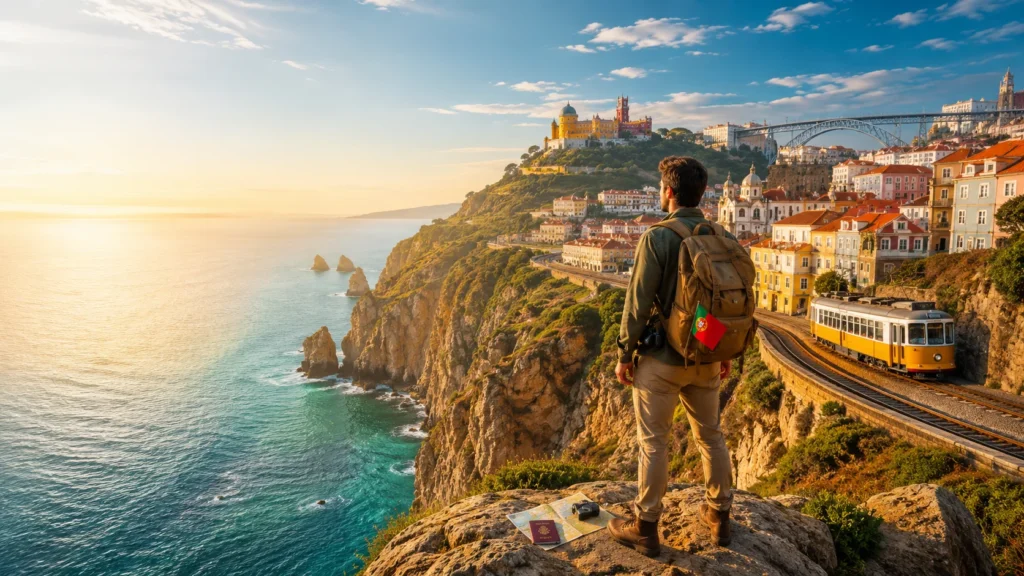
Portugal is where first-time solo travelers stop second-guessing themselves by day two.
Solo travel Portugal works for almost everyone: first-timers, women traveling alone, remote workers, and anyone who just needs a week of sun and custard tarts. The cities are walkable, the trains run on schedule, and strangers tend to be kind. This guide covers safety, the best places, beaches, costs, trains, food and a day-by-day plan, with numbers from official sources. Want the wider picture first? Read our solo travel Europe guide and come back here. Then grab a notes app and start your shortlist today.
Is Portugal good for solo travel?
Yes. Portugal ranks 7th out of 163 countries on the latest Global Peace Index, the trains connect the main cities, and a budget traveler can manage on roughly €55 to €90 a day (an estimate from independent budget breakdowns).
The Institute for Economics and Peace builds that index from 23 indicators. Portugal has sat in the top 10 for years.
Statistics Portugal (INE) counted 29.9 million non-resident tourists in its latest full-year data. So you won’t be the only foreigner in town, and that helps. English is easy to find in tourist areas, and hostels run social nights.
Is Portugal safe for solo travelers?
Yes. The US State Department lists Portugal at Level 1, its lowest risk level, which means “exercise normal precautions.” Violent crime against visitors is rare.
Petty theft is the real issue. Pickpockets work crowded spots like Lisbon’s Tram 28 and busy Alfama streets at night. Zip your bag, keep it in front of you, and you’ll rarely have a story to tell.
Honestly, your bigger risks are cobblestones and Algarve sunburn. Wear shoes with grip. The emergency number is 112.
For a wider safety toolkit, our solo travel safety guide covers apps and habits that work in any country.
Is Portugal safe for a woman traveling alone?
Yes, and many solo women say it feels calmer than parts of Spain or Italy. That comes from traveler accounts, not a formal study, so treat it as a pattern and not a promise.
Every big city has female-only hostel dorms. Skip empty side streets late at night, as you would anywhere. Our solo travel for women guide goes deeper on this. Traveling as a woman over 50 or 60? Read our guides to solo travel for women over 50 and solo travel for women over 60.
What are the best places in Portugal for solo travel?
Lisbon, Porto and a day trip or two cover most first trips. Add the Algarve if you have 10 days or more.
Is Lisbon good for solo travel?
Yes. Base yourself in Alfama, Baixa or Príncipe Real and you can walk to most sights. Evenings are easy to join alone, especially around Bairro Alto and Cais do Sodré.
At sunset, head to a miradouro (viewpoint). Santa Catarina and Senhora do Monte turn into relaxed social spots where chatting to a stranger feels normal.
Should you visit Porto alone?
Yes. Porto is smaller and slower than Lisbon. Walk the Ribeira riverfront, pop into a Port wine cellar across the river in Vila Nova de Gaia, and eat a francesinha (a gloriously heavy sandwich) at a counter seat.
Porto also works as a base for the Douro Valley, which is a long day trip by train or tour.
Why visit Sintra and Cascais?
Both are day trips from Lisbon on the suburban train. Sintra takes about 40 minutes from Rossio station. Arrive before 10 am, because tour buses take over by late morning.
Travelers in one popular r/solotravel thread rated Quinta da Regaleira as the best Sintra palace, with its tunnels and deep wells. Cascais is the easy beach day by train.
Is the Algarve worth it for a solo traveler?
It depends on your route. With 10 days or more, yes. With 7 days or fewer, probably skip it.
That second answer surprised me too. In that same Reddit thread, a woman planning 13 to 14 days started with Lisbon and Lagos. Commenters pushed her to trim the Algarve and spend that time on Sintra, Coimbra, Évora and the north. The Algarve sits far from Lisbon and Porto, so it eats travel days.
If you do go, Lagos is the easiest base for solo travelers (hostels, bars, cliff walks).
Can you see Benagil Cave alone?
Yes, but only on a licensed boat tour or a guided kayak or paddleboard tour. Portugal’s maritime authority banned swimming into the cave and landing on its beach after dangerous crowding. Fines for rule-breaking tour operators go up to €216,000.
Book a small boat and go early. Solo travelers often join a shared tour, which doubles as a way to meet people.
What are the best beaches for solo travelers in Portugal?
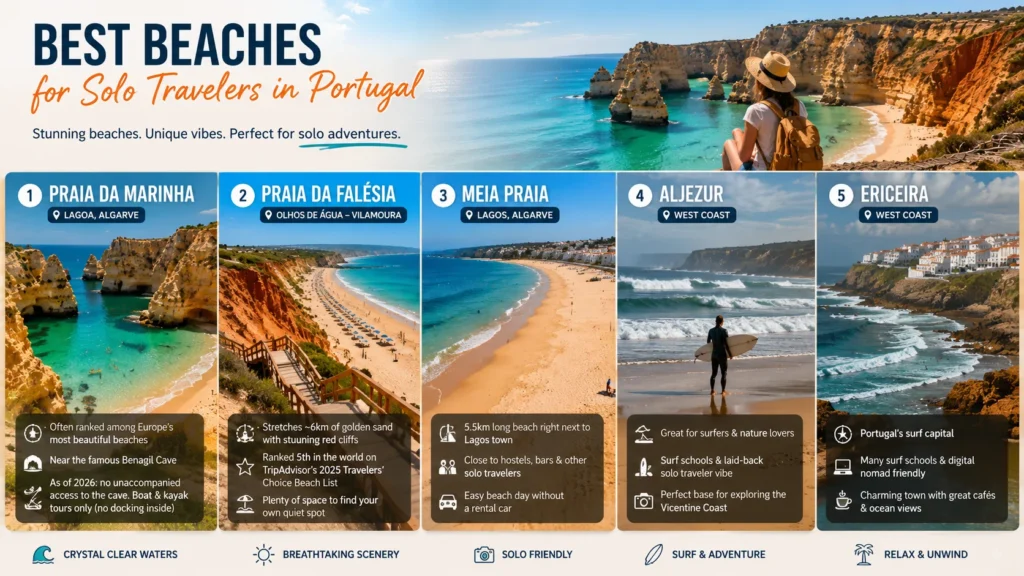
Praia da Marinha, Praia da Falésia and Meia Praia are three strong picks, each for a different reason.
Praia da Marinha
Near Lagoa in the Algarve, it’s regularly listed among Europe’s most beautiful beaches. The Seven Hanging Valleys Trail links it to Benagil, so you can walk between the two.
Praia da Falésia
It stretches about 6 km between Olhos de Água and Vilamoura, backed by red-orange cliffs. Tripadvisor’s Travellers’ Choice awards have ranked it the best beach in the world, and it still sits in their top five. It’s long enough that you can find your own quiet stretch of sand.
Meia Praia
In Lagos, it’s one of the longest beaches in the Algarve, right next to a town full of hostels, bars and other solo travelers. It’s the easiest pick if you want beach time without renting a car.
If you’d rather surf than sunbathe, base yourself in Aljezur or Ericeira on the west coast. Both have surf schools that welcome solo travelers.
How many days do you need for solo travel Portugal?
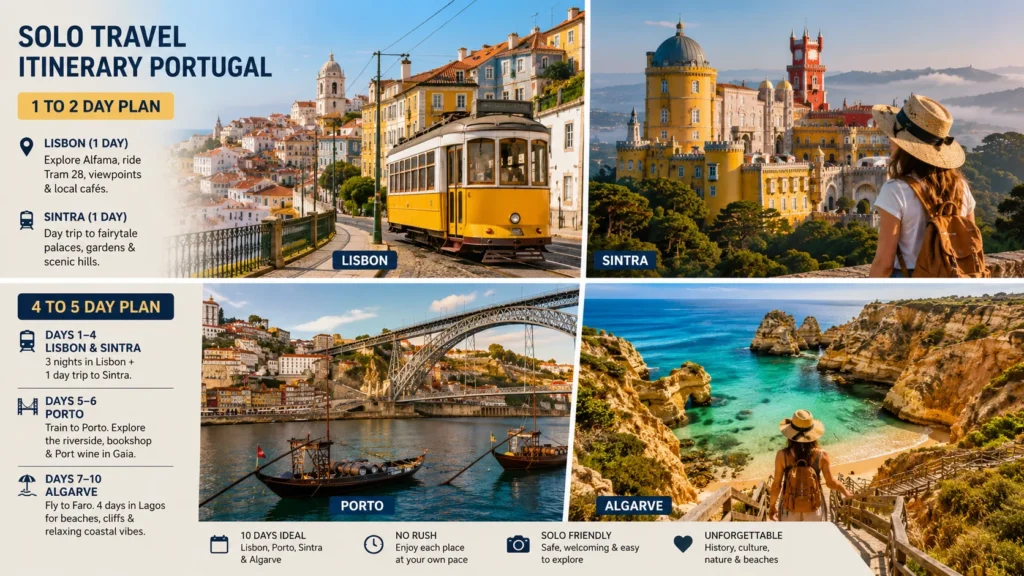
Seven days covers Lisbon and Porto. Ten days adds the Algarve. Thirteen to fourteen days covers mainland highlights without constant train rides.
5 days: Lisbon plus one day trip (Sintra or Cascais). Squeezing in Porto means you spend more time on trains than in the city.
7 days: Three nights in Lisbon with a Sintra day, then the train to Porto for three nights. Add one night in Coimbra if you want a quiet student town in between.
10 days: Lisbon (4 days), Porto (2 days), then fly to Faro and bus to Lagos for the last 4. It’s tight, so slow down at the end.
13 to 14 days: Add Coimbra, Évora and the Douro Valley, and keep the Algarve short.
When is the best time for solo travel Portugal?
Spring and early autumn win. You get warm weather, thinner crowds and lower prices than in July and August.
Winter rarely gets cold enough for heavy coats in Lisbon or the Algarve, and prices drop. INE also reports that tourism spreads more evenly across the year than before, with seasonality at its lowest since 2013. So off-season no longer means empty, but it still means quieter.
If meeting other travelers matters, pick shoulder season. Backpackers and remote workers fill hostel breakfast rooms and actually want to talk.
How much does solo travel Portugal cost?
Budget travelers spend about €55 to €90 a day. Mid-range travelers spend about €95 to €150. Those are estimates from independent budget breakdowns, so check current prices before you book.
That daily figure usually covers a hostel bed (about €25 to €40 in Lisbon, less in Porto), simple meals, local transport and one or two paid sights.
Lunch is where Portugal saves you money. A “prato do dia” (dish of the day) at a local tasca often costs €8 to €12 with soup included.
Our solo travel tips for beginners has a budget checklist you can copy.
How do you get around Portugal alone?
By train and bus between cities, and by metro, tram and foot inside them. You don’t need a car for the main route.
Are trains easy in Portugal?
Yes. CP’s Alfa Pendular runs Lisbon to Porto in roughly 2 hours 40 minutes to just over 3 hours. A second-class ticket recently cost €35.70 on the Alfa Pendular and €28.05 on the slower Intercidades. Early “Promo” fares can drop lower.
CP raises prices every January, so check cp.pt before you buy.
How do you use public transport in Lisbon?
Buy the rechargeable Navegante card for €0.50. A single Carris or Metro ticket costs €1.90. A 24-hour Carris and Metro pass costs €7.25. The 24-hour pass that adds CP trains costs €11.40 and covers the Sintra and Cascais lines.
Tram 28 costs more if you pay by bank card on board (about €3.30). Ride it once for the experience, then walk.
Should solo travelers rent a car?
Only for the Alentejo, the Douro or small villages. In Lisbon and Porto, a car means parking stress and extra cost.
Where should you stay during solo travel Portugal?
Hostels suit first-timers and budget travelers. Guesthouses suit people who want privacy plus a friendly host.
Pick a hostel with a social vibe: rooftop bar, family dinners, walking tours at reception. Read recent reviews for the words “quiet” and “locker.” Female-only dorms exist in Lisbon, Porto and Lagos.
If you value sleep over socializing, a small guesthouse in Alfama or Porto’s Baixa gives you a door that locks and a breakfast table full of travelers.
What should you eat alone in Portugal?
Eating alone is easy here. Counters, tascas and small cafés are built for one.
Try pastéis de nata (custard tarts) at the counter instead of a table, which costs less. Order bacalhau (salt cod), a bifana (pork sandwich) and grilled sardines in summer. Restaurants with Portuguese-only menus tend to cost less and taste more local than nearby English-menu spots.
How can you meet people while traveling alone in Portugal?
Free walking tours, food tours and social hostels are the fastest routes. You show up alone and often leave with dinner plans.
Want built-in company? Group trips for solo travelers handle planning and give you dinner companions on day one. Operators like Flash Pack and Solos Holidays run trips that include Portugal, so check their current departures. Read our guides to travel tours for solo women and solo travel vacation packages before you pay a single supplement.
Can you combine solo travel in Portugal and Spain?
Yes. Both countries sit in the Schengen Area, so there are no passport checks at the land border. Our solo travel Spain guide covers the Spanish side of the trip.
There’s no direct high-speed train between Lisbon and Madrid or Seville. Most solo travelers fly (Lisbon to Madrid takes about 1 hour 20 minutes) or take a direct bus, which runs Lisbon to Seville in roughly 6 hours via operators like Rede Expressos or FlixBus.
If your route runs south, pairing the Algarve with Seville makes more sense than pairing Lisbon with Madrid.
What do you need to know before you enter Portugal?
Most visitors from the US, UK, Canada and many other countries can stay up to 90 days in any 180-day period under Schengen rules.
The EU’s Entry/Exit System is now fully running at external borders. It records your face and fingerprints on arrival, so expect a few extra minutes at the airport.
ETIAS, a planned €20 online authorization for visa-exempt visitors, is not operating yet and has no confirmed start date. Check the official EU ETIAS page before you fly.
What mistakes should solo travelers avoid in Portugal?
Skip rushed itineraries, street taxis and the wrong shoes.
- Cramming 4 cities into 5 days. You’ll remember train stations.
- Hailing taxis at tourist hotspots. Unofficial guides and touts near Belém and Rossio quote 3 to 4 times the metered rate. Use Bolt or Uber, and book tours through your hostel or a verified app.
- Smooth-soled shoes on wet cobblestones. Pack broken-in shoes with grip.
- Skipping the Benagil rules. Don’t swim to the cave.
Pack a padlock for lockers, a power bank, a reusable bottle (tap water is safe), and a plug adapter for the two-round-pin Type F sockets.
Why does solo travel feel so personal in Portugal?
Because Portugal has a word, saudade, for missing something you can’t quite name, and a solo traveler meets that feeling at sunset in Alfama.
If your evenings turn reflective, read an English poem about the weight of loneliness or an Urdu poem about memories that stay with you. And if homesickness hits, a notebook helps. These journaling prompts for emotional healing fit on a train seat, and our inner peace quotes make good bookmarks.
Next stop after Portugal? Try Rome solo travel, or browse more solo travel guides on VerseSoul.
FAQ’s:
Yes. It ranks 7th of 163 countries on the Global Peace Index, has a Level 1 US travel advisory, and links its main cities by train. Hostels in every big city cater to solo travelers.
Yes. Violent crime against tourists is rare, and many solo women report feeling relaxed. Watch for pickpockets on trams and avoid empty streets late at night.
Yes. It is walkable, social and cheap by Western European standards. Base yourself in Alfama, Baixa or Príncipe Real and use the metro and trams for the hills.
Seven days covers Lisbon and Porto. Ten adds the Algarve. Thirteen to fourteen days covers the mainland highlights without constant transfers.
Yes. Trains connect Lisbon, Porto and Coimbra, and buses or flights cover the Algarve. A car only makes sense for the Alentejo and the Douro.
Yes. Operators like Flash Pack and Solos Holidays run group trips for solo travelers that include Portugal. Compare single supplements before you book.
It depends on your time. With 10 days or more, yes. With 7 days or fewer, spend that time on Lisbon, Sintra and Porto instead.
Citizens of the US, UK, Canada and many other countries can visit visa-free for up to 90 days in any 180-day period. ETIAS, a planned 20 euro online authorization, is not operating yet, so check the official EU site before you fly.
Final thoughts
Portugal is safe enough that you stop thinking about safety, cheap enough to extend on a whim, and small enough that one loop covers the best of it. Book the hostel with the rooftop bar. Take the slow train once. You’ll figure out the rest as you go, which is kind of the point of going alone.
When you want poems, healing reads or your next destination, VerseSoul is one tap away. Save this guide, send it to the friend who keeps saying “I could never travel alone,” and book that flight.
Pingback: Self Love Club: What It Is and Why You Should Join