

You lost a pregnancy, and somehow the whole world kept moving as if nothing happened. That gap between what you feel and what everyone around you expects is often the hardest part of all.
Here’s the direct answer: healing emotionally from a miscarriage means letting yourself grieve a real loss, protecting yourself from triggers while you’re still raw, leaning on people who won’t rush your timeline, and getting professional support if the sadness turns into something heavier. There’s no fixed schedule for this. Some weeks feel almost normal. Some days, even a year later, still knock the wind out of you.
This guide walks through what that grief actually looks like, why it hits as hard as it does, and what genuinely helps.
What does emotional healing after a miscarriage actually look like?
It looks messy, not tidy. Youdon’tt move through five neat stages and come out the other side “healed” on a schedule.
Most women describe it as waves. You’ll have a stretch of okay days, then something small (a song, a due date, a stranger’sa stranger’s stroller) pulls you right back under. That’s not a setback. That’s just how grief for something you never got to hold usually works.
Early pregnancy loss is common, even though almost nobody talks about it. According to the American College of Obstetricians and Gynecologists, it happens in about 10 of 100 known pregnancies. The Mayo Clinic puts the range at 10 to 20%, and up to 80% of those losses happen in the first trimester. Commando doesn’t mean small. Your griefdoesn’tt need a due date to be real.
How do you feel after a miscarriage, physically and emotionally?
Physically drained and emotionally raw, often at the same time, and the two feed each other more than most people realize.
Your hormone levels- hCG, estrogen, and progesterone, spike fast in early pregnancy and then drop hard after a loss. That sudden crash can bring on fatigue, irritability, insomnia, and mood swings on top of the grief itself. ACOG notes that physical symptoms like bleeding and cramping usually settle within about six weeks. The emotional symptoms often outlast the physical ones by a wide margin.
Knowing this isn’t your body malfunctioning helps.It’srecalibrating. You’re not losing control; you’re recovering from something real.
Is it normal to feel angry, numb, or even relieved?
Yes, all three, sometimes in the same afternoon.
Anger shows up at your body, at doctors, at pregnant strangers, at God, at nothing in particular. Numbness shows up when your mind protects you from feeling everything at once. And if the pregnancy was complicated, unplanned, or arrived at a hard time in your life, relief can show up too, tangled together with grief and guilt about feeling relief at all.
None of these emotions cancel out the others. You can grieve deeply and still feel relieved. You can love the pregnancy you lost and still feel furious at your own body. Grief isn’t a straight line, and it definitelyisn’tt one feeling at a time.
Did I do something to cause this?
Almost certainly not, and this is worth saying plainly because so many women quietly carry blame that was never theirs to carry.
About half of early miscarriages happen because the embryo has an abnormal number of chromosomes, something decided at conception, not by anything you did weeks later. ACOG is clear on this. Exercise, sex, stress at work, a single cup of coffee, lifting a bag of groceries: none of these cause miscarriage in the vast majority of cases. Your bodydidn’tt fail because of a choice you made.
That factdoesn’tt erase the grief. But it can quiet the guilt, and the guilt is often the heaviest part to carry alone.
How long does emotional healing after a miscarriage take?
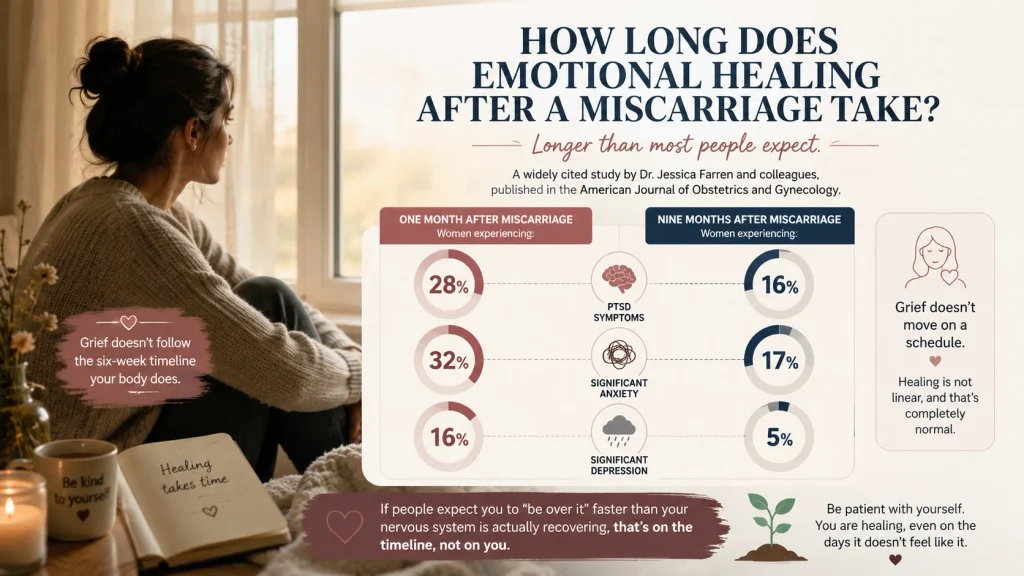
Longer than most people around you will expect, andthere’ss real research behind that.
A widely cited study by Dr. Jessica Farren and colleagues, published in the American Journal of Obstetrics and Gynecology, found that one month after a miscarriage, 28% of women had symptoms consistent with PTSD, 32% had significant anxiety, and 16% had significant depression. At nine months, those numbers had dropped buthadn’tt disappeared: 16% for PTSD symptoms, 17% for anxiety, 5% for depression. Griefdoesn’tt follow the six-week timeline your body does.
If people expect you to “be over it ” faster than your nervous system is actually recovering, that’s on the timeline, not on you.
What is delayed grief after a miscarriage, and is it normal?
Yes, completely normal, and it’s one of the least talked-about parts of this whole experience.
Some women feel almost nothing at first: they’re busy, in shock, or focused on physical recovery, and the real grief arrives weeks or months later. It can get triggered by something specific: your due date passing, afriend’ss pregnancy announcement, or simply the day life quiets down enough for the loss to catch up with you. Thisisn’tt you grieving “wrong.” Delayed grief is just grief on a different clock.
One trigger almost nobody warns you about: the return of your period. For many women, that first cycle after a miscarriage brings the sadness back as hard as the loss itself did, becauseit’ss a physical, undeniable sign that the pregnancy is truly over.
How do you cope with grief triggers like baby showers or pregnancy news?
It depends on the day, honestly, and permitting yourself to change your mind is part of coping well.
Some invitations you should skip entirely, guilt-free. A close friend’s baby shower two weeks after your loss is a legitimate one to decline with a short, honest message. For events you can’t avoid, build yourself an exit plan: tell one trusted person in advance to be your signal for “I need to step out,” and give yourself a real reason ready if anyone asks. Muting pregnancy and baby content on social media for a few weeks isn’t an instance; it’s basic self-protection while you heal.
You’re allowed to protect your peace without explaining yourself to anyone.
What self-care actually helps after a miscarriage?
Small, concrete, unglamorous things, not a spa day.
Rest without guilt. Your body just went through something physical, not just emotional, and it needs the same recovery time you’d need for any real medical event. Eat regularly even when you don’t feel hungry, since low blood sugar makes grief and anxiety feel sharper. Say the loss out loud to one person you trust, by name if you’d given the pregnancy one. Naming it makes it real rather than a secret you’re keeping alone.
Some days the only thing that actually helps is putting words to what you can’t say out loud yet. Our collection of sad poetry about love, loss, and silent pain exists for exactly that kind of night, when you need someone else’s because you don’t have your own yet.
How can partners support each other without one feeling unseen?
Differently, and usually more quietly on one side, which is exactly where the disconnect starts.
A 2021 study by Farren and colleagues, published in Ultrasound in Obstetrics & Gynecology, found real differences in how women and their partners experience post-traumatic stress, anxiety, and depression after a loss like this. Partners often grieve just as deeply but show it less, sometimes because they feel pressure to “stay strong” for the other person, sometimes because their loss feels less socially acknowledged.
The fix isn’t complicated: check in on each other by name, not just as a couple. Ask directly, “how are you doing with this today?” instead of assuming silence means someone’s. Revisit the due date together months later too. Grief doesn’t align just because two people share the same loss.
Does spiritual or prayer-based healing help after a miscarriage?
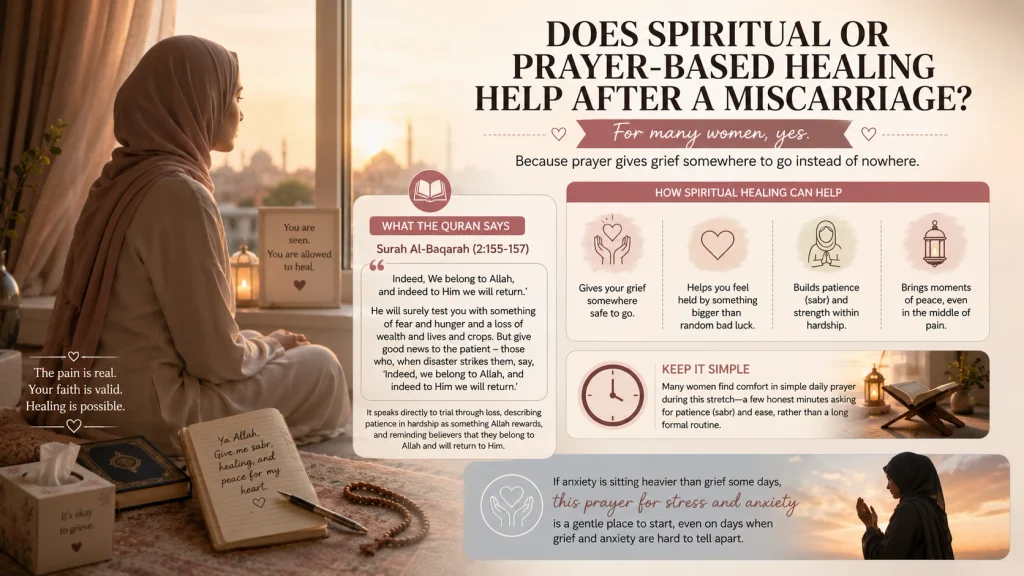
For many women, yes, and it works because prayer gives grief somewhere to go instead of nowhere.
In the Quran, Surah Al-Baqarah (2:155-157) speaks directly to trial through loss, describing patience in hardship as something Allah rewards, and reminding believers that they belong to Allah and will return to Him. That framing doesndoesn’te the pain, but it places it inside something larger than random bad luck. Many women find comfort in simple daily prayer during this stretch, a few honest minutes asking for patience (sabr) and ease, rather than a long formal routine.
If anxiety is sitting heavier than grief some days, this prayer for stress and anxiety is a gentle place to start, even on days when grief and anxiety are hard to tell apart.
When should you seek professional support for miscarriage grief?
If the sadness, anxiety, or intrusive thoughts aren’aren’tng after two or three months, or if they’re getting in the way of work, sleep, or relationships, that’s your signal.
Given that the Farren study found meaningful percentages of women still experiencing anxiety and PTSD symptoms months later, needing more support than friends and family can offer isn’t a sign of weakness. It’s cIt’sn. Look specifically for a therapist or counselor with experience in perinatal or reproductive loss, since general talk therapy sometimes misses the specific shape of this grief. Pregnancy loss support groups, in person or online, also help simply by putting you in a room with people who don’t have the loss explained to them.
How soon should you try to conceive again?
Physically, often sooner than older advice suggested. Emotionally, whenever you actually feel ready, not before.
The World HealthOrganization’ss older guidance recommended waiting six months, but that recommendation traces back to a single 2005 study and newer researchdoesn’tt support it. ACOG now says you can conceive as soon as about two weeks after an uncomplicated early miscarriage if you’re physically and emotionally ready. A large Norwegian cohort study of nearly 49,000 births found no increase in complications for women who conceived within six months of a prior loss, and some research even suggests slightly better outcomes for those who tried sooner rather than later.
The medical clearance and your emotional readiness are two separate questions. Only you can answer the second one, and nobody, not even a doctor, gets to put a deadline on it.
What helps in the long term: rituals, journaling, or a change of scenery?
Something small and repeatable, more than any single big gesture.
A short ritual gives grief somewhere specific to live instead of everywhere at once: lighting a candle on the due date, planting something in thepregnancy’ss memory, writing a letter you never send. Journaling helps the same way, even five unpolished minutes before bed. If Englishdoesn’tt hold the weight of what you’re feeling, Urdu often does. This Judai Shayari collection sits with exactly that kind of quiet, aching loneliness.
Some women also find that stepping away for a while, even a short trip alone, gives grief room to breathe outside your usual routine and the reminders that live in it. If that idea appeals to you, even months from now, this guide to planning a comfortable solo trip is a gentle place to start thinking it through whenever you’re ready.
FAQ’s:
Is it normal to grieve a miscarriage that happened very early, before 6 weeks?
Yes. Grief isn’t measured by gestational age. Whether the loss happened at 5 weeks or 15, the plans, hope, and identity you’d already built around that pregnancy were real, and so is your right to grieve them.
Yes. Research published in the American Journal of Obstetrics and Gynecology found that 28% of women showed symptoms consistent with PTSD one month after a miscarriage, with some women still experiencing symptoms at nine months.
No, not medically. ACOG and newer research both support trying again sooner than the older six-month guideline, often as soon as two weeks after an uncomplicated early loss, once you feel physically and emotionally ready.
There’s no fixed number. Many women feel noticeably steadier within a few months, while grief around anniversaries or due dates can resurface for a year or more. If symptoms aren’t easing at all after two to three months, professional support can help.
Keep it simple and honest: ‘I’m so sorry, I’m here, and there’s no timeline on this.’ Avoid phrases like ‘at least it was early’ or ‘you can try again,’ which minimize a real loss even when they’re meant kindly.
Final thoughts
Youdon’tt need to perform being okay for anyone, including yourself. Grieve in the order that actually happens, not the order people expect.
Give yourself the same patienceyou’dd give a friend going through this exact thing. You’lll find more writing on grief, healing, and starting over across VerseSoul, whenever you’re ready for it.