
Your heart races before a meeting that hasn’t even started yet. Your chest feels tight for no clear reason. Anxiety does that. It shows up early, uninvited, and loud.
Nearly 1 in 5 US adults deal with an anxiety disorder every year, according to the National Institute of Mental Health. That’s not a small club, and you’re not overreacting.
The good news: real, tested natural remedies exist. Not vague advice like “just relax.” Actual herbs, habits, and routines with clinical trials behind them. This guide walks through 15 of them, what the research says, and where the evidence gets shaky. No fake stats, no filler.
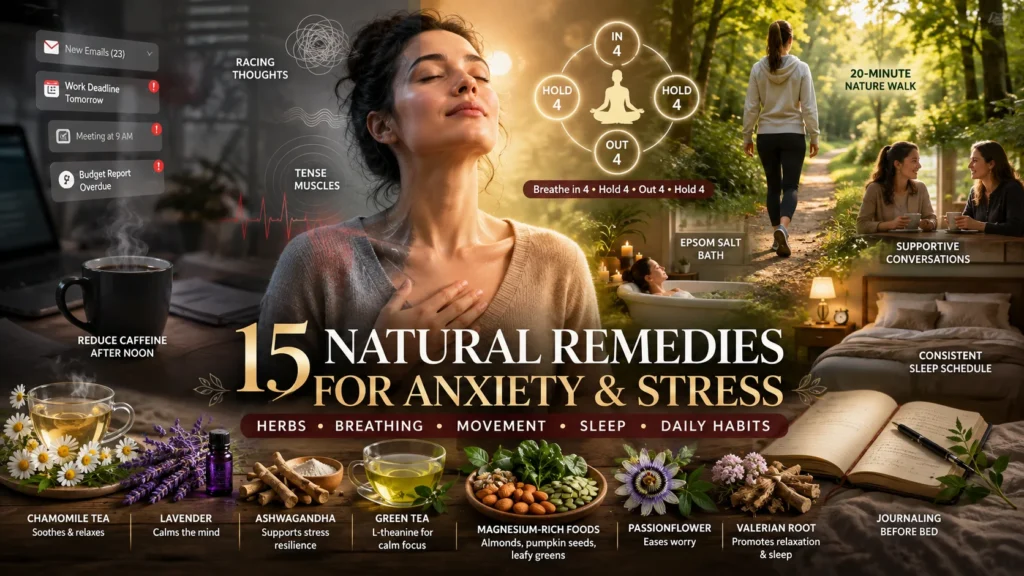
Quick answer: the natural remedies with the strongest research behind them are chamomile, lavender (specifically the Silexan extract), ashwagandha, L-theanine from green tea, magnesium, and regular exercise. Pick two or three, stay consistent for a few weeks, and most people notice a real shift.
What are the 15 best natural remedies for anxiety and stress?
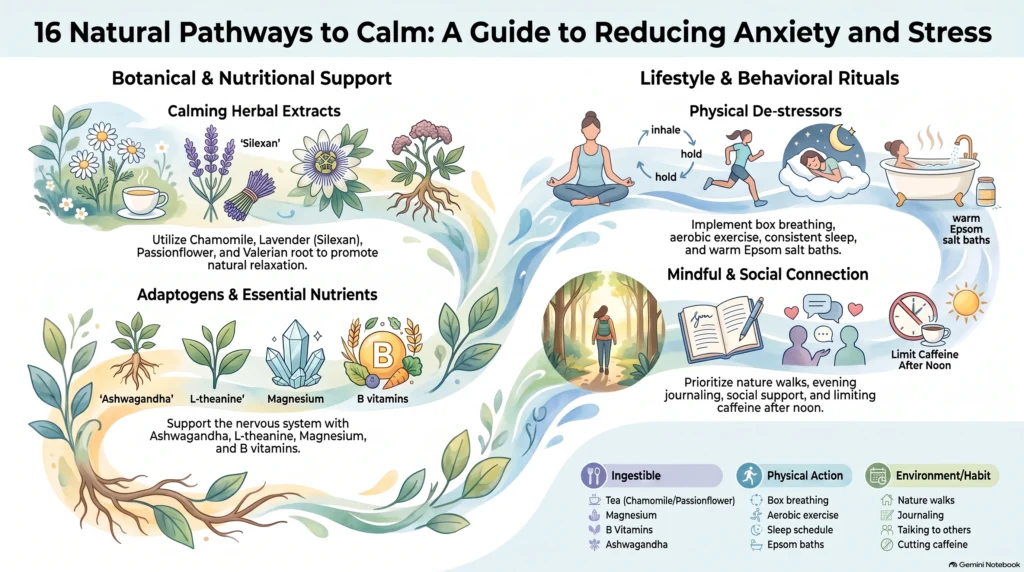
Here’s the full list first. The research on each one is below, so you can decide what’s worth trying.
- Chamomile tea or extract
- Lavender oil, specifically the Silexan form
- Ashwagandha root extract
- L-theanine from green tea
- Magnesium and B vitamins together
- Regular aerobic exercise, even short sessions
- Deep breathing, like box breathing
- Passionflower tea
- Valerian root
- Warm baths with Epsom salt
- Journaling before bed
- Nature walks or time outdoors
- A consistent sleep schedule
- Talking it out with someone you trust
- Cutting caffeine after noon
Which herbs actually have research to back them up?
Three herbs appear repeatedly in clinical trials. Not blog posts, actual randomized studies with placebo groups. Here’s what they found.
Chamomile: the tea that earned its reputation
A 2016 randomized controlled trial followed 179 people with moderate to severe generalized anxiety disorder for 8 weeks. Chamomile extract produced a clinically meaningful drop in anxiety symptoms, reviewed by the National Center for Complementary and Integrative Health (NCCIH), part of the NIH.
A 2024 systematic review in Clinical Nutrition Research looked at 10 clinical trials. 9 of them found chamomile helped with anxiety. Researchers think a compound called apigenin is behind it, since it may affect the same stress-hormone pathway that gets overactive during chronic stress.
One catch: if you’re allergic to ragweed, daisies, marigolds, or chrysanthemums, skip chamomile. Cross-reactions happen, and rare cases of anaphylaxis have been reported. Chamomile can also interact with blood thinners like warfarin.
Lavender: proven in a large meta-analysis
A 2017 meta-analysis pooled 5 studies and 1,165 participants with diagnosed anxiety. A standardized lavender oil capsule called Silexan beat placebo by a clear margin, and the effect held up across different anxiety diagnoses.
Lavender taken orally can cause headaches and changes in appetite in some people. Pair it with a sedative medication and drowsiness gets worse, so check with a doctor first if you’re on anything like that.
Ashwagandha: the adaptogen that actually lowers cortisol
In a 60-day randomized trial, ashwagandha extract significantly reduced anxiety scores on the Hamilton Anxiety Rating Scale, and morning cortisol dropped in a way the placebo group’s didn’t.
A 2024 meta-analysis combined 9 randomized trials and 558 patients. The result: a real, measurable drop in Perceived Stress Scale scores. This is one of the better-studied adaptogens out there, not just a supplement-aisle trend.
What else calms your nervous system besides herbs?
Herbs get the spotlight, but some of the best-studied remedies aren’t herbs at all. A few come from your diet, and one costs nothing.
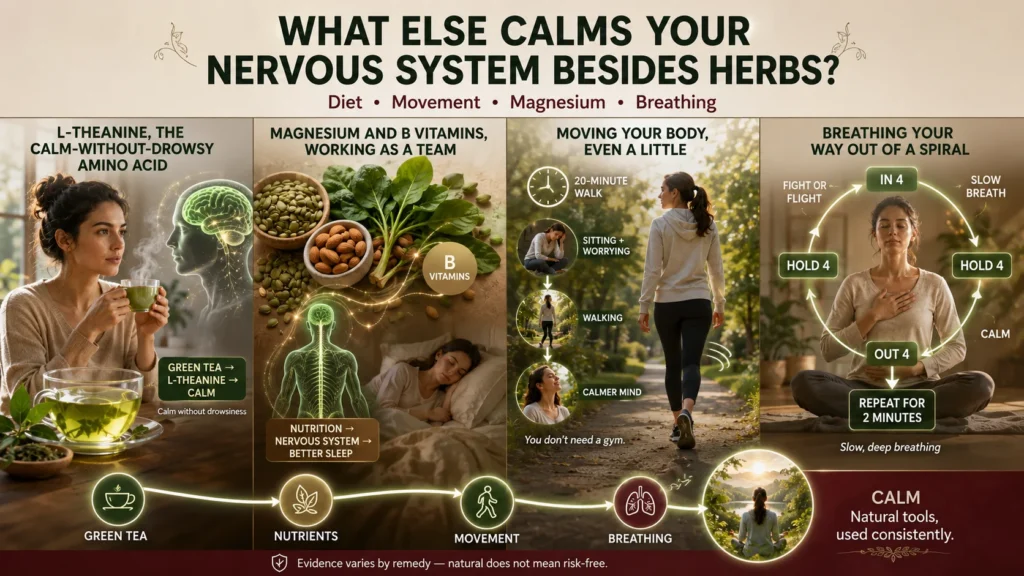
L-theanine, the calm-without-drowsy amino acid
L-theanine comes from green tea. A 2026 meta-analysis pooled 31 randomized trials involving 1,168 participants and found that it reduced stress after a single dose, without the drowsiness associated with most calming supplements.
Magnesium and B vitamins, working as a team
A placebo-controlled trial tested a combination of magnesium, B vitamins, rhodiola, and green tea extract over 28 days. Chronically stressed adults saw a significant drop on the Depression Anxiety Stress Scale, plus better sleep.
Moving your body, even a little
Exercise is one of the most consistently backed remedies on this entire list. A meta-analysis of college students found a large effect size (d = -0.83) after structured exercise programs. Another review of older adults found a solid drop in anxiety symptoms too (SMD -0.60), especially after 10 weeks or more.
You don’t need a gym membership. A brisk 20-minute walk most days does more for your nervous system than sitting and worrying ever will.
Breathing your way out of a spiral
Slow, deep breathing signals your vagus nerve to switch off the fight-or-flight response. Box breathing works well: breathe in for 4 counts, hold for 4, out for 4, hold for 4. Repeat for two minutes.
If you want a more guided version of this, VerseSoul’s self-love meditation practice walks through breathing and body awareness together, and it pairs well with any of the remedies above.
Do natural remedies for anxiety actually work, or is it hype?
Both, honestly. The evidence for chamomile, lavender, and ashwagandha is real. But an earlier 2009 chamomile trial only found a modest effect, and not every study agrees on how strong the benefit is.
Natural doesn’t mean risk-free either. “Natural” describes where something comes from, not how safe or strong it is. Some of these remedies interact with medications, and none of them are a substitute for therapy or treatment if your anxiety is severe.
Think of them as tools, not miracles. They work best stacked together and used consistently, not as a one-time fix before a stressful event.
What should you watch out for before trying these remedies?
A few things get skipped in most “top remedies” lists, so here they are straight.
- Chamomile can interact with blood thinners like warfarin and with cyclosporine.
- If you’re allergic to ragweed, marigolds, daisies, or chrysanthemums, chamomile can trigger a reaction.
- Lavender taken by mouth alongside sedative medication can increase drowsiness.
- Ashwagandha isn’t well studied in pregnancy, and it can affect thyroid hormone levels.
- Supplements aren’t regulated the same way medications are, so dosage and purity vary between brands.
If you’re on any prescription medication, run your chosen remedy by a doctor or pharmacist first. It takes five minutes, es and it’s worth it.
When do natural remedies stop being enough?
Of adults with an anxiety disorder in the US, an estimated 22.8% deal with serious impairment, the kind that gets in the way of work, sleep, or relationships, per NIMH data.
If chamomile tea and a daily walk aren’t touching how you feel after a few weeks, or if anxiety is stopping you from doing normal things, that’s the point to talk to a doctor or therapist. Natural remedies work well for everyday stress. Clinical anxiety often needs more than tea.
How do small daily habits keep anxiety from creeping back?
Remedies help in the moment. Habits keep the moment from happening as often.
A change of scenery works better than people expect. Readers who’ve taken a solo trip to Italy often say it reset their head faster than any supplement did. You don’t need a big trip; even a weekend away from your normal routine can reduce the noise.
Words help too, in a different way. Reading a poem about staying strong before bed gives your mind something steady to hold onto instead of the day’s worries.
If Urdu feels closer to home, this Urdu poetry about patience and belief carries the same idea: dark nights end, and your waqt does come. Sometimes that reminder does more than any pill.
Start small tonight. Pick one remedy from the list, one habit from this section, and give it two weeks before judging whether it works.
FAQ’s:
Does chamomile tea really help with anxiety?
Yes, based on real evidence. A 2016 randomized trial of 179 people with generalized anxiety disorder found a clinically meaningful drop in symptoms after 8 weeks of chamomile extract, and a 2024 review of 10 trials found 9 of them showed a benefit.
Can you take ashwagandha and lavender together?
Generally yes, since they work through different pathways, but check with a doctor first if you’re on any medication. Both can add to the effect of sedatives, so combining them with sleep aids or anti-anxiety prescriptions needs caution.
Should natural remedies replace anxiety medication?
No. They work well for everyday stress and mild anxiety, but they aren’t a substitute for prescribed treatment if you’ve been diagnosed with an anxiety disorder. Use them alongside professional care, not instead of it.
What is the best herb for stress and anxiety?
Chamomile and ashwagandha have the strongest clinical trial support right now. Chamomile works faster for everyday tension, while ashwagandha shows more benefit for longer-term stress and cortisol levels.
How can I calm my nervous system naturally, right now?
Try box breathing: in for 4 counts, hold for 4, out for 4, hold for 4, repeated for two minutes. It directly signals your vagus nerve to switch off the stress response, and it works faster than any supplement.
Final thoughts
Anxiety doesn’t need a perfect fix. It needs a few things that actually work and are used often enough to matter. Start with chamomile or a daily walk, add breathing when things spike, and give it real time before deciding it’s not for you.
For more reads on calm, self-love, and everyday healing, browse the rest of VerseSoul.