
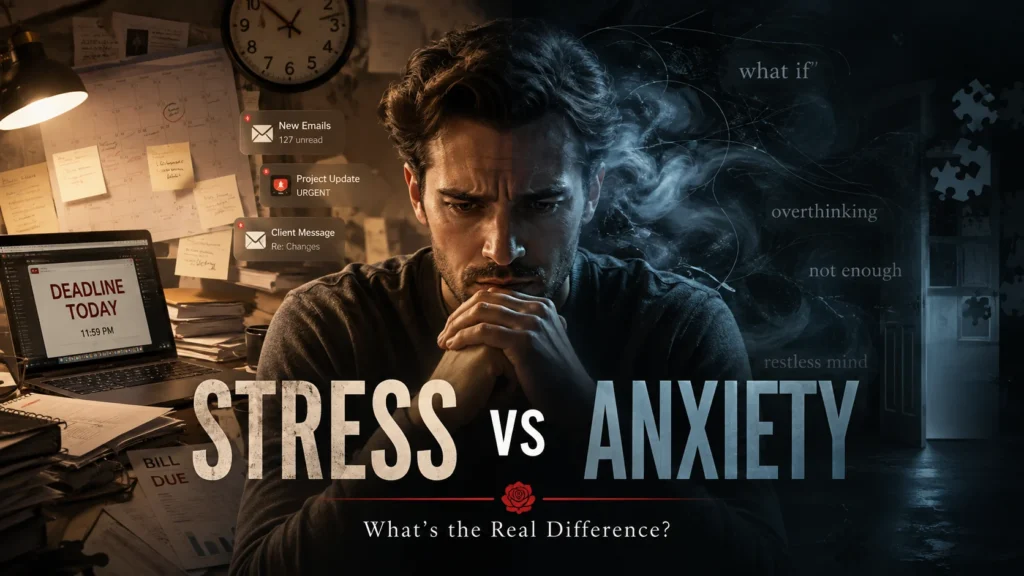
Your heart is racing before a meeting. Your stomach is in knots for no clear reason at all. Is that stress, or is that anxiety? Most people use both words like they’re the same thing, but your body actually treats them differently.
Stress is your reaction to something specific: a deadline, a fight, a bill you forgot to pay. Anxiety is what shows up even when nothing specific is wrong, just a low hum of worry that won’t switch off. Knowing which one you’re dealing with changes how you handle it.
Stress vs anxiety: what’s the real difference?
Stress is your body’s response to a real, identifiable pressure. It shows up, does its job, and usually fades once the pressure lifts.
Anxiety is different. It’s a persistent state of worry that can stick around even after the stressful event is long gone, according to the American Psychological Association. Stress reacts to something outside you. Anxiety often keeps running on its own fuel.
Both feel similar in the body. Both can leave you tired, tense, and short-tempered. But one has an exit door, and the other doesn’t always come with one.
What is stress and how does it actually hit you?
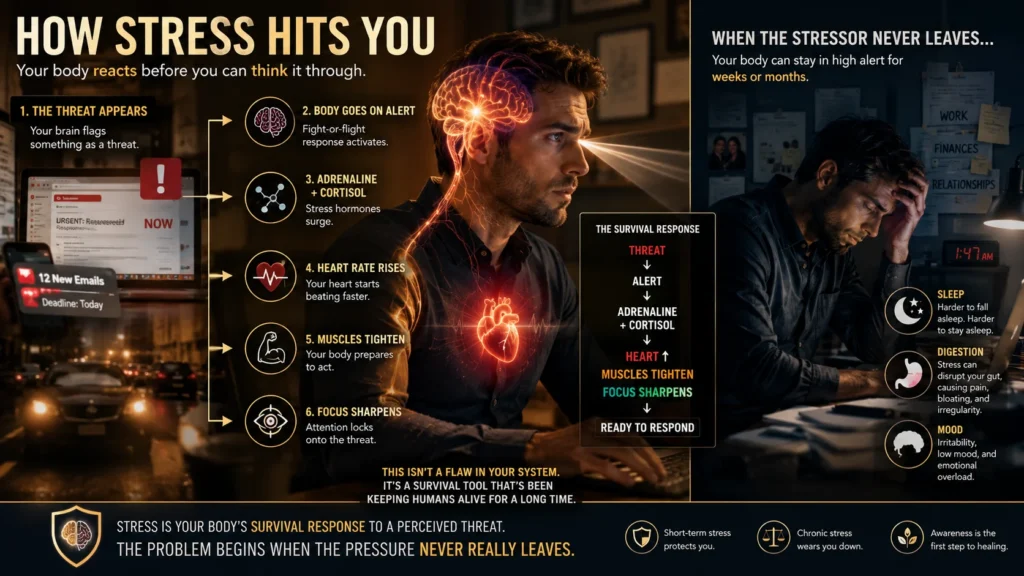
Stress kicks in the moment your brain flags something as a threat, whether that’s a car swerving into your lane or an inbox full of angry emails.
Your body releases adrenaline and cortisol, the hormones behind the fight or flight response, according to Cleveland Clinic and Harvard Medical School. Your heart rate climbs, your muscles tighten, your focus sharpens. This isn’t a flaw in your system. It’s a survival tool that’s been keeping humans alive for a very long time.
The problem starts when the stressor never really leaves. Work stress, money stress, relationship stress: these can keep your cortisol elevated for weeks or months, and that’s where stress starts doing real damage to your sleep, your digestion, and your mood.
What is anxiety and how does it feel?
Anxiety feels like dread with no obvious cause. You might wake up already bracing for a bad day before anything has actually gone wrong.
It often shows up as a racing heart, a tight chest, restless thoughts, or a stomach that won’t settle, and these physical symptoms tend to be less intense but longer lasting than a panic attack, per Cleveland Clinic. Generalized anxiety disorder, one of the most common forms, is marked by excessive worry that shows up more days than not for at least six months, according to the National Institute of Mental Health.
Anxiety isn’t always loud. Sometimes it’s quiet, just a constant low buzz that makes it hard to fully relax, even on a good day.
What causes stress and anxiety?
Stress usually has a clear trigger you can point to. Anxiety often doesn’t, and that’s part of what makes it so confusing to live with.
Common stress triggers include work pressure, financial strain, health scares, and major life changes like moving or losing a job. The American Psychological Association’s 2024 Stress in America survey found that money worries, political division, and the state of the country all rank among the top stressors for adults right now.
Anxiety tends to come from a mix of genetics, brain chemistry, past experiences, and sometimes chronic, unresolved stress that never got the chance to fully switch off. Women are affected by anxiety disorders at nearly double the rate of men, 23.4% versus 14.3% in a given year, according to NIMH data.
How can you tell if you have stress or anxiety?
Ask yourself one question: is there a clear reason for how you feel? If yes, it’s probably stress. If the feeling lingers with no obvious cause, it leans more toward anxiety.
Timing matters too. Stress usually eases once the situation resolves, a project ends, a conversation happens, a bill gets paid. Anxiety can hang around long after the original trigger has disappeared, or show up with no trigger at all.
Neither one has to be diagnosed by a search engine. If either is interfering with your work, sleep, or relationships, that’s worth bringing to a doctor or therapist rather than guessing alone.
What are the common symptoms of stress vs anxiety?
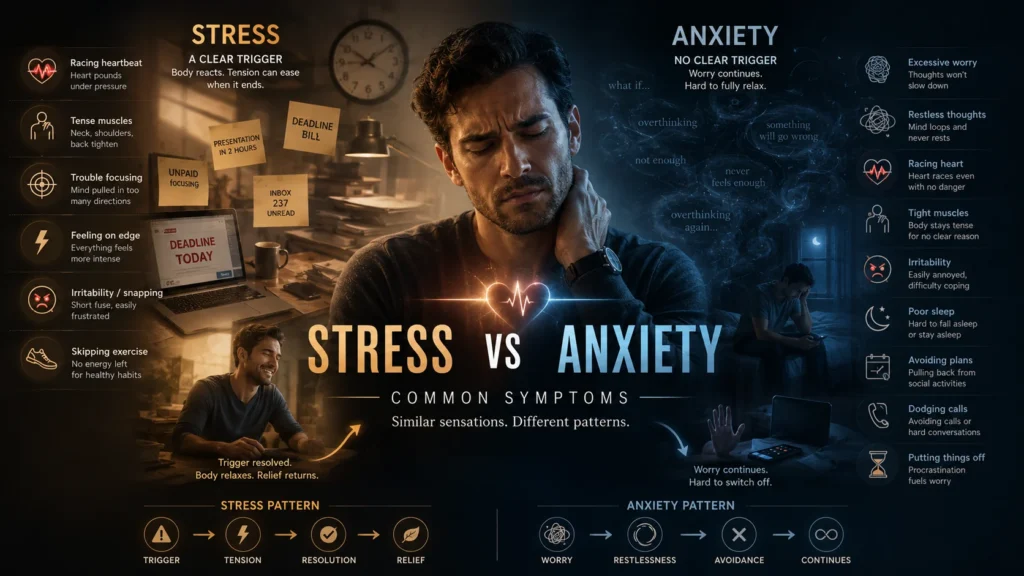
Stress and anxiety share a lot of the same physical territory: a fast heartbeat, tense muscles, trouble focusing, and a general sense of being on edge.
Stress symptoms tend to track closely with the trigger. Once your presentation is over or your rent is paid, the tension usually drops fast. Anxiety symptoms often include excessive worry, restlessness, irritability, and trouble sleeping that continues even when life looks fine on paper.
One noticeable difference: 55% of adults say they’ve lost patience or snapped at a family member due to stress in the past month, and 50% say they’ve skipped exercise because of it, according to APA data reported by Statista. Anxiety, on the other hand, tends to show up as avoidance: skipping the party, dodging the phone call, putting off the appointment.
How long does stress usually last?
Short-term stress can pass in minutes to hours, especially once you handle whatever caused it.
Chronic stress is a different story. It can persist for weeks or months when the underlying pressure, a toxic job, an ongoing conflict, financial trouble, doesn’t resolve. This is the kind of stress that starts affecting your immune system, your blood pressure, and your sleep over time.
Anxiety tends to outlast its trigger by a wide margin. A single anxious episode might last hours, but generalized anxiety disorder is defined by worry that continues for six months or longer, per NIMH’s clinical criteria.
Can stress and anxiety happen together?
Yes, and honestly, they usually do. Chronic stress is one of the most common paths into an anxiety disorder.
When your body stays in fight or flight mode for too long, it can start reacting to smaller and smaller triggers, until eventually it’s reacting to almost nothing at all. That’s often how ordinary stress quietly turns into something closer to clinical anxiety.
About a third of U.S. adults and adolescents will experience an anxiety disorder at some point in their lives, according to NIMH, and for a lot of them, it started as garden-variety stress that never got a real outlet.
What is the best way to manage stress and anxiety?
Start with your breath. Slow, deliberate breathing signals your nervous system that the danger has passed, even before your mind fully believes it.
Try this right now: breathe in for four counts, hold for four, breathe out for four. Repeat it five times. It sounds almost too simple, but it works because it directly calms the same fight or flight response driving both stress and anxiety.
Beyond breathing, regular movement, consistent sleep, and talking to someone you trust all make a measurable difference. If prayer is part of your life, a short one can genuinely help too. Surah Ar-Ra’d (13:28) puts it simply: hearts find rest in the remembrance of Allah. If that idea speaks to you, this Urdu poem about surrendering to Allah captures that same search for peace in words that might sit with you longer than advice ever could.
When should you seek help for stress or anxiety?
If stress or anxiety is stopping you from doing your job, sleeping through the night, or showing up for people you care about, it’s time to talk to someone qualified.
Warning signs worth taking seriously include panic attacks, constant dread, physical symptoms with no medical explanation, or using alcohol and other substances to cope. Only about one in four adults with mental health concerns actually spoke to a professional last year, according to a 2024 poll from the American Psychiatric Association, which means most people wait far longer than they should.
You don’t need a crisis to justify asking for help. A regular check-in with a doctor or therapist works the same way an oil change does: it’s easier to do before something breaks down completely. For a gentler starting point, our guide on finding a moment of calm through prayer is a good first step while you figure out your next one.
Can healthy habits reduce stress and anxiety?
Yes, and the research backs this up strongly. About 80% of people who use coping strategies like exercise, mindfulness, or hobbies say those habits genuinely help, per the American Psychological Association.
Sleep is the habit most people underestimate. Poor sleep raises cortisol, and high cortisol makes it harder to sleep, which is a loop worth breaking on purpose rather than by accident. Even a short walk outside, away from screens, can lower both stress hormones and anxious thinking within twenty minutes.
Sometimes the most useful reset isn’t a routine at all, it’s distance. A solo trip, even a short one, forces your mind out of the loop it’s stuck in. Our Iceland solo travel guide is proof that stepping away, even briefly, can do more for a tired mind than another to-do list ever will.
What can you do to feel calmer every day?
Small, repeatable habits beat big, occasional efforts almost every time. Building a two-minute breathing break into your morning does more long-term than an hour of meditation you only do once.
Journaling for even five minutes helps too. Writing down what’s actually bothering you, rather than letting it circle endlessly in your head, has been linked to lower anxiety and better mood by expressive writing researcher James Pennebaker’s decades of published work.
If words help you more than routines do, that’s fine too. A few lines of self-love poetry before bed can quiet a loud mind faster than scrolling ever will, and it costs you nothing but a few minutes.
What are the key differences between stress and anxiety?
Stress has a cause. Anxiety can exist without one. That single distinction explains most of the confusion between the two.
Stress fades once the trigger resolves. Anxiety can outlast the trigger by weeks, months, or longer. Stress is common to nearly everyone, with about 48% of U.S. adults reporting significant daily stress, according to Gallup’s Global Emotions data. Anxiety disorders, meanwhile, affect around 19% of U.S. adults in any given year, per NIMH.
Both are treatable. Both respond to the same basic toolkit: rest, movement, honest conversation, and sometimes professional support. Neither one means something is wrong with you. And if you’d simply like to sit with something softer for a minute, VerseSoul’s home page has poetry and reflections for exactly these days.
FAQ’s:
Is stress the same as anxiety?
No. Stress is a reaction to a specific situation, while anxiety is ongoing worry that can show up without any clear cause.
Can stress turn into an anxiety disorder?
Yes. Long-term, unmanaged stress is one of the most common paths into generalized anxiety disorder and other anxiety conditions.
What’s the difference between worry, stress, and anxiety?
Worry is a thought pattern, stress is a body response to a trigger, and anxiety is a more persistent emotional and physical state that can involve both.
Do stress and anxiety feel the same physically?
Mostly, yes. Both can cause a racing heart, tight muscles, and trouble focusing, which is exactly why the two get confused so often.
Is it normal to have stress and anxiety at the same time?
Yes, it’s common. Chronic stress often sets the stage for anxiety, so many people experience both together rather than one at a time.
When does stress become a medical concern?
When it lasts for weeks without relief, starts affecting sleep or relationships, or comes with physical symptoms a doctor can’t otherwise explain.
Final thoughts
You don’t need a clinical degree to start paying attention to which one you’re carrying, stress or anxiety. You just need to notice whether the feeling has a clear cause and an end point, or whether it’s been running quietly in the background for longer than it should.
Either way, you’re not stuck with it. Small daily habits, honest conversations, and the occasional professional check-in can shift both, sometimes faster than people expect. Start with your breath today, and go from there.