

Your hands are shaking before you’ve even said a word. That’s anxiety, and for a lot of people, the first move isn’t a pill or a breathing app. It’s a prayer for inner peace.
A prayer for inner peace is a short request, spoken or silent, for calm when stress, fear, or grief feels too heavy to carry alone. Say it slowly and it can settle your breathing within minutes, giving your mind somewhere steady to land.
You’re not reaching for this alone. About 18.1% of U.S. adults deal with an anxiety disorder in any given year, and women are 60% more likely than men to face one over a lifetime, per the National Institute of Mental Health. And prayer hasn’t gone anywhere either. Fewer than half of Americans, 44%, now pray daily, down from 58% back in 2007, according to Pew Research Center’s latest Religious Landscape Study.
What is a prayer for inner peace?
A prayer for inner peace is any short, honest appeal, out loud or in your head, asking for calm in a moment that feels out of control. It doesn’t need fancy words. It just needs to be said.
Some people pray to God, Allah, or a higher power they already believe in. Others just talk to whatever feels bigger than the panic in their chest. Both count.
The structure barely matters. What matters is slowing down enough to say it. Even 30 seconds of quiet, deliberate words can interrupt a spiral before it gets worse.
Why does prayer actually calm your mind?
Prayer calms you because slow, rhythmic recitation changes your breathing and heart rhythm, not because of anything mystical. Your body responds to the pace of the words as much as their meaning.
A 2001 study in the BMJ had healthy adults recite the rosary prayer and yoga mantras out loud, and both caused striking, synchronous increases in cardiovascular rhythm when recited six times a minute, along with a significant rise in baroreflex sensitivity, the body’s ability to regulate blood pressure. Six breaths a minute happens to be close to the pace clinicians use in relaxation training. Reciting a prayer just lands you there naturally.
A separate program at Massachusetts General Hospital, built around what researchers call the relaxation response (a category that includes prayer, meditation, and yoga), found participants used 43% fewer health care services in the year after training. Mayo Clinic lists prayer, in your own words or someone else’s, as a legitimate stress management technique, right alongside body scans and walking meditation.
How do you pray for inner peace when anxiety takes over?
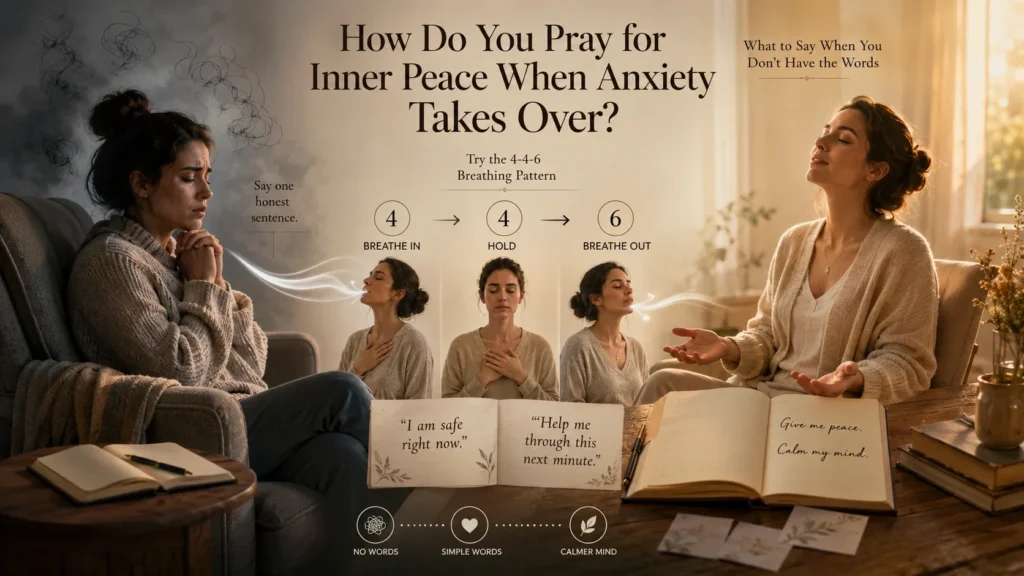
When you’re mid-panic, keep it short. Say one honest sentence, breathe out slower than you breathe in, and repeat it until your chest loosens.
Try the 4-4-6 breathing pattern
You don’t need the right words. You need any words, said slowly. Try this: breathe in for four counts, hold for four, then say your line as you breathe out for six. Something like “I am safe right now” or “help me through this next minute” works fine.
What to say when you don’t have the words
Some nights nothing comes, and that’s normal. It’s fine to borrow words instead of forcing your own.
A line as simple as “give me peace” or “calm my mind,” repeated slowly, counts as a full prayer. Length isn’t the point. If reading someone else’s words helps more than praying your own has so far, a handful of grounding inner peace quotes can work the same way a prayer does.
What does the Quran say about inner peace?
Surah Ar-Ra’d (13:28) is the verse most people reach for first. It says hearts find true rest specifically through the remembrance of Allah, naming that remembrance as the direct source of calm rather than something that just happens to come with it.
Surah Ash-Sharh (94:5-6) repeats one promise twice for emphasis: ease comes with hardship, not just after it. Surah Al-Baqarah (2:286) adds that Allah never places a burden on a person heavier than what they have the strength to carry. These verses keep showing up in Muslim prayer routines for anxiety, not because they’re pretty, but because they name the exact fear people bring to prayer: losing control.
If poetry speaks to you louder than scripture does, that same ache for peace runs through pieces like The Soul Is a Light, a spiritual poem built around the same surrender.
A short prayer for inner peace you can say today
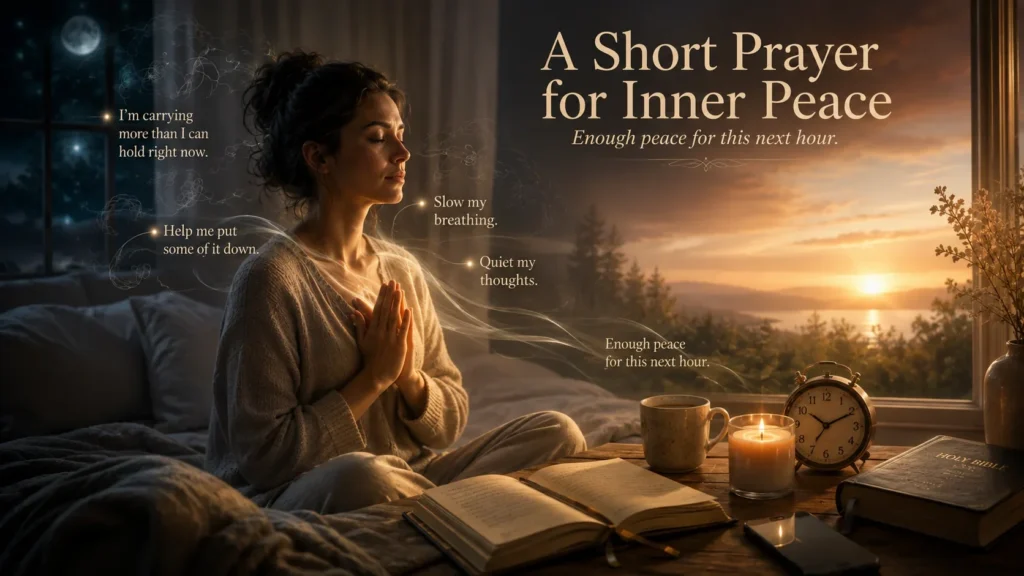
Here’s one you can use tonight, word for word, or change however you need it:
“I’m carrying more than I can hold right now. Help me put some of it down. Slow my breathing, quiet my thoughts, and give me enough calm to get through today. I don’t need every answer, just enough peace for this next hour.”
Say it once, slowly. Sit for 10 seconds before you do anything else. You can say this one before bed, before a hard conversation, or the second anxiety wakes you up at 3am.
Can prayer replace therapy or medication for anxiety?
No, and no credible source claims it can. Prayer helps you cope in the moment. It doesn’t treat panic disorder, generalized anxiety disorder, or clinical depression on its own.
Generalized anxiety disorder alone affects close to 7 million U.S. adults, and only about 43% of them get adequate treatment. Mayo Clinic frames prayer and spirituality as one part of a bigger stress plan, alongside sleep, relationships, and professional support, never a stand-in for any of them.
When to see a professional instead
If a prayer for inner peace gets you through a hard hour, use it. If the hard hours keep stacking up, that’s worth a conversation with a doctor or therapist, not just a longer prayer.
How do you build a daily prayer habit for inner peace?
Pick one fixed moment. Same time, same short prayer, every day for two weeks before you judge whether it’s working.
Best time of day to pray for calm
Morning and right before bed are the two anchors most people keep, mostly because both already have a natural pause built in.
Morning prayer sets the tone before your inbox does. Night prayer closes the day out instead of letting anxious thoughts run the show while you’re trying to sleep. Neither is more correct. Pick the one you’ll actually keep, and jot one line after each prayer, what you asked for, what shifted. A guided self-love meditation uses this same slow-breath structure if you want a second daily anchor.
What if you don’t believe in God but still want inner peace?
You don’t need belief in a specific god for this to work. The same slow breathing and repeated words calm your nervous system whether you call it prayer, meditation, or just talking to yourself.
Secular versions that work the same way
Secular versions swap “God” for “the universe,” “myself,” or nothing at all. The line still works: “let me put this down for now, I don’t need to carry it all at once.” Urdu poetry carries this same plea in a different register. Hamd poems, like this Hamd in Urdu, are built entirely around surrendering weight you can’t carry alone.
And some people find that same quiet somewhere else entirely, alone, off-grid, with nobody talking. A trip built around solo travel in Iceland works the same nervous system, just without any words at all.
FAQ’s:
Can you pray for inner peace every day?
Yes. There’s no limit on how often you can pray, and a fixed daily prayer tends to work better than an occasional one because your body learns the pattern.
Does prayer really help with anxiety?
Yes, at least in the moment. Slow, rhythmic prayer lowers your breathing rate and calms your nervous system, though it doesn’t replace treatment for a diagnosed anxiety disorder.
Is there a short prayer for inner peace and calm?
Yes. Even one sentence, said slowly and meant sincerely, counts as a full prayer. Length has nothing to do with whether it works.
What’s the best time of day to pray for peace of mind?
Whatever time you’ll actually stick to. Morning and right before bed are the two most common anchors because they’re already built into most routines.
Which Quran verse is best for inner peace?
Surah Ar-Ra’d (13:28) is the one most people turn to first, alongside Surah Ash-Sharh (94:5-6) and Surah Al-Baqarah (2:286). All three speak directly to letting go of control.
Can you pray for inner peace without following a specific religion?
Yes. The calming effect comes from the slow, repeated structure of prayer itself, not from any one belief system.
Final thoughts
Anxiety doesn’t wait for a convenient time, and neither should your prayer. Say it messy, say it short, say it in the middle of a grocery store if you have to. The words matter less than the fact that you slowed down enough to say them. For more on sitting with your own thoughts, VerseSoul’s full library covers healing, poetry, and solo travel too.