
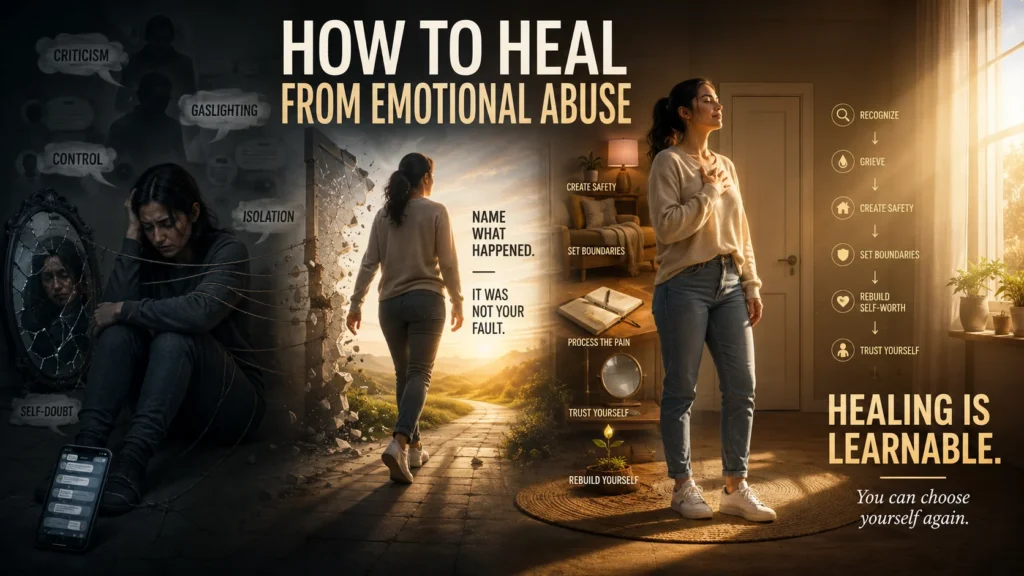
Emotional abuse doesn’t leave bruises. It leaves you doubting your own memory, apologizing for things that were never your fault, and feeling small in rooms where you used to feel completely yourself.
Healing isn’t a straight line. Some days you feel free. Other days, one offhand comment from a stranger sends you right back to that old, smaller version of you. That’s normal. It doesn’t mean you’re doing this wrong.
The good news is that healing is learnable. It’s a set of skills, not a personality trait you either have or don’t. This guide walks through what emotional abuse actually looks like, the real stages of healing, and the steps that help you rebuild your confidence and your trust in yourself again.
You heal from emotional abuse by naming what happened, limiting contact with the person who hurt you, and rebuilding your sense of self through therapy, journaling, boundaries, and self-compassion. There’s no fixed timeline. Real change usually shows up within months, and full healing often takes over a year.
What is emotional abuse and how do you recognize it?
Emotional abuse is a pattern, not one bad argument. It includes constant criticism, name-calling, gaslighting, isolation from friends and family, and control disguised as concern.
The CDC calls this psychological aggression: verbal and non-verbal communication meant to harm you mentally or control you. It can be loud, like yelling and insults, or quiet, like monitoring your phone, threatening you, or humiliating you in front of others.
It’s more common than most people realize. Close to half of women, 48.4%, and nearly as many men, 48.8%, report experiencing psychological aggression from an intimate partner at some point in their life, according to CDC survey data.
If you grew up around it, that counts too. The CDC lists emotional abuse as behavior that harms a child’s self-worth, including shaming, rejecting, name-calling, or withholding love from a parent or caregiver. You’re not imagining it, and you’re not alone in it.
What are the real stages of healing from emotional abuse?
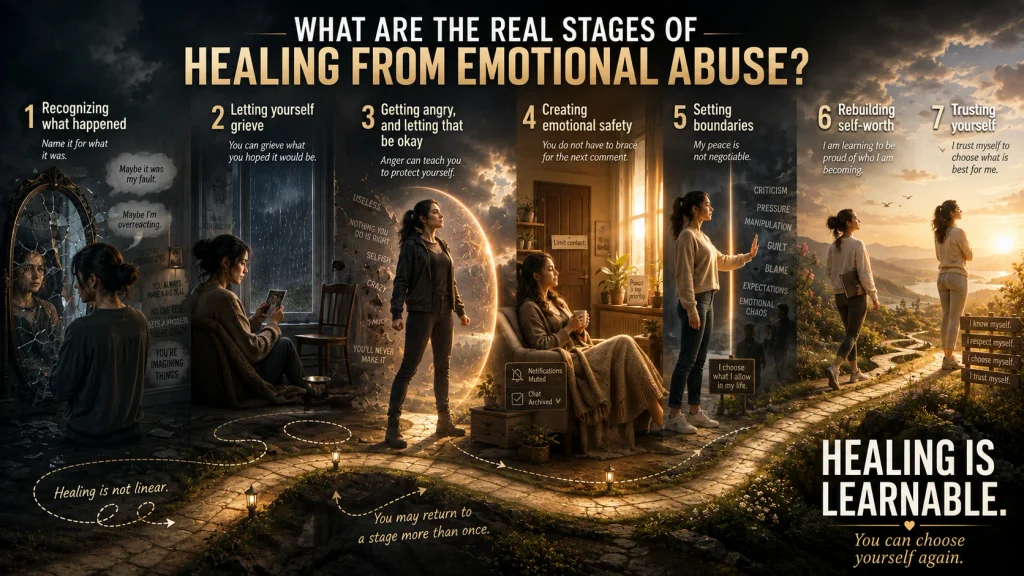
Healing usually moves through recognizable stages: recognizing, grieving, anger, safety, boundaries, rebuilding worth, and trust. They rarely happen in a neat order. Expect to loop back through a few of them more than once.
Recognizing what happened
This is the stage where you stop calling it “a difficult relationship” and start calling it what it was. It’s often the hardest step, and also the one that unlocks everything after it.
Letting yourself grieve
You’re allowed to grieve someone who hurt you. You’re grieving the relationship you thought you had, not just the person.
Getting angry, and letting that be okay
Anger gets a bad reputation in healing conversations, but it’s often the emotion that finally gets you to protect yourself. Don’t rush past it.
Creating emotional safety
This means limiting or cutting contact, muting old chats, and building a space, physical and mental, where you’re not bracing for the next comment.
Setting boundaries
Boundaries are how you practice protecting the safety you just built. More on this below.
Rebuilding self-worth
This is slow, deliberate work: noticing your own wins, correcting your inner voice, and relearning that your needs matter too.
Trusting yourself again
The final stage isn’t about never doubting yourself again. It’s about catching the doubt faster, and choosing yourself anyway.
Why do you keep blaming yourself, and how do you stop?
You blame yourself because the abuse trained you to. Abusers often shift responsibility onto their partner, so guilt becomes an automatic reflex, even long after the relationship ends.
This isn’t a character flaw. Groups like the National Coalition Against Domestic Violence note that people stay in, and blame themselves for, abusive situations out of fear the behavior will escalate, not because they’re weak or foolish.
A simple check that helps: when a thought like “I ruined everything” shows up, ask yourself if you’d say that to a friend in your exact situation. You probably wouldn’t. That gap is worth paying attention to.
What are the first steps to take when you want to heal?
Start with the practical, not the emotional. The feelings will still be there once you’ve handled the basics.
- Get physically and digitally safe first: block, mute, or limit contact where you can.
- Tell one person you trust what actually happened, out loud.
- Find a therapist who understands coercive control, not just general couples counseling.
- Write down specific incidents while they’re fresh. It helps you trust your own memory later.
How does setting boundaries help you rebuild your self-worth?
Boundaries aren’t punishment. They’re information. They tell people, including yourself, what you will and won’t accept going forward.
Start small: saying no without a paragraph of justification, muting a group chat that always turns into criticism, or simply leaving a conversation that’s going in circles.
If you want a fuller list of ways to put yourself first daily, our guide on how to practice self-love has 15 real ones you can start today.
How can journaling help you process the pain and heal faster?
Journaling isn’t about writing something pretty. It’s about getting the thoughts out of your head and onto a page where they stop looping.
Psychologist James Pennebaker’s original expressive writing studies at the University of Texas found that people who wrote about a traumatic experience for 15 to 20 minutes across a few consecutive days had fewer health center visits afterward than people who wrote about neutral topics. A later review by the VA found therapeutic journaling produced measurable improvement in anxiety and PTSD symptoms compared to no writing at all.
Try this: write for 15 minutes about the relationship, without worrying about grammar or whether it makes sense. Don’t edit. Don’t reread it right away.
Words don’t have to be clinical to help, either. Sometimes a poem says what a journal entry can’t. I Have No Complaints Left and its Urdu companion piece, Ab Kisi Se Koi Shikwa Nahi, both capture that exact moment when the complaints finally stop.
How does self-compassion help you heal from emotional abuse?
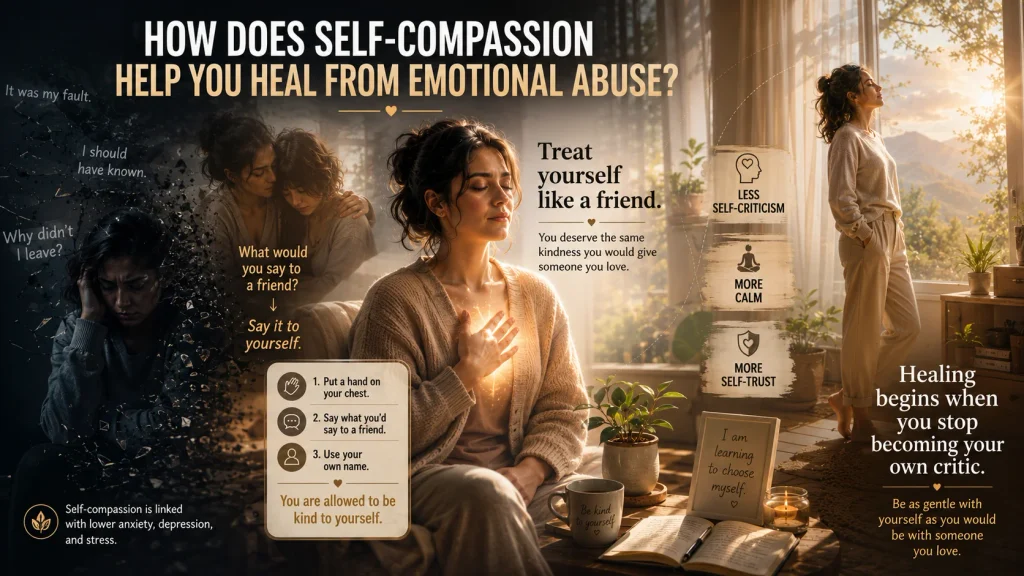
Self-compassion means treating yourself the way you’d treat a friend who came to you with the same story. Research from psychologist Kristin Neff at the University of Texas links higher self-compassion to lower anxiety, depression, and stress.
It’s not a generic feel-good idea, either. A 2023 review by Neff points to a specific study on domestic violence survivors that found self-compassion helped them cope with what they’d been through.
A quick way to practice it: put a hand on your chest, and say what you’d say to a friend, using your own name. It feels awkward at first. It works anyway.
For a deeper look at what this actually means day to day, read what is self love: meaning, definition and signs.
How do you handle emotional triggers while you’re healing?
A trigger isn’t weakness. It’s your nervous system recognizing a pattern from before, even when the actual danger is gone.
When it happens, name it out loud if you can: “This is a trigger, not the actual situation.” Then ground yourself: feel your feet on the floor, name five things you can see, and breathe out longer than you breathe in.
If anxiety shows up more often than not, our guide on finding inner peace walks through daily habits that calm your nervous system over time, not just in the moment.
What can you do today to start your healing journey?
You don’t need a five-year plan. You need one small, doable thing today.
That could be journaling for ten minutes, blocking one number, or simply doing something alone that reminds you who you are outside the relationship. Some people find that a solo trip, even a short one, does exactly that. It’s proof you can plan, decide, and take care of yourself with no one’s approval but your own.
If that idea appeals to you, our solo travel guide to Machu Picchu is a good place to start dreaming.
How long does it take to heal from emotional abuse?
There’s no fixed number, and anyone promising one is guessing. Some people notice real shifts in a few months. Others, especially with childhood roots, work through it for years.
That range makes sense once you know the scale of this. Nearly two-thirds of US adults report at least one Adverse Childhood Experience, and emotional abuse is one of the categories the CDC tracks. If yours goes back that far, give yourself the same patience you’d give someone else carrying that much history.
Progress usually looks like fewer bad days, not zero bad days. Track that instead of chasing a finish line.
When should you seek professional support for emotional healing?
Sooner than you think. You don’t need to hit a breaking point to deserve support.
Reach out to a therapist if you’re struggling to function day to day, if the same memories keep intruding, or if you notice yourself repeating old patterns in a new relationship. A therapist who specializes in trauma or coercive control will move faster than general talk therapy.
FAQ’s:
Can emotional abuse affect your confidence?
Yes. Constant criticism and control wear down your sense of self over time, and it’s common to doubt decisions you once made easily. Confidence comes back with consistent self-compassion, boundaries, and support.
Is it possible to heal without forgetting what happened?
Yes, and most people heal exactly this way. Healing isn’t about erasing the memory. It’s about the memory no longer controlling how you feel about yourself today.
What is the first stage of emotional healing?
The first stage is recognizing what happened for what it was. Many people spend months minimizing the abuse before they can name it clearly, and that naming is what opens the door to real healing.
How can boundaries help with emotional healing?
Boundaries protect your energy while you heal. They stop the same patterns from repeating with new people, and they give you practice trusting your own limits again.
How do I know when I have truly healed?
There’s no single finish line. Most people notice healing through smaller signs: reacting less to old triggers, trusting your own judgment again, and feeling calm instead of anxious in relationships.
How do I start rebuilding trust in myself?
Start small. Keep tiny promises to yourself, notice when your gut feeling turns out right, and give yourself credit for it. Trust rebuilds through repetition, not one big decision.
You don’t owe anyone a fast recovery, and you don’t owe anyone a quiet one either. Heal at the pace that’s actually yours.
If you want more support along the way, explore more healing and wellness guides on VerseSoul, from self-love practices to poetry that says what you can’t always say yourself.