

You already know the lines. Put yourself first. You deserve love, too. None of that tells you what to actually do on a Tuesday when you’re annoyed at how you handled a meeting, or when you skipped the gym again, and the guilt won’t quit.
Self-love isn’t a mode; it’s a set of small choices you repeat until they become who you are. This guide skips the fluff and gets into what actually works, whether you’re 22 and burnt out or 52 and only now permitting yourself to matter. It draws on real psychology research, honest stories from people working through this in Reddit’s self-love communities, and habits that hold up outside a journal entry. No 30-day miracle claims. Just a clear map; you can start walking today.
What does it really mean to practice self-love?
Self-love means treating yourself with the same patience you’d offer a friend on a bad day. It’s not vanity, and it’s not a bubble bath with candles. The self-love meaning most people miss is that it’s a practice, not a feeling that shows up on its own.
Psychologist Kristin Neff, who helped build much of the modern research on this, breaks it into three parts: self-kindness rather than harsh self-judgment, remembering that struggle is part of being human, not proof that you’re failing alone, and staying mindful of painful feelings rather than pushing them down or drowning in them. Nearly 4,000 studies now exist on self-compassion, and almost all of them point in the same direction: people who practice it are doing better, not worse, on nearly every measure of well-being.
Why is learning how to practice self-love so important?
Because the alternative has a real cost: chronic self-criticism is one of the strongest known predictors of anxiety and depression, and it doesn’t just sit quietly in the background.
Research on self-compassion consistently links it to lower anxiety, lower depression, less shame, and even fewer eating disorder symptoms. It’s not a soft, optional add-on to mental health. For a lot of people, it’s the missing piece that makes therapy, boundaries, and better habits actually stick.
How to practice self-love every day without feeling selfish?
Selfishness takes from others. Self-love stops you from constantly taking from yourself. That distinction matters more than it sounds.
A useful test: does this choice come from respect for your own limits, or from wanting to hurt or control someone else? Making time to rest, saying no to a draining favor, or eating a proper lunch instead of skipping it again isn’t selfish. It’s maintenance. You can’t keep showing up for the people you love from an empty tank.
What are the first steps to practice self-love?
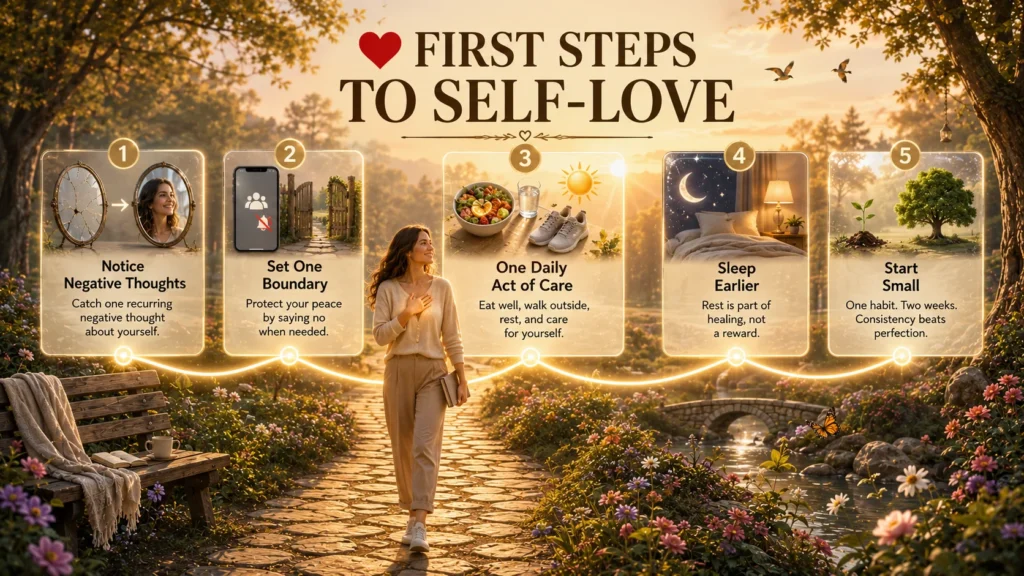
Start smaller than you think you need to. Pick one habit, not five, and give it two weeks before judging whether it’s working.
A simple starting sequence: notice one recurring negative thought you have about yourself this week. Pick one small boundary you’ll hold, even if it’s just muting a group chat that drains you. Add one tiny act of care each day, a proper meal, 10 minutes outside, and an early bedtime. That’s it. The meaning of self-love gets clearer through action, not through more reading about it.
How can positive self-talk improve self-love?
Positive self-talk works because it reminds your brain you’re more than whatever mistake or setback just happened. Psychologists Geoffrey Cohen and David Sherman, who developed self-affirmation theory, found that reflecting on your core values makes people less defensive and more open to change, with effects that can last for months.
This isn’t about forcing fake positivity when things are genuinely hard. It’s about widening the lens. You can acknowledge that “that presentation went badly” while also holding on to “I am still someone who works hard and cares about doing well.”
What daily affirmations encourage self-love?
Keep them believable, not aspirational fantasy. “I’m allowed to rest” lands better than “I am a limitless goddess of light” on a Monday morning. Simple, specific lines work best: I did the best I could with what I knew at the time. My worth isn’t tied to my productivity today. I’m allowed to take up space. If you want a ready-made set to start with instead of writing your own, VerseSoul’s self-love quotes for women collection has lines built for exactly this kind of daily reset.
Why should you stop comparing yourself to others?
Comparison steals your attention from your own actual life and hands it to a version of someone else’s highlight reel. It rarely gives you anything useful in return.
Social comparison research has repeatedly linked heavy social media comparison with lower self-esteem and higher anxiety, especially when the comparison is upward, meaning you’re measuring yourself against people who appear to be doing better. The fix isn’t pretending you don’t notice other people’s lives. It’s catching the spiral early and redirecting to your own progress instead.
How can setting healthy boundaries help you practice self-love?
Boundaries protect the energy self-love needs to survive. Without them, even the best morning routine gets drained by 3 pmm.
Research on burnout consistently shows that people who set and hold clear limits at work, in friendships, and in family relationships report lower stress and less emotional exhaustion than those who don’t. A boundary isn’t a wall. It’s just a clear line about what you will and won’t accept, communicated calmly and held consistently.
Why is saying “no” an important part of self-love?
Every “yes” you don’t mean is a small theft from your own time and energy. Saying no protects the yeses that actually matter to you.
You don’t owe anyone an essay-length excuse. “I can’t take that on right now” is a complete sentence. The guilt fades faster than you expect once you notice how much lighter your week feels.
What daily habits make self-love easier?
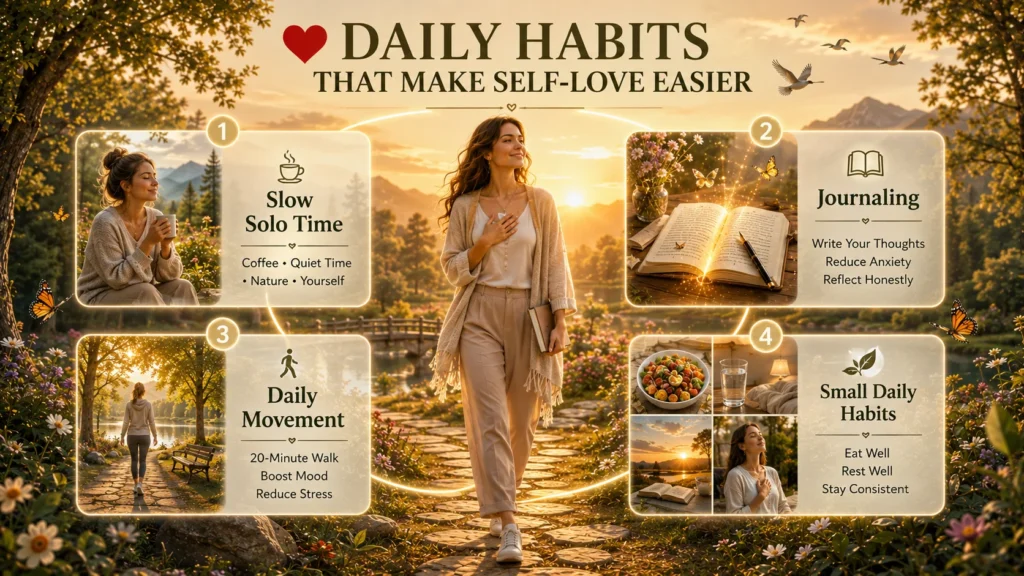
Self-love gets easier when it’s built into your day instead of treated as a separate project. Small, boring, repeatable habits beat big, dramatic gestures every time.
Which self-love activities work best for beginners?
Start with anything that gives you undivided time with yourself. That could be a slow solo coffee, a walk with no phone, or even a full step outside your routine for a weekend. Some people find that a short solo trip, even somewhere as unfamiliar as chasing the northern lights on a solo trip to Iceland, does more for self-trust than a month of affirmations, simply because you prove to yourself you can handle being alone and enjoy it.
How can journaling improve self-love?
Journaling gives your thoughts somewhere to go besides looping in your head. A 2022 systematic review and meta-analysis published in the peer-reviewed literature found journaling interventions produced an average 5% reduction in mental health symptom scores, with a stronger 9% benefit specifically for anxiety. That’s a modest but real, measurable effect from something that costs nothing but ten minutes.
How can exercise boost self-love?
Movement changes body chemistry in ways that support mood almost immediately. Even a 20-minute walk raises endorphins and reduces cortisol, the stress hormone tied to anxiety and low mood. You’re not exercising to punish your body into a different shape. You’re moving it because a body you respect is easier to be kind to.
Can gratitude help you practice self-love?
Yes, and the research on this is stronger than most people expect. A 2024 study published in JAMA Psychiatry, drawing on data from nearly 49,000 women in the long-running Nurses’ Health Study, found that participants with the highest gratitude scores had a 9% lower risk of all-cause mortality over the following 4 years, compared with those with the lowest scores.
Gratitude doesn’t need a formal ritual. Naming three specific things that went right today, even small ones, quietly shifts your brain’s default settings over time.
How can you forgive yourself for past mistakes?
Self-forgiveness starts with separating what you did from who you are. A mistake is an event. It’s not a permanent character reference.
Ask what you’d say to a close friend who made the same choice, then say that to yourself. It sounds simple because it is, but most people never actually try it. Sometimes putting the feeling into words helps more than thinking it. A few lines of reflective poetry can do that work too, the way VerseSoul’s motivational English poetry on second chances puts language to the exact kind of quiet hope that self-forgiveness runs on.
What role does mindfulness play in self-love?
Mindfulness is what lets you notice a harsh thought without immediately believing it. That gap between noticing and reacting is where self-love actually gets built.
Jon Kabat-Zinn’s Mindfulness-Based Stress Reduction program, now taught in hospitals and clinics worldwide, is built on this exact skill: observing thoughts and sensations without judgment. You don’t need an eight-week course to start. Even a minute of noticing your breath before responding to a stressful text counts. Some readers find the same slowing-down effect in poetry written for reflection, including VerseSoul’s Urdu poetry on patience and belief, which shares the themes of waiting and trusting yourself.
What are the biggest mistakes people make when practicing self-love?
The most common one is confusing self-love with self-esteem, then chasing constant positive feedback instead of steady self-respect. Neff’s research shows that self-compassion offers mental health benefits similar to those of self-esteem, but without the fragility, since it doesn’t depend on winning or comparing well with others.
The second mistake is treating affirmations as a substitute for action. Saying “I deserve rest” while still working through every lunch break cancels out the message. Words and behavior need to match, or your brain stops trusting either one.
How long does it take to develop self-love?
There’s no universal deadline, and anyone promising a fixed number of days is oversimplifying. For some people, a shift in daily self-talk feels noticeable within a few weeks. For others coming out of years of harsh self-criticism or a difficult family background, it’s closer to months of consistent practice before it feels automatic.
How can you measure progress in your self-love journey?
Track behavior, not just mood, since mood fluctuates day to day regardless of progress. Notice things like: did you catch a negative thought and challenge it this week? Did you hold a boundary you would have dropped six months ago? Did you rest without guilt, even once? Those small wins add up faster than they feel in the moment.
FAQ’S:
Is self-love the same as self-esteem?
No. Self-esteem depends on how you feel about your achievements and how you compare to others. Self-love, or self-compassion, holds steady even when you fail, which research shows makes it more stable in the long term.
Can practicing self-love feel selfish or uncomfortable at first?
Yes, especially if you grew up being praised for putting others first. That discomfort usually fades within a few weeks of consistent, small practice.
Do self-love affirmations actually work, or is that just wishful thinking?
Self-affirmation research from psychologists Cohen and Sherman shows real, measurable effects on stress and defensiveness, particularly when the affirmations reflect values you genuinely hold rather than generic positivity.
What's the fastest way to start practicing self-love today?
Pick one habit only– journaling, a short walk, or naming three things you’re grateful for– and repeat it daily for two weeks before adding anything else.
How is practicing self-love different for men versus women?
The core principles- kindness, boundaries, and honest self-talk- are the same for everyone. Men often face more stigma around admitting they need rest or emotional support, which can make boundary-setting the hardest step.
Final thoughts
Self-love isn’t a finish line you cross once. It’s closer to a muscle you keep using, some days easily, some days with real effort. Start with one habit from this list, give it two honest weeks, and notice how differently you talk to yourself by the end of it. You can find more real, research-backed guides like this one across VerseSoul, from healing and mindfulness to poetry that says what you can’t always find words for.
Pingback: Self Love Club: What It Is and Why You Should Join