
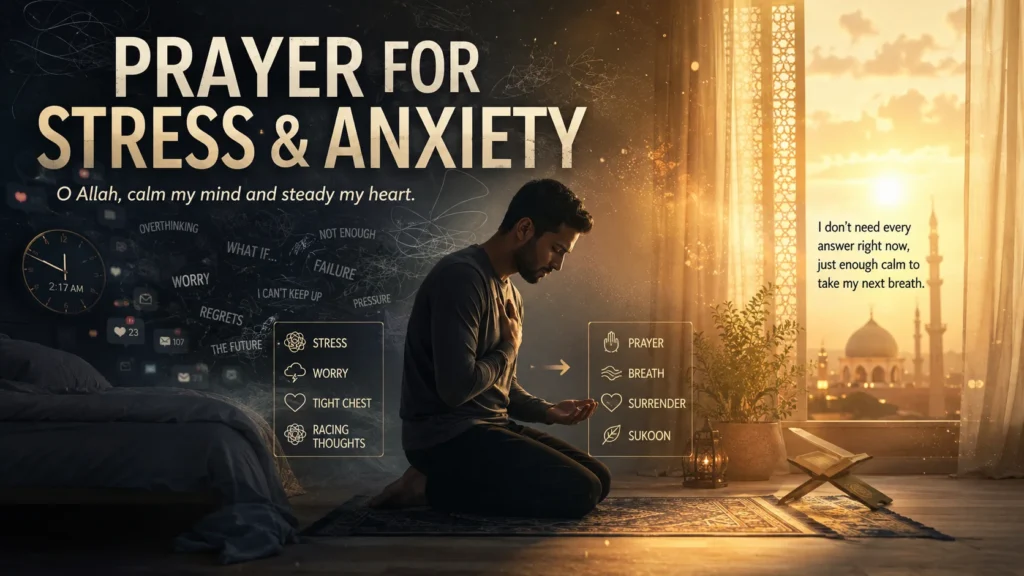
Your chest feels tight before you’ve even opened your eyes properly. That’s stress, or maybe anxiety, and for a lot of people, the first thing they reach for isn’t a pill. It’s a prayer for stress and anxiety, said quietly, sometimes through tears, sometimes half-asleep.
A prayer for stress and anxiety is a short, honest request for calm when your mind won’t slow down on its own. You don’t need perfect words or a peaceful setting. You need to start.
You’re not overreacting, and you’re not alone in this. Anxiety disorders affect 301 million people worldwide, about 4.05% of the global population, and that number has climbed more than 55% since 1990, according to Global Burden of Disease data. That’s a lot of people carrying the same weight you are right now.
This guide gives you real prayers to say today, what the Quran and the Prophet ﷺ taught about worry, and the research behind why prayer actually helps your body calm down.
Is prayer good for stress and anxiety?
Yes, for most people, prayer genuinely helps. It slows your breathing, gives your mind somewhere to land, and reminds you that you’re not carrying everything by yourself.
Prayer isn’t a replacement for medical care, though. Think of it as one solid tool in a bigger toolbox, not the only tool you own.
What’s the difference between everyday stress and anxiety?
Stress usually has a cause you can point to, like a deadline, a bill, or an argument. Anxiety can show up even when nothing specific is wrong, just a constant hum of worry running in the background.
Knowing which one you’re dealing with helps you pray with more direction. If you want the fuller breakdown, including causes and symptoms for both, stress vs anxiety covers it in detail.
Why do so many people turn to prayer first?
Prayer is free and private, and you can do it anywhere: mid-commute, in a bathroom stall, or lying awake at 3 am. That accessibility matters when panic doesn’t wait for a convenient moment.
It also does something a to-do list can’t. It lets you say the scary thought out loud, or in your head, without needing to fix it right away.
What does the research say about prayer and stress?
Research on Islamic prayer specifically supports this. A 2021 literature review in the Medical Journal of Malaysia linked regular Salah to lower cortisol and improved relaxation markers, and earlier studies by Doufesh and colleagues found a consistent negative relationship between prayer and anxiety levels, alongside increased alpha-wave activity associated with relaxation.
None of this makes prayer magic. It means slowing down, breathing on purpose, and speaking honestly to God does something measurable to your nervous system, not just your mood.
What does the Quran say about stress and anxiety?
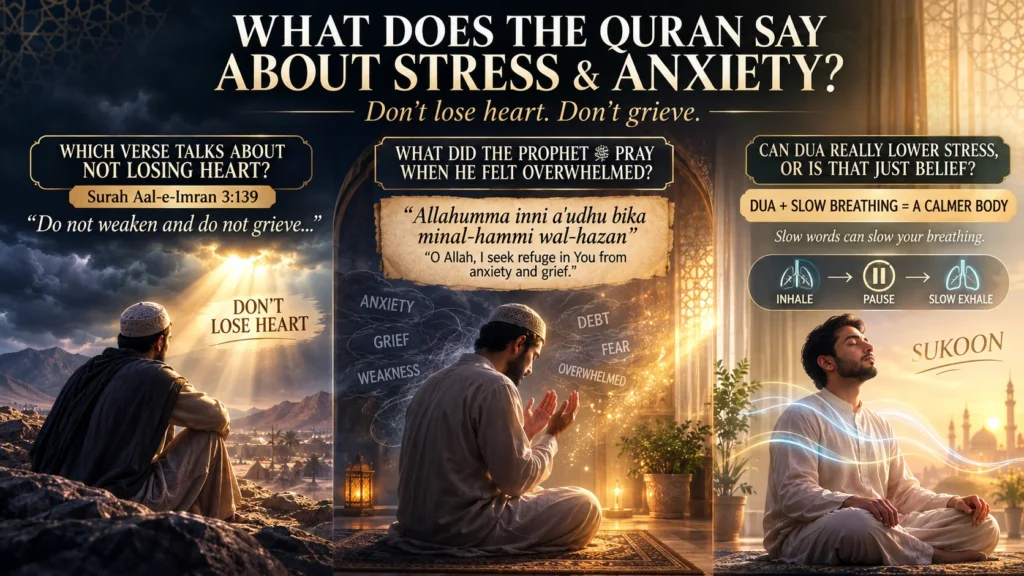
The Quran addresses worry directly, more than once, and the message stays consistent: don’t lose heart, and don’t grieve alone. Allah already knows exactly what you’re carrying.
Three sources come up again and again for anxious moments: one verse, one dua from the Prophet ﷺ, and one habit of remembrance you can build daily.
Which verse talks about not losing heart?
Surah Aal-e-Imran (3:139) says: “Do not weaken and do not grieve, for you will be superior if you are true believers.” It was revealed right after a hard military defeat at Uhud, so it’s not abstract comfort meant for easy days.
That context matters. This verse was written for the exact moment things had already gone wrong, which makes it land differently than a generic “stay positive” line.
What did the Prophet ﷺ pray when he felt overwhelmed?
The Prophet ﷺ regularly said: “Allahumma inni a’udhu bika minal-hammi wal-hazan” (O Allah, I seek refuge in You from anxiety and grief), recorded in Sahih al-Bukhari 6363. He taught this exact dua to a companion, Abu Umamah, who was buried under debt and worry at the time.
The dua names eight specific struggles in one breath: anxiety, grief, weakness, laziness, cowardice, miserliness, debt, and being overpowered by others. You can say it in Arabic, or simply in your own words, asking refuge from whatever’s actually sitting on your chest today. If you’d rather sit with this same surrender in poetry, this surrender to Allah poem walks through the same letting-go, line by line.
Can dua really lower stress, or is that just belief?
Both, honestly. The words carry spiritual weight for believers, and the mechanics of slow, repeated speech also calm your body regardless of what anyone believes about it.
Saying a dua slowly and out loud forces your breathing to slow down with it. That alone can shift your nervous system out of panic mode within minutes, not hours.
What is a short prayer for stress and anxiety you can say today?
Keep it short when you’re overwhelmed. Long, polished prayers are lovely on a calm afternoon, but they’re hard to remember mid-panic. One honest sentence works fine.
Below are three prayers crafted for three different moments: sudden panic, total wordlessness, and a heavier-than-usual week.
What can you say the moment panic hits?
“O Allah, my chest is tight, and my mind won’t stop. Give me peace for this exact moment. I don’t need every answer right now, just enough calm to take my next breath.”
Say it once, slowly, and breathe out longer than you breathe in. Repeat it as many times as you need to.
How do you pray when you don’t have words left?
Some days you’re too tired to form a full sentence, and that’s fine. A single word, repeated slowly, still counts as a complete prayer.
Try just saying “sukoon” (calm) or “ease” on repeat, timed with your exhale. Length was never the requirement here. Sincerity always was.
What’s a longer prayer for a heavy week?
“O Allah, this week has felt like too much. Help me separate what I can actually change from what I need to hand over to You. Give me patience with myself, strength for tomorrow, and rest tonight. I trust that ease comes with hardship, even when I can’t see it yet.”
Save this page or write it somewhere you’ll actually see again: your phone notes, a sticky note on the mirror. You’ll likely need it again before the week’s out, and that’s completely normal.
What are the physical signs that stress has taken over?
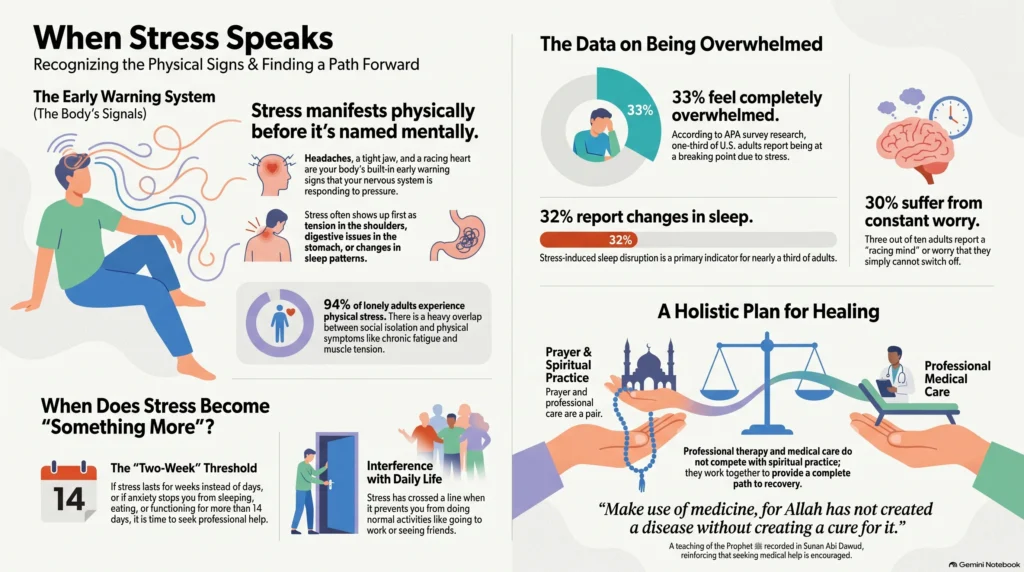
Stress doesn’t just live in your head. It shows up in your shoulders, your stomach, and your sleep, often before you’ve consciously named what’s actually wrong.
Knowing the signs early helps you catch stress before it becomes something that needs more support than a prayer alone can provide.
How does stress actually show up in your body?
According to Statista data drawn from APA survey research, 33% of U.S. adults report feeling completely overwhelmed because of stress, 32% report noticeable changes in sleep, and 30% report constant worry they can’t switch off.
Headaches, a tight jaw, and a racing heart before anything’s even happened yet are all your body’s early warning system. None of that means you’re weak. It means your nervous system is doing exactly what it’s built to do.
When does normal stress turn into something bigger?
If stress sticks around for weeks instead of days, or starts stopping you from doing normal things like going to work or seeing friends, it may have crossed into something that needs more attention. The American Psychological Association found that 94% of highly lonely adults report at least one physical stress symptom, things like fatigue or muscle tension.
That overlap between loneliness and physical stress is worth sitting with for a second. Sometimes the fix isn’t just prayer; it’s also about reaching out to a real person.
When should prayer stop being your only plan?
If anxiety is stopping you from sleeping, eating, or functioning for more than two weeks, that’s the point to also talk to a doctor or therapist. Prayer and professional care aren’t competing with each other. They work better as a pair.
There’s no shame in needing both. The Prophet ﷺ himself said, “Make use of medicine, for Allah has not created a disease without creating a cure for it,” recorded in Sunan Abi Dawud.
How do you build a daily prayer habit for anxiety?
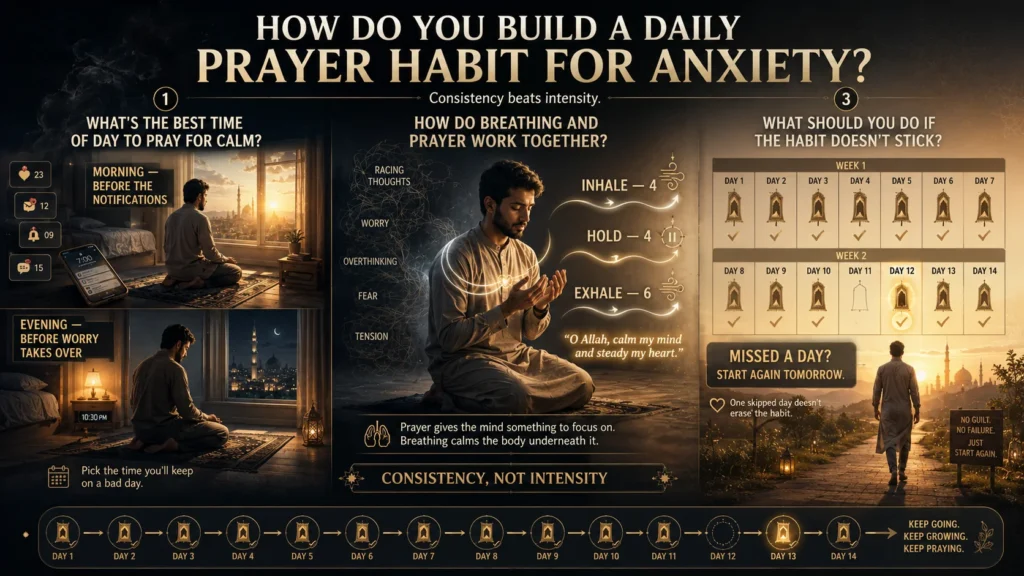
Pick one fixed time, keep the prayer short, and repeat it for two weeks straight before deciding whether it’s working. Consistency beats intensity here, every time.
Most people who actually stick with this build it around an anchor they already have, like Fajr, right before sleep, or a set work break.
What’s the best time of day to pray for calm?
Morning prayer sets your tone before your notifications do. Evening prayer closes the day out instead of letting worry run the show while you’re trying to fall asleep.
Neither one is more correct than the other. Pick whichever you’ll actually keep doing on a bad day, not just a good one.
How do breathing and prayer work together?
Try this pattern: breathe in for four counts, hold for four, then say your line slowly as you breathe out for six. The prayer gives your mind something to focus on. The breathing does the physical work underneath it.
Gallup’s State of the Global Workplace 2026 report found around 40% of employees worldwide reported a lot of stress the day before being surveyed. Slow, paced breathing is one of the few free tools that actually brings that number down in real time, not just in theory.
What should you do if the habit doesn’t stick?
Miss a day, and start again the next one. Don’t treat one skipped prayer as proof the whole thing failed, because it isn’t.
If sitting still feels impossible some days, that restlessness is worth noticing too. Movement helps some people process anxious energy the same way prayer does. A slow, unhurried trip built around quiet days, like these solo travel destinations, works on the same nervous system, just with fewer words involved. For a shorter daily reset, this hope-centered poetry pairs well with a morning prayer too.
FAQ’s:
Is there a specific prayer for a panic attack?
Yes. Keep it to one sentence: ‘O Allah, give me peace for this moment and strength for the next one.’ Say it slowly while you breathe out longer than you breathe in.
What is a short prayer for stress and anxiety?
‘O Allah, calm my mind and steady my heart’ is enough on its own. A short, sincere line beats a long one you can’t remember when you’re already overwhelmed.
Can I pray for anxiety and negative thoughts at the same time?
Yes, one prayer can cover both. Ask for your mind to be quieted and your thoughts to be steadied in the same breath, since the two usually show up together anyway.
Is there a Catholic prayer for stress and anxiety too?
Yes, the Serenity Prayer is a common one across Christian traditions, asking for peace to accept what can’t be changed and courage to change what can. That same idea, surrendering what’s outside your control, shows up across nearly every faith.
How many times a day should I pray for anxiety?
There’s no fixed number. Some people pray once, right when panic hits. Others build it into two fixed points, morning and night. Consistency matters more than frequency.
Can prayer actually help me fall asleep when I’m anxious?
Yes, a short bedtime prayer said slowly can help you wind down, since the pace of the words slows your breathing along with it. If sleep problems continue for weeks, it’s worth mentioning to a doctor too.
Does prayer replace therapy for anxiety disorders?
No. Prayer helps you cope in the moment, but it doesn’t treat a diagnosed anxiety disorder on its own. Use it alongside professional support, not instead of it.
What’s the most powerful prayer for stress and anxiety?
The one you’ll actually say. The Prophet’s own dua against hamm and hazan is a strong place to start, but the most powerful prayer is usually the shortest one you can remember under pressure.
Final thoughts
Stress doesn’t wait for a convenient time, so don’t wait for perfect words either. Say your prayer for stress and anxiety messy, say it short, say it standing in line at the grocery store if that’s exactly where anxiety catches you.
301 million people worldwide are carrying some version of what you’re carrying right now. You’re not doing this wrong, and you’re not doing it alone.
Start today. One honest sentence, said slowly, is enough to begin with. For more on healing, poetry, and finding calm, VerseSoul’s full library has it all.