
Spain doesn’t slow down just because you showed up without a travel partner. Tapas bars stay loud past 11 PM, trains still leave on the minute, and nobody looks twice at a solo diner with a book propped against the wine glass.
That’s really the whole appeal. Spain closed out 2025 with a record 96.8 million foreign visitors, and a growing share of them traveled independently. Solo travel here stopped being a workaround a while ago. It’s just how a lot of people see the country now.
This guide skips the fluff. It covers whether Spain is actually safe to travel alone, which cities are worth your limited time, what a realistic budget looks like, and how to get around the country without renting a car. Worth bookmarking before you book your flight.
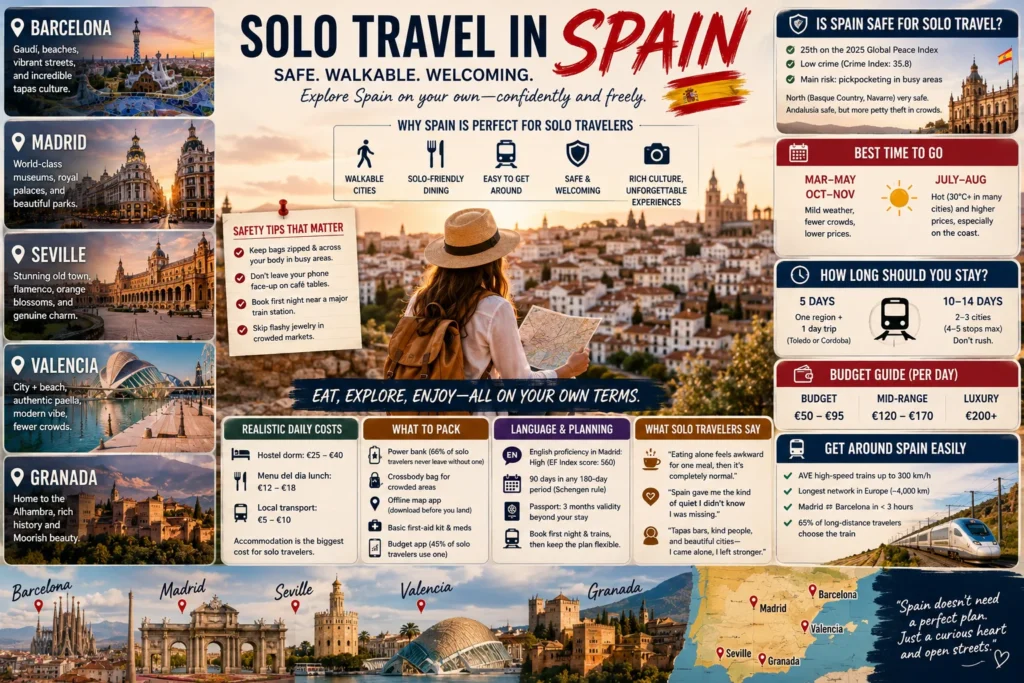
Quick answer: yes, solo travel in Spain works well for almost anyone. It ranks among the more peaceful countries in the world, its high-speed rail network is the longest in Europe, and cities like Madrid, Valencia, and Seville are genuinely built for walking, eating, and exploring on your own.
Is Spain safe for solo travel?
Yes. Spain sits at 25th on the 2025 Global Peace Index, and its national crime index score of 35.8 puts it firmly in low-crime territory. The real risk isn’t violent crime; it’s pickpocketing in busy tourist spots.
Regional safety does vary a bit. The north, including the Basque Country and Navarre, runs notably calm thanks to tight local governance. Andalusia in the south stays safe, too, though its large tourist crowds mean petty theft occurs more often than in quieter regions.
Is Spain specifically safe for solo female travelers?
Yes, and Spain is one of the more commonly recommended countries in Europe for women traveling alone. Well-lit central neighborhoods, late-night street life, and a culture where eating or walking alone barely registers all help.
That said, the anxiety before the trip is real even when the country itself is safe. If pre-trip nerves are the bigger obstacle right now, VerseSoul’s guide to journaling for emotional healing offers a few methods worth trying before you fly, not after you land in a panic at Barajas.
What precautions actually matter?
- Keep bags zipped and worn across your body in Las Ramblas, La Boqueria, and on metro platforms, the spots where pickpocketing is most concentrated.
- Don’t leave your phone face-up on an outdoor cafe table. It’s the most common type of theft in Spain.
- Book your first night’s stay near a major train station. Arriving tired and trying to figure out a neighborhood at the same time is how bad decisions happen.
- Skip flashy jewelry in crowded markets. It draws attention you don’t need.
Which Spanish cities work best if you’re traveling alone?
Barcelona, Madrid, Seville, Valencia, and Granada each work well on their own, but they suit different kinds of trips. Pick based on what you actually want from the days, not just the postcard photos.
Barcelona or Madrid first?
Barcelona pulled in about 20.1 million tourists in 2025 (the most of any Spanish region), which means Gaudi’s architecture and the beachfront come with real crowds, especially around Las Ramblas. Madrid feels more compact and walkable, with the Prado and Retiro Park sitting close to a center that empties and calms down once the tapas crowd goes home.
Neither is the wrong first stop. Madrid edges ahead for a true first-timer because the layout is easier to read on foot, but Barcelona wins if art and the sea matter more to you than an easy first few days.
Why Seville, Granada, and Valencia deserve a spot too
Andalusia runs 20 to 30 percent cheaper than Barcelona or Madrid for equivalent quality, and Seville and Granada are where that discount lands hardest. Granada’s Alhambra alone justifies a two-day stop, and Seville’s old town is small enough to explore entirely on foot in an afternoon.
Valencia sits in between: a real city with a beach attached, paella that actually comes from there, and noticeably fewer crowds than Barcelona for a similar coastal feel. If you’re weighing Spain against a quieter, cheaper neighbor, VerseSoul’s solo travel guide to Portugal covers a country with a similar safety profile and slightly gentler prices.
How many days do you actually need?
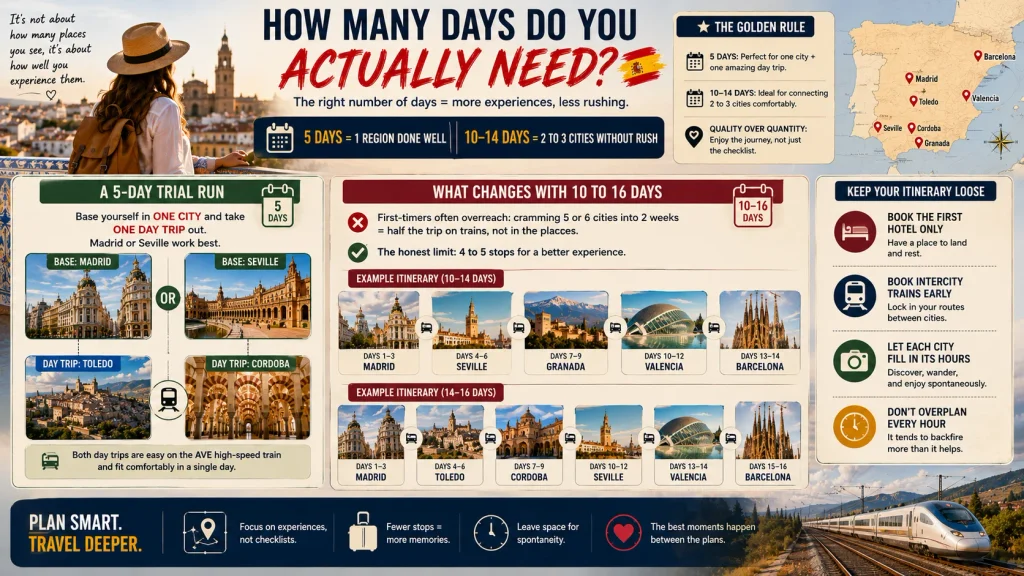
Five days covers one region properly. Ten to fourteen days lets you string two or three cities together without rushing every single one.
A 5-day trial run
Base yourself in one city; Madrid or Seville work well, and take a single day trip out. Toledo from Madrid or Cordoba from Seville both fit inside a day on the AVE without feeling like a scramble.
What changes with 10 to 16 days
This is where first-timers overreach. A common mistake in solo travel planning forums is cramming five or six cities into two weeks and spending half the trip on trains instead of in them. Four to five stops is the honest limit if you actually want to enjoy any of them.
Leave the itinerary loose too. Book the first hotel and the intercity trains, then let each city fill in its own hours once you’re there. Overplanning every single hour tends to backfire more than it helps.
How much does solo travel in Spain cost?
Budget travelers spend roughly 50 to 95 euros a day. Mid-range comfort runs 120 to 170 euros a day. Solo travelers tend to land at the higher end of each range since there’s no partner to split a hotel room with.
Realistic daily numbers
A hostel dorm bed runs 25 to 40 euros a night. A menu del dia, Spain’s fixed lunch deal of two or three courses plus a drink, costs 12 to 18 euros and is genuinely one of the best value meals in Western Europe. Local transport inside a city usually adds another 5 to 10 euros a day.
Where the money actually goes
Accommodation eats the biggest share of any solo budget, simply because you’re paying the full room rate alone. The fix isn’t cutting corners everywhere; it’s picking one or two splurges (a proper dinner in Seville, the Alhambra ticket) and staying disciplined with the rest, especially lunch, where the menu del día already does the saving for you.
How do you get around Spain without a car?
The AVE high-speed rail network. Spain operates almost 4,000 kilometers of high-speed track, the longest network in Europe and the second-longest in the world after China’s, with trains reaching up to 300 kilometers per hour.
Madrid to Barcelona takes under three hours by train, often faster door-to-door than flying, once you count airport time. About 65 percent of long-distance travelers within Spain already choose the train over driving or flying, and for a solo traveler, that means no car rental, no parking stress, and a comfortable seat to plan the next stop from.
When’s the best time to go alone?
March to May and October to November. Both windows bring mild weather, thinner crowds, and noticeably lower prices than peak summer.
July and August push accommodation costs up sharply, especially along the coast and in Barcelona, and the heat in inland cities like Seville and Madrid can hit the high 30s Celsius. Shoulder season also makes solo travel easier logistically. Trains and popular sights book up less, so you can plan a day or two instead of weeks out.
What should first-timers plan before landing?
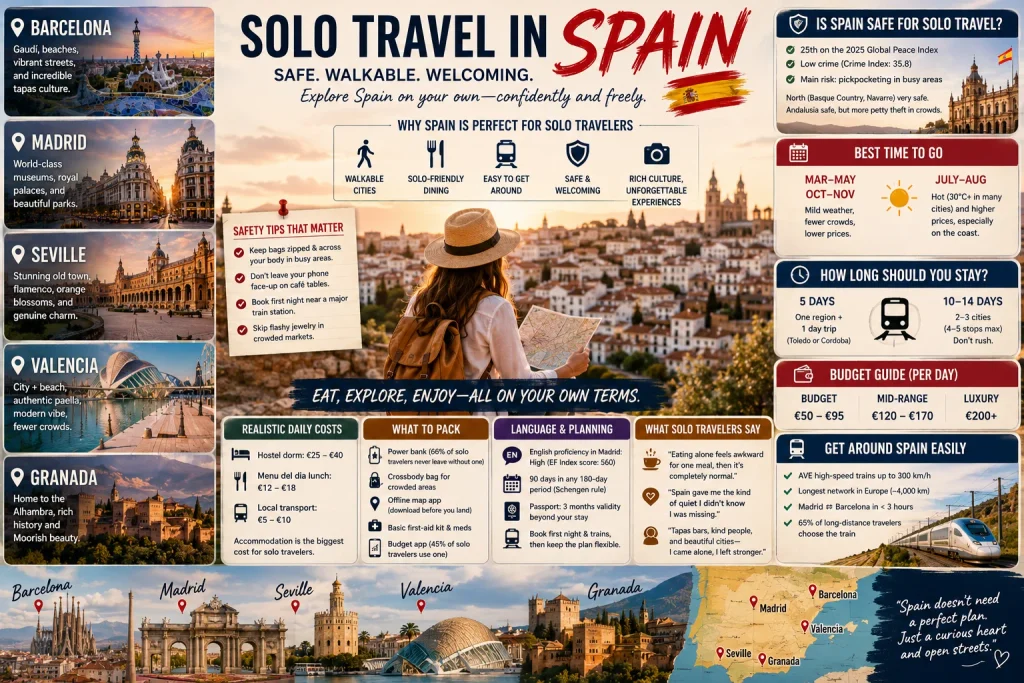
Sort your Schengen days, your passport validity, and your language expectations before you pack, not after you’re already at the gate.
If you’re from a visa-exempt country like the US, UK, Canada, or Australia, you can stay in Spain for up to 90 days within any rolling 180-day period, and that count is shared across the entire Schengen area, not just Spain. The EU’s Entry and Exit System now tracks this automatically at the border, so there’s no more vague stamp to misread. Your passport also needs to be valid for at least 3 months beyond your planned departure date, or border officers can turn you back at check-in.
On language: you don’t need to be fluent in Spanish. Madrid scores 560 on the EF English Proficiency Index, placing it in the high proficiency bracket among world cities. Hence, ordering food, booking a room, or asking for directions in English rarely causes real problems in the bigger cities.
What do people who’ve already done this wish they’d known?
Eating alone feels awkward for about one meal, then it stops being a thing. Spain’s tapas bars are built around standing at the counter, ordering a few small plates, and moving on, which happens to be one of the most solo-friendly dining formats in Europe. Nobody’s watching to see if you came with anyone.
The gym-and-routine question comes up constantly in solo travel planning groups too. The honest answer is simpler than people expect: most hotels and hostels near city centers are within walking distance of a park or a 24-hour gym, so a normal fitness routine survives a trip to Spain better than most other habits do.
A lot of solo travelers come back describing something they didn’t expect: not loneliness, but a quiet they didn’t know they were missing. If you want words for that feeling once you’re home, VerseSoul’s English poem I Have No Complaints Left and the Urdu piece Dahshat-e-Tanhai Mein both sit with that same solitude, just in two different languages.
FAQ’s:
Is Spain good for solo travel?
Yes. Spain ranks among the world’s safer countries, runs Europe’s longest high-speed rail network, and its cafe and tapas culture makes solo dining completely normal.
Is Spain expensive for solo travelers?
Not really. A budget solo trip runs about 50 to 95 euros a day, and the menu del dia lunch deal keeps food costs low even in bigger cities.
Is Spain safe for solo female travelers?
Yes. Spain is regularly recommended for women traveling alone, with well-lit city centers and a culture where solo dining and walking draw little attention.
How many days should I spend in Spain on a solo trip?
Five days works for one region done properly. Ten to fourteen days lets you cover two or three cities without rushing, as long as you keep the list to four or five stops.
Can I get around Spain without speaking Spanish?
Yes, especially in Madrid, Barcelona, and other major cities. English proficiency is high in urban Spain, and the AVE train system has English signage and booking throughout.
Final thoughts
Spain doesn’t need you to arrive with a plan for every hour or a travel partner to lean on. It needs a rough route, a realistic budget, and a willingness to eat lunch alone at a counter without thinking twice.
Start with four or five stops, book the trains early, and leave the rest loose. For more solo travel breakdowns like this one, along with healing and poetry guides that pair well with a long train ride, VerseSoul’s homepage has the full list.