
You know the healing isn’t done when a random song, a smell, or one sentence from someone still knocks the wind out of you.
That’s not a setback. That’s your nervous system telling you exactly where you are in the process.
Emotional healing isn’t a switch you flip once and forget about. It moves through real, recognizable stages, and knowing them changes how you handle the hard days.
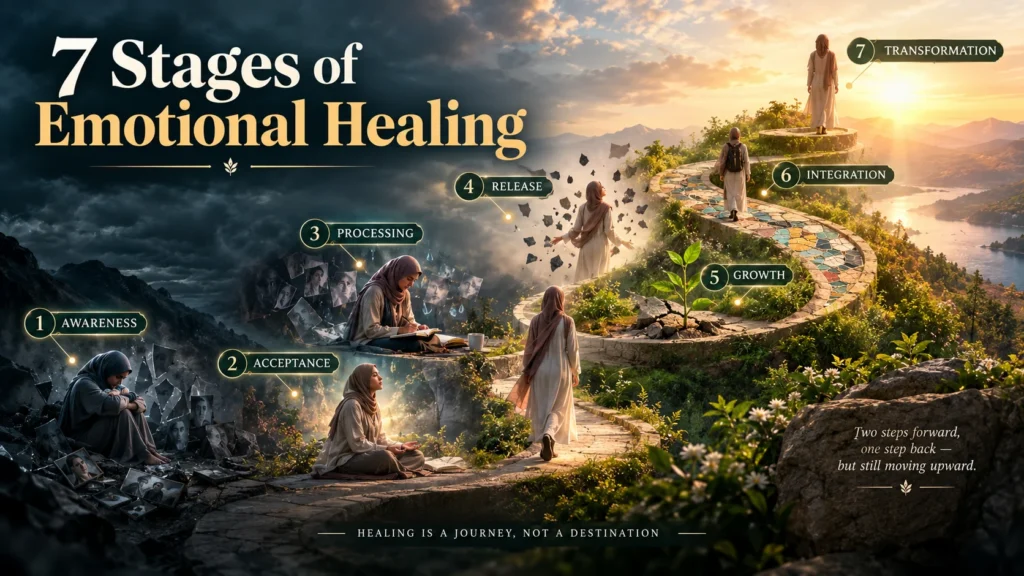
The 7 stages of emotional healing are awareness, acceptance, processing, release, growth, integration, and transformation. You don’t move through them in a straight line. Most people circle back through a few stages more than once before they stick.
What are the 7 stages of emotional healing, one by one?
Each stage has its own job. Skip one, and it tends to show up again later, usually at a worse time.
Stage 1: awareness
You can’t heal what you haven’t named. Awareness is the moment you stop calling it “just a rough patch” and start calling it what it actually was.
Stage 2: acceptance
Acceptance doesn’t mean you’re okay with what happened. It means you stop spending energy wishing it hadn’t.
Stage 3: processing
This is the stage most people get stuck in the longest, and honestly, the one that feels the worst while you’re in it. You’re sitting with the anger, the grief, and the guilt, all at once, instead of pushing them down.
Stage 4: release
Release is where you loosen your grip on the story you’ve been carrying. Not forgetting it. Just no longer letting it run the show.
Stage 5: growth
This is where something useful starts forming out of the pain. A Pew Research Center survey found that 69% of people who went through a major hardship said they discovered real personal strength because of it, not despite it.
Stage 6: integration
Integration is when the experience becomes part of your story instead of the whole story. You can mention it without your voice shaking.
Stage 7: transformation
The last stage isn’t about never feeling triggered again. It’s about noticing the trigger, and choosing a different response than you would have a year ago.
How can you tell you’re actually healing emotionally?
You’ll notice it in your body before you notice it in your mood. Fewer tension headaches, better sleep, and less of that constant, low-grade dread in your chest.
That physical piece matters more than most people think. Chronic emotional pain gets stored in the body, and researchers studying trauma often link it to muscle tension, fatigue, and digestive problems when it stays unresolved.
Emotionally, healing looks like reacting less to old triggers, remembering the situation without your heart racing, and catching yourself before you spiral into old thought patterns. Small stuff. It adds up.
Why does healing feel like two steps forward, one step back?
Because it is; nobody warns you about the transition stage, the point where you feel mostly fine and then suddenly you’re back in an old pattern for no obvious reason.
This happens because healing isn’t linear; it’s more like circling a spiral staircase. You pass the same emotional “floor” again, but each time from a slightly higher vantage point.
A bad day three months into healing doesn’t erase three months of progress. It just means one more lap around the spiral. Give yourself credit for how much shorter that lap gets over time.
Can you skip a stage of emotional healing?
Not really, and this is the part most quick-fix advice leaves out. You can rush past a stage, sure. But it usually waits for you and shows up again later, often disguised as something else.
Skip processing, and the anger you never let yourself feel can turn into random irritability months later. Skip release, and you might find yourself dating people who remind you of the exact thing you’re trying to move on from.
Unresolved emotional pain doesn’t just sit quietly either. Research reviewed by the American Psychological Association links chronic emotional stress to higher blood pressure, heart disease, and chronic pain over time. Your mind keeps the tab open until it’s actually paid.
What actually stops emotional healing from happening?
Usually it’s one of three things: staying busy enough to avoid feeling anything, isolating instead of talking to someone, or trying to heal completely alone when the situation actually needed real support.
That third one is worth sitting with. About 75% of people who go into therapy report a real benefit from it, according to the American Psychiatric Association, and most people who improve start noticing it within roughly 20 sessions. That’s not a small number, and it’s not a sign of weakness either. It’s just what the data shows.
Shame keeps people stuck too. If part of you still believes you deserved what happened, or that needing help means something is wrong with you, that belief will quietly block every other stage until you address it directly, ideally with a therapist who specializes in trauma.
What are the biggest myths about emotional healing?

Myth one: healing means you’ll never feel the pain again. Reality: healing means the pain stops running your life. It can still visit. It just doesn’t move in anymore.
Myth two: you have to forgive the person who hurt you for healing to count. Reality: plenty of people heal fully without ever forgiving anyone. Forgiveness is optional. Peace isn’t.
Myth three: time alone heals everything. Reality: time without any active processing usually buries things deeper. People who journal, talk to someone, or work through it directly tend to move through the stages faster than people who wait it out.
Myth four: if you’re still struggling after a year, something’s wrong with you. Reality: nearly two-thirds of US adults report at least one adverse childhood experience, according to CDC data, and healing timelines for anything rooted that early are rarely quick. Slow isn’t broken.
How long does emotional healing usually take?
There’s no fixed number, and anyone who gives you one is guessing. Some people move through all seven stages in a few months. Others, especially with pain that goes back to childhood, work through it for years.
What actually predicts speed isn’t willpower. It’s whether you’re actively processing the pain, through therapy, journaling, or honest conversation, versus just waiting for time to do the work by itself.
A more useful way to track progress is counting fewer bad days, not to chase a finish line where every day feels perfect. That finish line doesn’t really exist, and chasing it adds unnecessary pressure.
How can journaling and self-compassion speed up each stage?
Journaling works because it gets the loop out of your head and onto paper, where it stops circling. Psychologist James Pennebaker’s expressive writing research found that people who wrote about a difficult experience for 15 to 20 minutes across a few days had measurably better outcomes than people who wrote about neutral topics.
You don’t need a perfect entry. Set a 15-minute timer, write without editing, and don’t reread it right away.
Self-compassion does something similar for the emotional side. Research from psychologist Kristin Neff links higher self-compassion to lower anxiety, depression, and stress, and a comfortable relationship with yourself is basically the finish line of the transformation stage.
If you want a simple daily starting point for that, our guide on what self-love actually means breaks down what this looks like day to day, not just in theory.
How can prayer or quiet reflection support emotional healing?
For a lot of people, prayer does what journaling does, minus the pen. It gives pain somewhere to go instead of staying stuck in your chest.
You don’t
need the perfect words. Saying plainly what hurts, even in your own language, tends to matter more than saying it beautifully.
Sometimes poetry says what a prayer or a journal entry can’t quite reach. I Have No Complaints Left, and its Urdu companion, Ab Kisi Se Koi Shikwa Nahi, both sit right in that quiet space between grief and peace.
And if you’re at the stage where you want distance and a clear head, sometimes that means physical distance too. Read our solo travel guide to Iceland for an idea of what it looks like to give yourself that kind of reset.
What can you do today to start moving through the stages?

You don’t need a five-year plan. You need one small, doable thing today, the kind that actually fits into a normal Tuesday.
Pick one: write for 15 minutes without editing yourself, tell one person the real version of what happened, or sit somewhere quiet and notice what you’re feeling without trying to fix it yet.
Small, repeated actions move you through these stages faster than one big breakthrough moment ever will. Healing is closer to a daily habit than a single event.
FAQ’s:
What is a sign that you're really healing emotionally?
The clearest sign is reacting less. The memory or the person can come up in conversation and your heart rate barely changes. You notice the old feeling, name it, and it passes faster than it used to.
Why does one particular stage feel the hardest?
For most people it’s the processing stage, because it means sitting with anger, grief, and guilt instead of avoiding them. It feels worse before it feels better, which is exactly why so many people rush past it and get stuck longer overall.
What does it feel like after you've healed a stage?
Lighter, mostly. Not euphoric, just lighter. You stop rehearsing the story in your head, and thinking about it feels more like remembering than reliving.
Is it normal for old patterns to resurface after you thought you were done healing?
Yes, this is the transition stage, and it catches almost everyone off guard. It doesn’t erase your progress. It usually means a new situation is echoing the old one, and your nervous system is asking you to double check your boundaries.
How do you know when you've truly healed?
There’s rarely one clean finish line. Most people notice it through smaller signs over time: sleeping better, trusting their own judgment again, and feeling calm instead of braced in situations that used to trigger them.
Can self-love speed up the 7 stages of emotional healing?
Yes. Self-compassion research links it to lower anxiety, depression, and stress, and it makes every stage, especially acceptance and integration, move noticeably faster because you stop fighting yourself along the way.
Final thoughts
You don’t owe your healing to a deadline, and you don’t owe anyone a version of it that looks impressive from the outside.
Some stages will take a weekend. Others will take longer than you’d like. Both are normal, and neither means you’re doing this wrong.
For more guides on healing, self-love, and poetry that says what words alone sometimes can’t, explore VerseSoul.
Pingback: Urdu Poetry About Giving Up on People - VerseSoul
Pingback: Heartbreak Poetry in Urdu: Dil Toot Jaye To - VerseSoul