
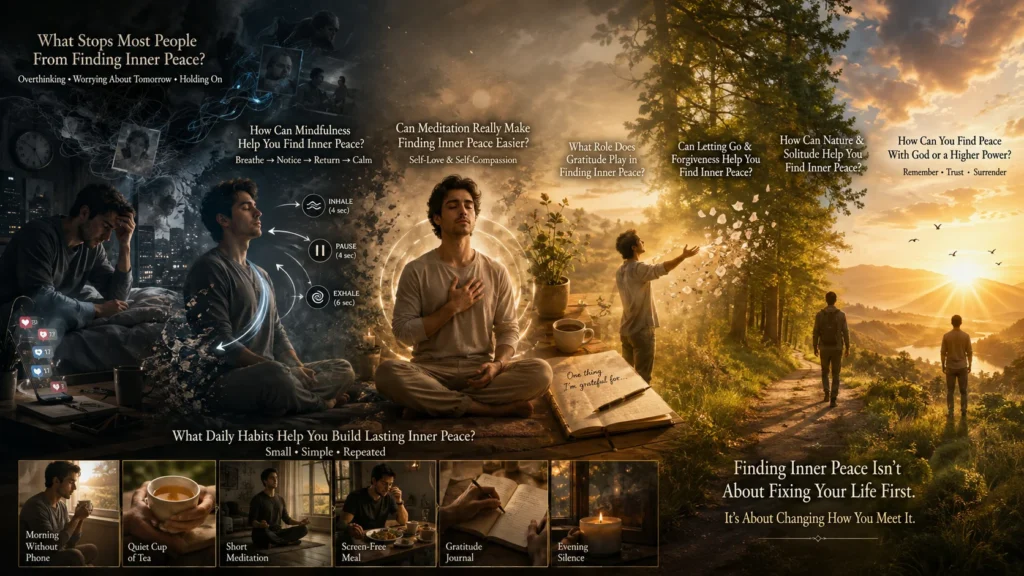
You don’t need a mountain retreat to feel calm. You need about ten honest minutes and the willingness to stop outrunning your own thoughts.
Finding inner peace isn’t one dramatic breakthrough. It’s a skill, built the same way you build a stronger body: small reps, repeated on purpose.
Life will still hand you traffic jams, hard conversations, and 2am worry spirals. Inner peace doesn’t remove those things. It changes how much power they have over you.
Finding inner peace means training your mind to stay steady when life doesn’t. It grows from small, repeated choices (how you breathe, what you forgive, where you put your attention), not one dramatic realization. Anyone can start building it today, in about 10 minutes.
What does finding inner peace really mean?
Inner peace isn’t the absence of problems. It’s staying regulated while you’re inside one.
Two people can miss the same flight. One spirals into blame and panic for an hour. The other takes a breath, rebooks, and gets on with the day. Same event, completely different inner state.
That gap between the event and your reaction is where inner peace lives. It’s not luck or personality. It’s a set of habits you can actually practice.
Why does finding inner peace matter for your daily life?
A calmer mind makes better decisions, sleeps better, and recovers faster from setbacks. That’s not a feel-good line, it’s how your nervous system actually works.
When you’re constantly reactive, your body stays in a low-grade stress state. Over time, that shows up as tight shoulders, shallow sleep, and snapping at people you love for no real reason.
Inner peace lowers that baseline. You still feel stress. You just don’t live inside it anymore.
What stops most people from finding inner peace?

Two things block it more than anything else: replaying the past and waiting on the future.
Overthinking every mistake
Your brain treats an embarrassing memory from three years ago like it’s happening right now. That’s why one awkward comment can hijack your whole evening.
The fix isn’t forcing yourself to “just stop thinking about it.” It’s giving your mind something specific to do instead, which is exactly what mindfulness practice trains.
Waiting for the outside world to change first
“I’ll feel peaceful once I get the promotion, once the relationship settles, once the move is done.” That’s a trap. Peace tied to outside conditions never arrives, because there’s always a next condition waiting.
Real peace gets built while the outside world is still messy, not after it’s fixed.
How can mindfulness help you find inner peace?
Mindfulness works because it changes your body’s chemistry, not just your mood. Regular practice measurably lowers your stress response.
Researchers at Harvard Medical School have found that meditation can reduce heart rate, triglycerides, and cortisol, all physiological markers of stress. That’s not a mood boost, that’s your body’s actual stress hormone dropping.
A separate study from the University of California, Davis found something even more direct: focusing on the present moment, rather than letting the mind drift, was linked to lower levels of the stress hormone cortisol. The more mindful someone scored on a standard questionnaire, the lower their resting cortisol.
You don’t need an hour on a cushion. Five focused minutes of noticing your breath, without trying to change it, is enough to start.
Can meditation really make finding inner peace easier?
Yes, and the effect builds the longer you stick with it. Meditation isn’t about emptying your mind, it’s about training attention.
Every time your thoughts wander and you gently bring them back, that’s a rep, like a bicep curl for focus. Over weeks, that rep gets easier and faster.
Start with a simple pattern: breathe in for four counts, hold for four, out for six. That longer exhale activates your parasympathetic nervous system, the part of your body responsible for calming down after stress.
How does self-love and self-compassion support inner peace?
Self-compassion isn’t self-indulgence. It’s one of the strongest predictors of a calm, stable mind that researchers have found.
Psychologist Kristin Neff, who pioneered self-compassion research, points to a large-scale analysis across 20 studies that found a strong link between higher self-compassion and lower anxiety, depression, and stress. People who talk to themselves kindly after a mistake recover faster than people who punish themselves for it.
That’s the whole difference between self-love as a slogan and self-love as a practice. If mornings feel like your hardest hour, VerseSoul’s self-love meditation guide walks through a short, doable reset you can use before your day even starts.
What role does gratitude play in finding inner peace?
Gratitude isn’t about pretending everything’s fine. It’s a specific mental exercise that measurably shifts your mood.
In one of the most cited studies in positive psychology, researchers Robert Emmons and Michael McCullough found that people who kept weekly gratitude journals exercised more, reported fewer physical symptoms, felt better about their lives overall, and were more optimistic about the week ahead, compared to people who logged daily hassles instead.
Try this tonight: write down one specific thing, not “my family,” but “the way my sister laughed at my bad joke today.” Specific beats general every time.
Can letting go and forgiveness help you find inner peace?
Holding a grudge keeps your body in the same stress state as the original hurt, on repeat, for free. Letting go isn’t saying it was okay. It’s refusing to keep paying for it.
This is where faith often does what willpower can’t. The Quran offers a simple promise in Surah Ash-Sharh: with every hardship comes ease (94:5-6), a reminder that difficulty is never the whole story.
Forgiveness works the same way whether or not it’s aimed at someone else. Sometimes the person you’re struggling to forgive is yourself. VerseSoul’s prayer for inner peace guide has a short prayer built exactly for that moment, when anxiety takes over and you need calm right now.
How can nature and solitude help you find inner peace?
A walk outside does more for a racing mind than most people expect, and there’s brain-scan evidence to back it up.
Stanford researchers had participants take a 90-minute walk, either through a natural setting or along a busy street. The results were striking: neural activity in the subgenual prefrontal cortex, a brain region active during rumination, decreased among participants who walked in nature versus those who walked in an urban environment. Less rumination means less of that looping, negative self-talk.
You don’t need a forest. A park, a quiet trail, or even a tree-lined street works. Some of the calmest headspace comes from traveling alone, too. VerseSoul’s solo travel guide to Iceland gets into what it’s like to stand somewhere completely silent, with nothing but your own thoughts for company.
How can you find peace with God or a higher power?
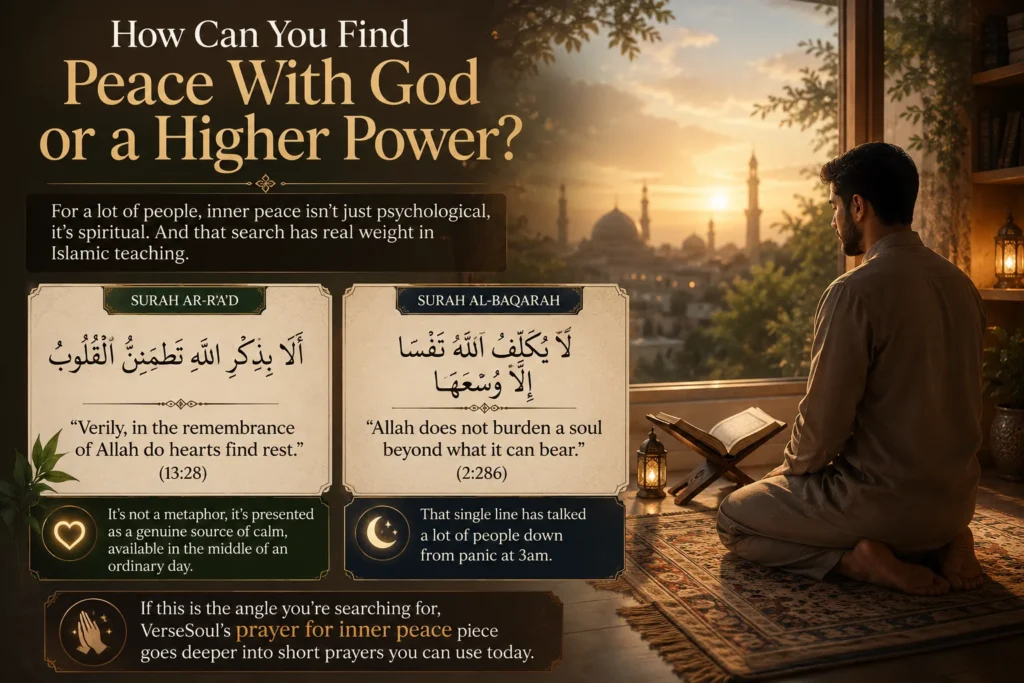
For a lot of people, inner peace isn’t just psychological, it’s spiritual. And that search has real weight in Islamic teaching.
The Quran speaks directly to this in Surah Ar-Ra’d: hearts find rest in the remembrance of Allah (13:28). It’s not a metaphor, it’s presented as a genuine source of calm, available in the middle of an ordinary day.
Surah Al-Baqarah adds something practical too: Allah does not burden a soul beyond what it can bear (2:286). That single line has talked a lot of people down from panic at 3am. If this is the angle you’re searching for, VerseSoul’s prayer for inner peace piece goes deeper into short prayers you can use today.
What daily habits help you build lasting inner peace?
Small, boring, repeated habits beat one big lifestyle overhaul every time.
A few that actually hold up: ten quiet minutes before you touch your phone in the morning, one meal a day eaten without a screen, a single line of gratitude before bed. None of these are impressive. That’s the point.
Silence matters more than people give it credit for too. Sitting in stillness, even for a few minutes without music or scrolling, gives your nervous system a real chance to settle instead of staying switched on all day. If prose isn’t your thing, a few lines of verse can land faster than an hour of advice. VerseSoul’s spiritual poem “The Soul Is a Light” sits with exactly that kind of quiet.
Deep listening helps too, not just to others, but to what’s actually going on underneath your own reaction. Urdu poetry has always known how to hold that kind of silence. “Silent Nights and the Soul’s Whisper” is built entirely around what the heart says when the noise finally stops.
How long does it really take to find inner peace?
Longer than the “21 days” myth promises, and that’s actually good news.
The 21-day idea comes from a 1960s plastic surgery book, not real behavior research. The actual data, from a University College London study led by Phillippa Lally, found that a new habit reached its automatic plateau after an average of 66 days, with real range from 18 to 254 days depending on the person and the habit.
So if you’re on day 12 and it still feels like work, that’s not failure. That’s exactly on schedule.
FAQ’s:
Can you find inner peace without religion?
Yes. Mindfulness, gratitude, self-compassion, and time in nature all show measurable calming effects on their own, no faith required. Many people also combine both, using prayer alongside these practices.
How do I stop overthinking and find peace of mind?
Give your mind a specific task instead of trying to force it blank. A slow four-count breath, a short walk, or writing the worry down on paper all interrupt the loop better than willpower alone.
Is it normal to lose your sense of inner peace during stressful periods?
Completely normal. Inner peace isn’t a permanent state you reach once. It’s a skill you rebuild after every rough patch, and rebuilding gets faster the more you practice it.
Does journaling actually help you find inner peace?
Yes, particularly gratitude journaling. Research from UC Davis found people who kept a weekly gratitude journal reported better mood, better sleep, and more optimism than those who didn’t.
Can you find peace with God even if your faith feels shaky right now?
Yes. Doubt and searching are part of most people’s spiritual journeys, not a disqualification from it. Short, honest prayer often works better in shaky moments than waiting to feel certain first.
How fast can someone actually start feeling calmer?
Often within the same day. A slow breathing exercise or a five-minute walk can lower stress in minutes. Lasting inner peace takes longer to build, but the first small relief can happen almost immediately.
Final thoughts
Finding inner peace isn’t about fixing your life first. It’s about changing how you meet it, one small, repeated choice at a time.
Start with one thing from this guide today. Not all of them. One.
The calm you’re looking for isn’t somewhere else. It’s built right here, in the ordinary minutes you’re already living through.