

You already tried the self-love thing alone. A journal, some affirmations taped to your mirror, maybe a bath.
It worked for about four days.
Self-love isn’t fake. Doing it solo, with no one checking in on you, just happens to be one of the hardest habits to keep. A self love club fixes exactly that gap.
Direct answer: A self love club is a small, regular group of people, in person or online, who meet to practice self-acceptance together through journaling, affirmations, and honest check-ins. It works because accountability and shared struggle make self-love easier to sustain than trying it alone.
What is a self love club?
A self love club is a group of people who meet on purpose to build self-worth together, instead of alone in a bedroom at midnight.
It runs more like a book club than a crisis support group, except the book happens to be your own head.
Most self love clubs follow a simple loop: check in, share one honest thing, do a short activity like journaling or affirmations, then close with one small commitment for the week. Some meet weekly over coffee. Others live entirely online, in a Discord server or a subreddit like r/SelfCompassion or r/selfesteem, where members post daily wins and rough days without judgment.
The name is new. The idea isn’t. Women’s circles, church small groups, and grief support groups have used this same format for decades: same time, same people, same honest space, repeated until it becomes a habit instead of an event.
Why does self-love work better with a group than alone?
Loneliness makes self-criticism louder. A group makes it quieter.
Here’s the research, kept short. The U.S. Surgeon General’s 2023 advisory on loneliness found that roughly 1 in 2 American adults report feeling lonely, and the health impact of chronic loneliness is comparable to smoking 15 cigarettes a day. A 2010 meta-analysis led by psychologist Julianne Holt-Lunstad reviewed 148 studies with over 300,000 participants and found that people with stronger social relationships had a 50% greater likelihood of survival. The authors compared that effect to well-known risk factors like smoking.
Self-compassion researcher Kristin Neff has spent over a decade studying why this matters for self-love specifically. Her model of self-compassion has three parts: self-kindness, mindfulness, and something she calls “common humanity,” the realization that you’re not the only one who struggles. That third piece is nearly impossible to build sitting alone with a journal. It needs other people in the room, actually saying “me too.”
If you are new to the idea, start with the self love meaning and these 15 real ways to practice self-love, then bring a group into it once the basics feel familiar. The habit sticks better once someone else is doing it alongside you.
Who should join a self love club and why?
Anyone rebuilding confidence after a hard stretch, whether that’s a breakup, burnout, or just moving somewhere new.
People coming back from travelling alone often feel this gap hardest. If you’ve read our solo travel Portugal guide and just landed home from a trip by yourself, you know that quiet letdown of having no one to unpack the day with. A self love club fills exactly that space, on a weekly basis instead of a one-time trip.
Students, new parents, people managing anxiety, and anyone who’s tired of journaling into a void all tend to get the most out of joining one. The common thread isn’t a diagnosis. It’s simply wanting company while doing the work.
What actually happens inside a self love club?
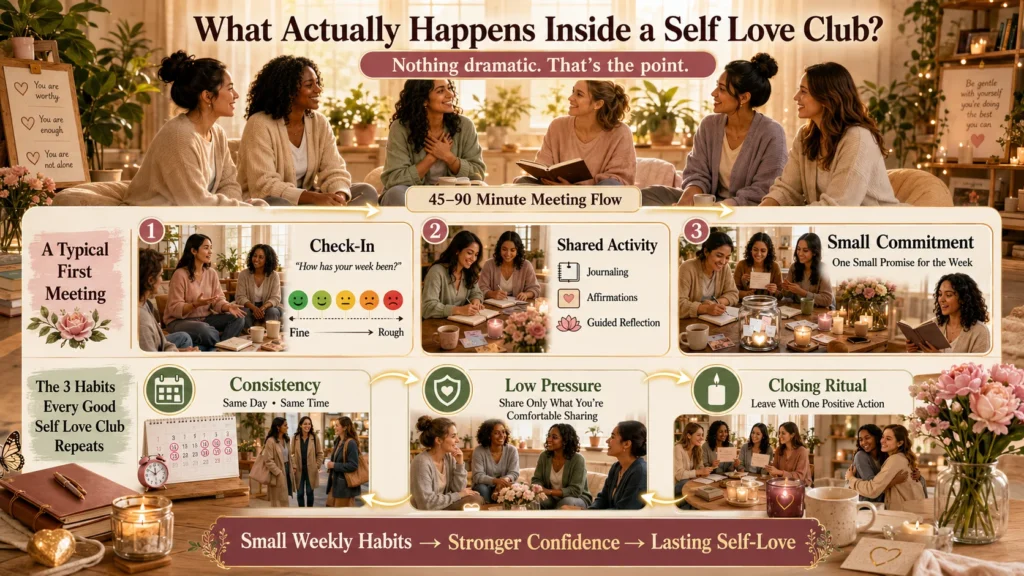
Nothing dramatic. That’s the point.
A real self love club meeting usually runs 45 to 90 minutes and follows the same three moves every time: a check-in, a shared activity, and a small commitment.
A typical first meeting
Most groups open with a round where everyone answers one low-stakes question, like how their week’s been on a scale of “fine” to “rough.” Everyone just listens. Nobody offers unsolicited advice or tries to fix anyone.
Then comes the main activity, usually journaling, an affirmation exercise, or a guided reflection. If you want a gentle starting point before your first session, these self-love journal prompts for beginners work well as homework between meetings.
Some clubs close the night by reading something aloud, a quote or a short poem. English readers often reach for these English poems on courage and mercy, while Urdu-speaking members lean toward this Roman Urdu poetry on hope. Either way, it gives the group something to sit with after the talking stops.
The 3 habits every good self love club repeats
Every self love club that lasts more than a month tends to repeat three habits: consistency (same day, same time), low pressure (no one has to share more than they want), and a closing ritual that gives people something concrete to walk away with.
Drop any one of those three and the group quietly dissolves within a few weeks. The same pattern keeps AA meetings, book clubs, and running groups alive long after the initial excitement fades.
How does a self love club improve emotional well-being over time?
It works slowly, the same way exercise or sleep does. Small, repeated, and easy to underrate week to week.
The National Academies of Sciences estimates that 1 in 4 adults over 65 experience social isolation, which is linked to a higher risk of premature death, dementia and depression. A weekly group cuts directly against that risk, at any age, by guaranteeing at least one recurring point of real contact.
Members also report fewer spirals of negative self-talk over time, mostly because a group catches those spirals early. Saying “I keep telling myself I’m not good enough” out loud to four people who nod back tends to shrink the thought in a way that writing it in a private journal rarely does.
How can you start a self love club in 7 simple steps?
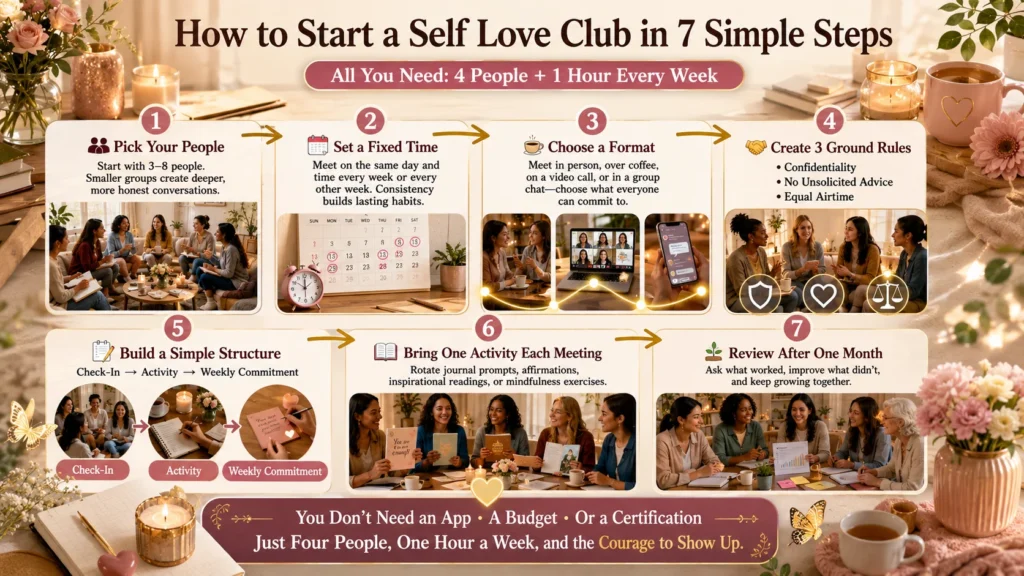
You need four people and one hour a week. That’s genuinely the entire barrier to entry.
- Pick your people. Start with 3 to 8 people. Smaller groups talk more honestly than big ones.
- Set a fixed time. Same day, same hour, every week or every other week. Irregular schedules kill self love clubs faster than anything else.
- Choose a format. In person over coffee, a video call, or a group chat, whatever your group will actually show up for.
- Write 3 ground rules. Confidentiality, no unsolicited advice, and equal airtime for everyone. Say them out loud in the first meeting.
- Build a simple structure. Check-in, activity, commitment. You don’t need to reinvent this every week.
- Bring one activity per meeting. Rotate whose turn it is to bring a journal prompt, an affirmation, or a short reading.
- Review after a month. Ask the group what’s working and what feels forced, then adjust from there.
You don’t need an app, a budget, or a certification to start.
Can an online self love club actually work?
Yes, and for a lot of people it works better than an in-person one.
Online self love clubs remove two of the biggest barriers: geography and the social anxiety of showing up in person to a room full of strangers. A Discord server, a WhatsApp group, or an active subreddit like r/SelfCompassion can create the same “me too” effect as a living room circle, just typed instead of spoken.
The tradeoff is real too. Text conversations miss tone, and it’s easy to lurk without ever actually participating. The fix is simple: pick one platform, set a light weekly prompt, and ask everyone to reply with at least one line, even on the days they don’t feel like writing much.
Is there a self love club app?
There is no single official self love club app. Most groups simply use tools they already know, such as WhatsApp, Discord, Zoom or Meetup.
Pick the one your members open every day, not the one with the most features. A group chat that people actually check beats a fancy app that nobody installs.
What is a self love club gift?
A self love club gift is something small a member gives to themselves or receives from the group, usually tied to a milestone rather than a special occasion.
Common examples include a journal, a candle, a self-compassion book, or a handwritten note from the group after someone shares something hard for the first time. The value sits in the timing, not the price tag, marking a moment where someone actually showed up for themselves.
Some clubs run a simple monthly ritual where each member writes one kind sentence to whoever’s turn it is. That single sentence, read out loud, tends to land harder than anything bought in a store.
What does self-love mean in slang?
In casual slang, “self-love” sometimes gets used loosely or as a euphemism, outside the wellness context this article is written in.
Inside a self love club, and everywhere on this page, self-love means something much simpler: self-respect, self-acceptance, and treating yourself the way you’d treat a friend having a hard week. That’s the definition worth building a habit around.
Where can you find a self love club near me?
Check what already exists locally before building your own from scratch.
Community centers, local libraries, and women’s circles often run free weekly groups already. Meetup and Facebook Groups list self-improvement and self-compassion circles by city. Reddit communities like r/SelfCompassion and r/selfesteem function as informal, always-on self love clubs with active daily members. If nothing local exists yet, that’s usually a sign to start one with 3 friends, not a sign that self-love clubs aren’t for your area. While your group forms, the healing guides on VerseSoul make a good solo warm-up.
What mistakes should every self love club avoid?
Two mistakes kill most self love clubs: turning into a complaint session, and letting one person’s crisis take over every meeting.
A self love club works best when it stays separate from clinical therapy. If someone’s going through something that needs real clinical support, the kindest thing the group can do is point them toward a therapist, rather than trying to fix it in 90 minutes over coffee. Keep the format light, keep it consistent, and protect the equal-airtime rule even when one person really wants to talk longer.
The other common failure is skipping meetings “just this once” until the group quietly stops existing. Self-love, like most habits, dies from neglect, not from one bad meeting.
FAQ’s:
Is a self love club worth joining?
Yes. The mix of accountability, shared honesty, and a fixed weekly commitment makes self-love habits stick far longer than practicing alone.
Can I start a self love club at school or work?
Yes. Many schools and workplaces already allow informal wellness or affinity groups to meet during lunch breaks or after hours, usually with no special approval needed for a small, casual circle.
Is a self love club suitable for teenagers and adults?
Yes, though the format should shift by age. Teens tend to do better with shorter, more structured meetings, while adults can handle longer, more open-ended conversations.
How often should a self love club meet?
Weekly or every other week works best. Meeting less often than monthly makes it too easy for the habit to fade.
How does a self love community improve confidence?
It works through Kristin Neff’s idea of common humanity: hearing other people admit the same insecurities you carry quietly makes those insecurities feel smaller and far less personal.
Is a self love club free to join?
Many are. Library, community centre and online peer groups usually cost nothing, and a group you start with friends costs only your time. Paid clubs and workshops exist too, so check the fee before you commit.
How many people do you need to start a self love club?
Three to eight people is enough. Smaller groups tend to share more honestly, and you can begin with just you and two friends.
Can a self love club replace therapy?
No. A self love club is peer support and habit building, not clinical care. If you are dealing with depression, trauma or thoughts of self-harm, please talk to a licensed professional or a local crisis line.
Is there a self love club app?
There is no single official app. Most clubs use tools they already know, like WhatsApp, Discord, Zoom or Meetup.
Final thoughts
A self love club won’t fix everything in one meeting, and it isn’t supposed to.
What it does is turn a habit that usually dies alone in a journal into something four or five people show up for, week after week. That consistency is the whole trick.
If you’re building your own self-love practice in the meantime, VerseSoul has more grounded writing on healing, poetry, and the quiet parts of getting better, one honest page at a time.