

You’re scrolling because your head is loud right now. Good news: it doesn’t stay that way. Below are 21 inner peace quotes that actually work, plus the science, the daily habits, and the mistakes that quietly wreck your calm.
Quick answer: Inner peace quotes work because they interrupt a spiraling thought with a short, specific one. Read one slowly, sit with it for ten seconds, and your nervous system gets a small, real reset. It’s not magic. It’s just a pattern interrupt that happens to rhyme.
What are inner peace quotes and why do people search for them?

People search “inner peace quotes” when their mind is too full to think straight. They’re not looking for poetry class. They want one line that makes the noise stop for a second.
Google’s own “people also search for” data backs this up. The top related searches are short inner peace quotes, deep inner peace quotes, inner peace quotes in English, peace quotes for Instagram, and nature peace quotes. That’s not academic curiosity. That’s someone at 11 PM, phone in hand, trying to feel less overwhelmed.
An inner peace quote is a short line, usually one to two sentences, that names a feeling of calm and gives you a way to reach it. It works the same way a good song lyric works. You don’t need the full backstory to feel something.
Why do inner peace quotes actually work on a stressed-out brain?
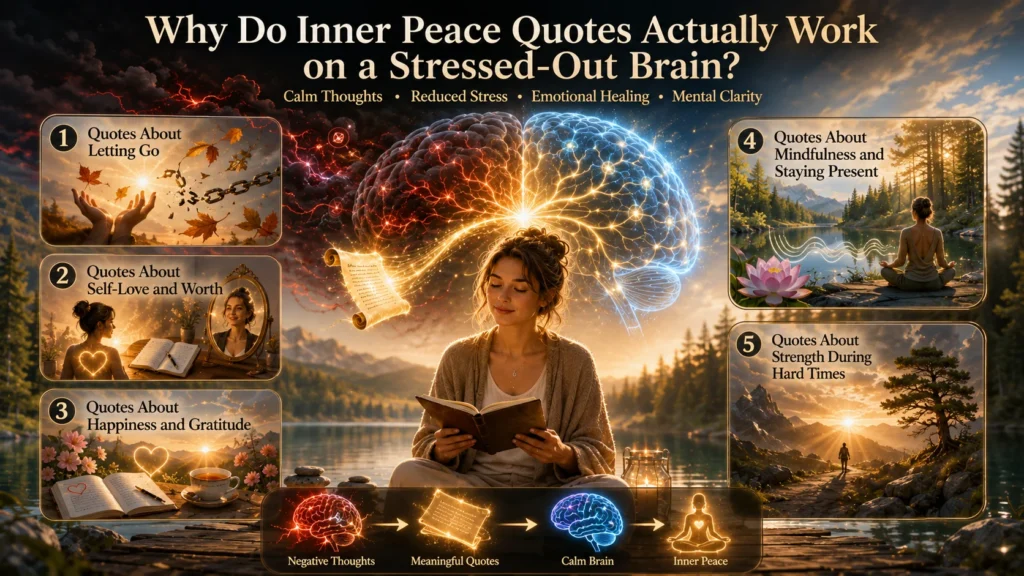
They work because reading a calming, affirming line activates the same brain regions involved in self-processing and reward. Your brain briefly treats the words as if you said them yourself.
A 2025 review by the American Psychological Association found that people who practiced short self-affirmations showed reduced neural activity in regions tied to threat processing, which lowered their measured stress response. The effect wasn’t a one-off either. Follow-up checks nearly two weeks later still showed lower anxiety and better mood.
Separate research out of the University of California found that a brief self-affirmation exercise improved problem-solving performance in people under chronic stress, even when they were tested under time pressure in front of an evaluator. So no, reading a good quote before a hard conversation isn’t superstition. It’s a small, measurable buffer.
Here’s the part worth knowing: the effect is strongest when the words are specific, not generic. “I am calm” barely moves the needle. “You have power over your mind, not outside events” gives your brain something concrete to hold onto.
21 powerful inner peace quotes for calm, clarity and quiet strength
Read these slowly. Pick one that actually matches how you feel today, not the one that sounds the most impressive.
Quotes about letting go
“You will not be punished for your anger, you will be punished by your anger.” – Buddha
“When I let go of what I am, I become what I might be.” – Lao Tzu
“The wound is the place where the light enters you.” – Rumi
“Letting go doesn’t mean giving up. It means realizing something is beyond your control.”
These four cover the same ground from different angles: anger, identity, pain, and control. If you’re stuck replaying an argument tonight, the first one is yours.
Quotes about self-love and worth
“No one can make you feel inferior without your consent.” – Eleanor Roosevelt
“You yourself, as much as anybody in the entire universe, deserve your love and affection.” – Buddha
“You can’t pour from an empty cup.”
“Self-care is not selfish. You cannot serve from an empty vessel.”
If self-love quotes are the piece you actually need right now, we’ve built out a full collection of self-love quotes for women with more lines and how to use each one without it feeling like a slogan.
Quotes about happiness and gratitude
“Very little is needed to make a happy life. It is all within yourself, in your way of thinking.” – Marcus Aurelius
“Happiness is not something ready made. It comes from your own actions.” – Dalai Lama
“Keep your face to the sunshine and you cannot see a shadow.” – Helen Keller
“Gratitude turns what we have into enough.”
Quotes about mindfulness and staying present
“Mindfulness means being awake. It means knowing what you are doing.” – Jon Kabat-Zinn
“The mind is everything. What you think, you become.” – Buddha
“Realize deeply that the present moment is all you ever have.” – Eckhart Tolle
“Wherever you are, be all there.”
If Urdu poetry is more your language for this feeling, there’s a quiet piece called Silent Nights and the Soul’s Whisper that says almost the same thing, just in a different tongue.
Quotes about strength during hard times
“You have power over your mind, not outside events. Realize this, and you will find strength.” – Marcus Aurelius
“It always seems impossible until it’s done.” – Nelson Mandela
“When we are no longer able to change a situation, we are challenged to change ourselves.” – Viktor Frankl
“Be like a tree and let the dead leaves drop.” – Rumi
“This too shall pass.”
There’s an English poem on this site called When the Soul Bleeds that sits in this exact space, written for the nights when a quote alone isn’t quite enough and you need something longer to sit with.
Is happiness really the same thing as peace of mind?
Not quite, and that’s actually good news. Happiness comes and goes with your circumstances. Peace of mind is steadier because it doesn’t depend on things going your way.
Think of happiness as weather and peace of mind as climate. You can have a genuinely bad day, lose your keys, get stuck in traffic, still feel a version of peace underneath it because you’re not fighting the moment. That’s why “happiness is peace of mind” shows up so often in searches. People sense the two are related but aren’t identical, and they’re right.
How can you use inner peace quotes every day without it feeling forced?
Use one quote as an anchor at a fixed point in your day, not as a random scroll-stop. Repetition at the same moment is what makes it stick.
Morning routine. Read one quote before you check your phone. Your brain is least defended in the first ten minutes after waking, which is exactly why doomscrolling first thing hits so hard, and why a calm line hits just as hard in the other direction.
Journaling. Write the quote at the top of the page, then write one honest sentence about why it landed or didn’t. This isn’t decoration. It’s the fastest way to notice which quotes are actually true for you right now.
Meditation. Use a short quote as your focus point instead of counting breaths. “This too shall pass” said slowly on an exhale does the same job as a mantra.
Saving for later. Screenshot the one or two that actually hit, not all 21. A folder of 40 unread quote screenshots helps nobody.
What daily habits build real inner peace, not just a good mood for an hour?

A quote gets you through a rough ten minutes. Habits are what keep the rough ten minutes from happening as often.
Gratitude, written down. In a well-known 2003 study, Robert Emmons and Michael McCullough had participants keep weekly gratitude journals for ten weeks. That group reported roughly 25% higher happiness levels, slept better, and exercised more than a group that journaled about daily hassles instead. Same ten weeks, same participants’ willingness, wildly different outcome.
Fewer notifications, not zero. You don’t need a digital detox retreat. Turning off notifications for two or three apps does most of the work.
Nature, even five minutes of it. A short walk without headphones resets attention faster than most people expect. If you’ve ever taken that reset further, whether that’s a weekend hike or a full trip alone through somewhere like our solo travel guide to Portugal, you already know how far that feeling can stretch. There’s something about navigating a new place with no one to answer to that strips a lot of the noise out of your head, and it’s a big reason solo travel keeps showing up as its own kind of therapy.
Honest relationships. The American Psychological Association’s 2025 Stress in America survey found that around half of adults reported feeling isolated, left out, or lacking companionship, and that group reported far higher stress overall. Peace of mind is rarely a solo project. It’s built with people who actually check in.
What mistakes quietly disturb your inner peace?
Most people don’t lose their calm to one big disaster. They lose it to small habits that add up.
Comparing your behind-the-scenes to someone else’s highlight reel is the biggest one, and social media makes it constant instead of occasional. Right behind it is over-scheduling every hour, which leaves zero room to actually feel what happened during the day. And bottling frustration until it explodes does more damage than saying the smaller, honest thing early.
None of these need a dramatic fix. Naming the pattern is usually 80% of solving it.
What do people get wrong about inner peace?
The biggest myth is that inner peace means feeling calm all the time. It doesn’t. It means you stop treating every uncomfortable feeling as an emergency.
Myth: peaceful people don’t get angry or anxious. Reality: they still feel those things fully. The difference is how long the feeling controls the next decision they make. A peaceful reaction to bad news can still include crying, swearing, or a rough hour. It just doesn’t turn into a rough week.
Myth: you need to meditate for an hour a day to feel any of this. Reality: the self-affirmation research mentioned earlier used sessions as short as a few minutes. Consistency beats duration almost every time.
Myth: reading quotes is a waste of time compared to “real” therapy or self-help. Reality: they’re not competing tools. A quote is a five-second reset you can use mid-meeting. Therapy is where you unpack why you needed the reset in the first place. Most people need both, not one instead of the other.
Myth: inner peace means avoiding conflict. Reality: it’s often the opposite. People with genuine peace of mind tend to say the honest, slightly uncomfortable thing sooner, because they’re not managing their own anxiety about the conversation on top of the actual issue.
FAQ’s:
Do inner peace quotes actually reduce stress, or is that just a placebo effect?
Both, and that’s fine. Self-affirmation research shows measurable drops in stress-related brain activity, but even if some of the benefit is expectation, a calmer nervous system is a calmer nervous system either way.
Is it okay to repeat the same quote every day?
Yes. Repetition is what turns a nice sentence into a real mental habit, the same way going to the gym once does nothing but going three times a week for a month changes you.
Do I need to believe a quote fully for it to help?
No. Neutral or slightly skeptical repetition still helps, according to research on affirmations. Belief tends to grow after the habit, not before it.
Can inner peace quotes replace therapy or medication for anxiety?
No. They’re a small daily tool, not a treatment. If anxiety is affecting your sleep, work, or relationships most days, that’s worth talking to a professional about.
What’s the difference between an inner peace quote and a regular motivational quote?
Motivational quotes usually push you toward action. Inner peace quotes usually pull you toward acceptance. Both have their place, but they’re solving different problems.
Final thoughts
You don’t need all 21 of these. You need the one that matched something you’re actually feeling today, and a small habit that keeps bringing you back to it. That’s really the whole point of a quiet corner like VerseSoul: one line, read slowly, on the day you needed it.
Pingback: Prayer for inner peace: how to find calm today