
Somewhere between checking your bank balance for the fifth time and Googling “is it weird to eat dinner alone” twice in one afternoon, you decide you’re doing this anyway.
That’s basically the entry ritual for solo travel in Europe. Millions of people go through it every year, then get on the plane anyway. The global solo travel market reached $482.5 billion in 2024, and it continues to grow. Europe lands near the top of nearly every “best places to go alone” list, and it earns that spot: dense train networks, walkable old towns, and a level of safety most nervous first-timers don’t expect until they’ve landed.
This guide covers what actually matters. Real costs, real safety numbers, the visa rule nobody explains clearly, and a first-timer route that people actually finish without burning out.
Solo travel in Europe is safe, doable on a modest budget, and easier to plan than most people think. Expect $30 to $120 a day depending on region, a 90-day visa-free limit inside the Schengen zone, and Portugal, Slovenia, and the Czech Republic among the friendliest starting points.
Is solo travel in Europe actually safe?
Yes, and by a wide margin compared to most of the world. Seven of the top 10 most peaceful countries on the 2025 Global Peace Index sit inside Europe, according to the Institute for Economics and Peace.
Iceland has topped the index for 17 straight years running, and its police don’t routinely carry firearms on patrol. Ireland, Austria, Switzerland, and Portugal round out Europe’s safest tier, all landing in the global top 10.
That doesn’t mean switch your brain off. Pickpocketing in tourist-heavy spots, think Barcelona’s Las Ramblas or Rome’s metro, is the actual risk, not violent crime. Keep your bag zipped in front of you, and you’ve handled most of it.
What’s the best time of year to travel solo in Europe?
Late April to June and September to October offer the best mix of good weather, thinner crowds, and lower prices.
July and August are peak season everywhere. Hostel prices spike, and cities like Venice and Dubrovnik get uncomfortably packed. Shoulder season fixes all of that at once.
If Scandinavia is on your list, June through August is really the only comfortable window, since Nordic winters test even seasoned travelers. Mediterranean spots like Greece and Portugal stay pleasant well into October.
How much does solo travel in Europe actually cost?
Budget for $30 to $50 a day in Eastern Europe, and $70 to $120 a day in Western Europe, more if you’re booking hotels instead of hostels.
Zurich topped Europe’s Backpacker Price Index in 2025 at nearly $164 a day for a bare-bones budget, while Budapest sat under $50 on the same index, according to Statista. That’s more than 3 times the cost for essentially the same style of trip.
One cost nobody warns you about: the single supplement. Hotels routinely charge more per person when a room is booked by one traveler rather than two, and it can quietly add $400 to $700 to a two-week trip if you’re not staying in hostels or private Airbnb rooms.
Mixing regions is the real budget hack. Splurge three days in Paris, then spend a week working through Prague, Budapest, and Kraków, and your average daily spend drops fast without the trip feeling cut short anywhere.
What is the Schengen 90/180 rule, and why does it actually matter?
You can spend 90 days inside the Schengen Area within any rolling 180-day period across all 29 member countries, not per country.
The clock starts on the day you first enter any Schengen country and doesn’t reset when you leave. It’s a rolling window, so a trip you took four months ago can still count against your total today.
As of April 2026, the EU’s new Entry/Exit System logs every crossing biometrically, so the old habit of hoping a border agent forgets to stamp your passport no longer works. Planning more than 90 days means arranging a long-stay visa, or building in time outside the zone, in places like the UK, Ireland, or the Balkans.
Which European countries are best for first-time solo travelers?
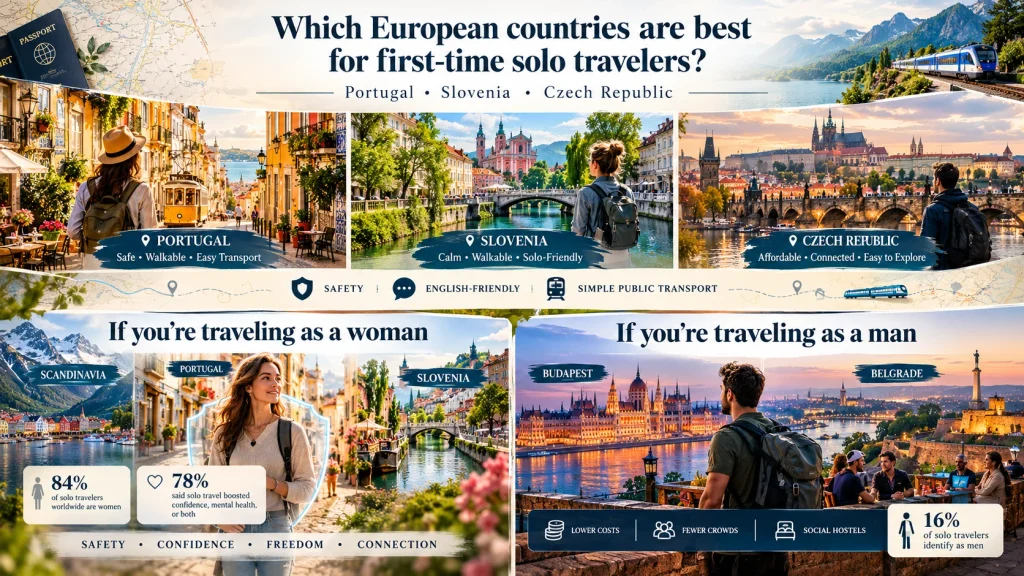
Portugal, Slovenia, and the Czech Republic consistently top the list for first-timers, thanks to low crime, widely spoken English, and simple public transport.
Portugal sits inside the world’s 10 safest countries on the 2025 Global Peace Index, and Lisbon’s compact old town means you rarely need public transport at all. Ljubljana, Slovenia’s capital, is small enough to walk end to end in 25 minutes and calm enough that solo dinners never feel awkward.
For a longer, country-specific breakdown, our guides to solo travel in Portugal and Italy cover exact routes, costs, and what to skip.
If you’re traveling as a woman
Scandinavia, Portugal, and Slovenia consistently rank as the most comfortable regions for solo female travelers, based on both safety data and traveler surveys.
Around 84% of solo travelers worldwide identify as women, so you’re not the outlier you might feel like at the departure gate. Hostelworld’s 2025 solo travel survey found 78% of solo travelers said the trip boosted their confidence, mental health, or both.
If you’re traveling as a man
Eastern Europe and the Balkans tend to get overlooked by solo male travelers, and that’s exactly why they’re worth it: lower costs, fewer crowds, and a stronger hostel social scene than the well-worn Western European circuit.
Just 16% of solo travelers identify as men, according to Condor Ferries’ 2025 data, which means online solo travel content focused on men is thinner than it should be. That gap works in your favor. Cities like Budapest and Belgrade run some of the strongest hostel social scenes in Europe, partly because fewer big tour groups pass through them.
How do you get around Europe without renting a car?
Trains. Europe’s rail network connects almost every major city, and an Interrail or Eurail pass often beats booking individual tickets once you’re covering more than four countries.
Budget airlines like Ryanair and Wizz Air undercut trains on price for longer hops, but they nickel-and-dime you with baggage fees and often fly from airports an hour from the city. For anything under 4 hours, the train usually wins once you count the airport transfer time.
Buses, FlixBus especially, fill the gaps trains don’t reach, particularly through the Balkans, and they’re usually the cheapest option on the board.
What should you actually pack for solo travel in Europe?
One 40L backpack, a crossbody bag for daily use, and a portable charger. That’s genuinely most of it.
Cobblestone streets and stairs-only metro stations in half of Europe’s old cities make rolling suitcases miserable. A backpack you can actually run to catch a train with matters more than people admit until they’re doing it at 6 AM in Lisbon.
Pack layers over separate outfits for each day. Weather swings hard between regions, and layering lets one bag handle Lisbon sun and Prague drizzle in the same week.
How do you meet people without booking a big group tour?
Stay in social hostels with common kitchens, book one free walking tour per city, and say yes to the first group dinner invite you get.
Hostelworld’s 2025 data found that 58% of solo travelers now rank meeting new people as a top priority, up sharply from 43% the year before. Solo travel and social travel aren’t really opposites anymore. They’re the same trip.
Not every evening needs company, though. Long train rides and solo dinners are where a lot of people do their best thinking, and putting some of it into words helps more than scrolling does. Our guide to journaling for emotional healing works just as well from a hostel bunk as it does at home.
What do experienced solo travelers actually wish they’d known sooner?
Budget more flexibility than money. A rigid itinerary causes more stress on a solo trip to Europe than a tight budget ever does.
Travelers who’ve done multi-month European trips tend to land on the same handful of lessons: build in a full rest day between destinations instead of moving every single day, keep a debit card and a credit card in separate places in case one gets blocked abroad, and double-check whether a destination actually sits inside the Schengen zone before building a route around it. Croatia, Romania, and Bulgaria only joined more recently, and travelers still mix this up.
The weight of your backpack matters more than the brand on it. Pack it, then walk around your block for 15 minutes before you fly. If your shoulders hate you after 15 minutes, they’ll hate you more on day 3 of the actual trip.
What’s a realistic solo Europe itinerary for beginners?
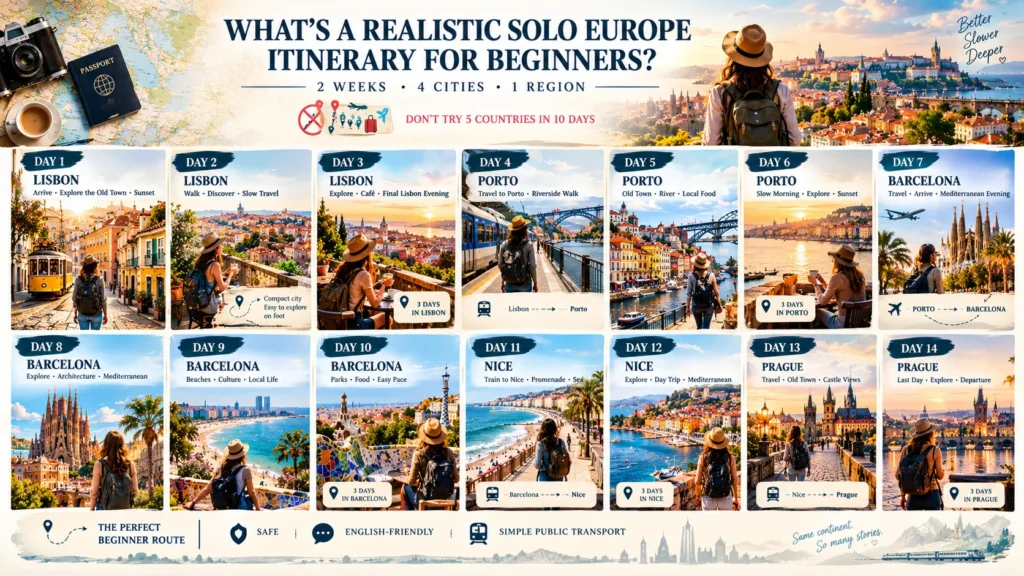
Two weeks, four cities, one region. Trying to cover five countries in 10 days is the single most common planning mistake first-timers make.
A workable beginner loop: 3 days in Lisbon, 3 days in Porto, a short flight or overnight train to Barcelona for 3 days, then 4 days working down the coast toward Nice. One region, one climate, minimal transit stress, and a route real people actually finish.
Once that trip feels comfortable, Central Europe (Prague, Vienna, Budapest, Kraków) makes a natural second loop, and it costs considerably less than the Iberia-to-French Riviera run.
What mistakes do most first-time solo travelers make in Europe?
Overpacking the itinerary, underpacking the backpack, and skipping travel insurance.
A full day of travel between cities eats more time than people budget for, once you count checkout, transit to the station, and checking into the next place. Two destinations a week is realistic. Four is how people end up seeing more airports than actual cities.
Travel insurance runs $50 to $100 a month on average and covers the one bad week that would otherwise wreck the trip financially, whether that’s a canceled flight, a stolen phone, or an unplanned ER visit.
Some of what you feel on a trip like this doesn’t fit into a packing list. Life’s Journey, a poem about time, pain, and faith, gets close to that quiet, in-between feeling, and its Urdu companion, Zindagi Ka Safar, says the same thing in a different rhythm.
FAQ’s:
Is Europe safe for solo female travelers?
Yes. Europe is statistically one of the safest regions in the world for solo female travelers, and 84% of solo travelers worldwide are women, so you’re traveling in good company. Stick to well-lit areas at night and the usual pickpocket precautions, and you’ve covered almost every real risk.
Can you travel Europe alone on $50 a day?
In Eastern Europe, yes, comfortably. Cities like Budapest, Kraków, and Belgrade let you eat well, sleep in a decent hostel, and get around on $30 to $50 a day. Western Europe usually needs closer to $70 to $120 a day for the same comfort level.
Do I need a visa for solo travel in Europe?
It depends on your passport. Travelers from the US, UK, Canada, and most of the EU can enter Schengen countries visa-free for up to 90 days within any 180-day period. Longer stays, or passports from certain countries, require a Schengen visa arranged in advance.
Is two weeks enough for a first solo trip to Europe?
Yes, if you keep it to one region. Two weeks covering four cities in one area, like Portugal into Spain, gives you enough time to actually enjoy each stop instead of mostly seeing airports and train platforms.
What is the safest country in Europe for solo travel?
Iceland has topped the Global Peace Index as the world’s safest country for 17 straight years running. Within continental Europe specifically, Ireland, Austria, Switzerland, and Portugal round out the safest tier.
Final thoughts
Solo travel in Europe isn’t the daring leap it gets built up to be. It’s mostly logistics: a decent backpack, a rough budget, and knowing the 90-day rule before you build your route.
The nerves before the flight are normal. Almost everyone who’s done this says the same thing: the hardest part is buying the ticket, not the trip itself.
For more travel guides, healing resources, and poetry that says what a packing list can’t, explore VerseSoul.