
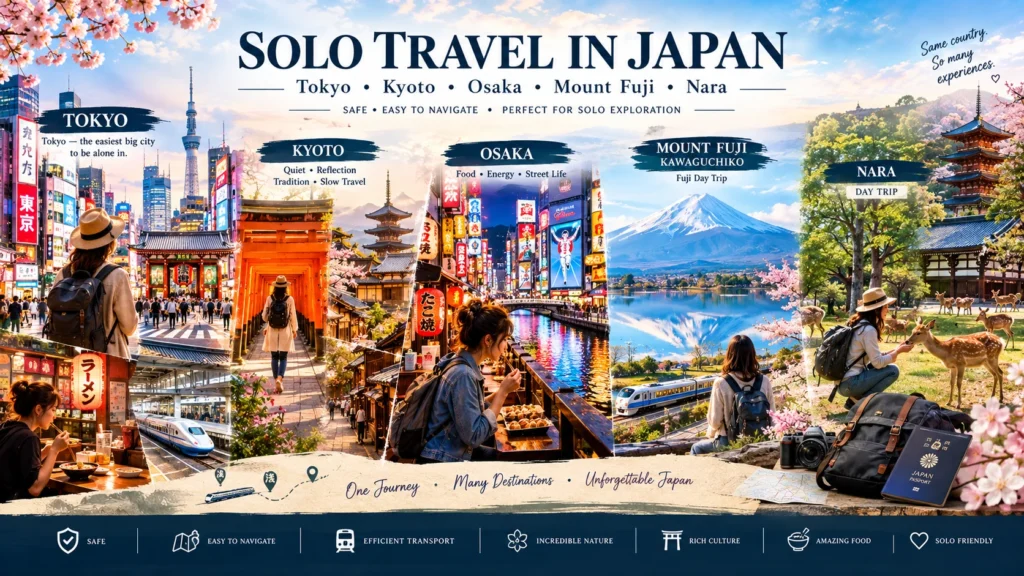
You can eat ramen alone at midnight in a Tokyo alley, and nobody will look at you twice. That’s how normal solo travel is in Japan.
Japan welcomed a record 42.7 million international visitors in 2025, up 15.8% from the year before, according to the Japan National Tourism Organization. A growing share of them came alone. The country’s clean stations, clear signage, and near-zero petty crime make it one of the easiest places on earth to figure out on your own, even if you’ve never traveled solo before.
Is Japan good for solo travel? Yes. Japan ranked 12th out of 163 countries on the 2025 Global Peace Index and 3rd in the Asia-Pacific region, with low crime, reliable trains, and widespread English signage in tourist areas, making it one of the most manageable destinations for a first solo international trip.
This guide covers where to go, what it costs, how to get around, and the parts nobody warns you about before you land at Narita.
Is solo travel in Japan a good idea?
Yes, and for most first-timers, it’s actually an easier solo trip than a trip to a big European city. Trains run on schedule, streets are clearly numbered, and staff at hotels and stations are used to helping confused tourists.
On the r/solotravel community, a common thread runs through nearly every Japan trip report: people expected culture shock. Instead, they found a country that’s simple to navigate once you download a translation app and a transit map. The most repeated piece of advice isn’t about safety. It’s about loneliness. Eating alone every meal for two weeks can wear on you, so most solo travelers mix in a hostel with a common room or a guided food tour every few days to talk to other humans.
That mix of independence and occasional company is honestly a good metaphor for solo travel generally. If you like reflecting on what changes in you when you’re on your own, our Luxury Solo Travel guide digs into that same feeling from a different angle.
Why is Japan one of the best countries for solo travel?
Japan combines low crime rates, an efficient train system, and a culture that doesn’t treat solo diners or travelers as unusual. That combination is genuinely rare.
Restaurants have solo counter seating built into their design. Convenience stores (konbini) sell fresh, decent food 24 hours a day, so you’re never stuck hunting for a place that will serve one person. And because Japan’s exchange rate has remained favorable for foreign visitors through 2025, at roughly ¥150 per US dollar, the country is noticeably cheaper for tourists than it was before 2019, even as local prices have risen.
There’s also something quietly reassuring about a place that doesn’t ask anything of you emotionally while you figure yourself out. If that idea resonates, the line “har tareeki ke baad ek deeda-war zaroor janam leta hai” from our Iqbal poetry on hope captures that same quiet certainty that things work out.
What are the best places for solo travel in Japan?
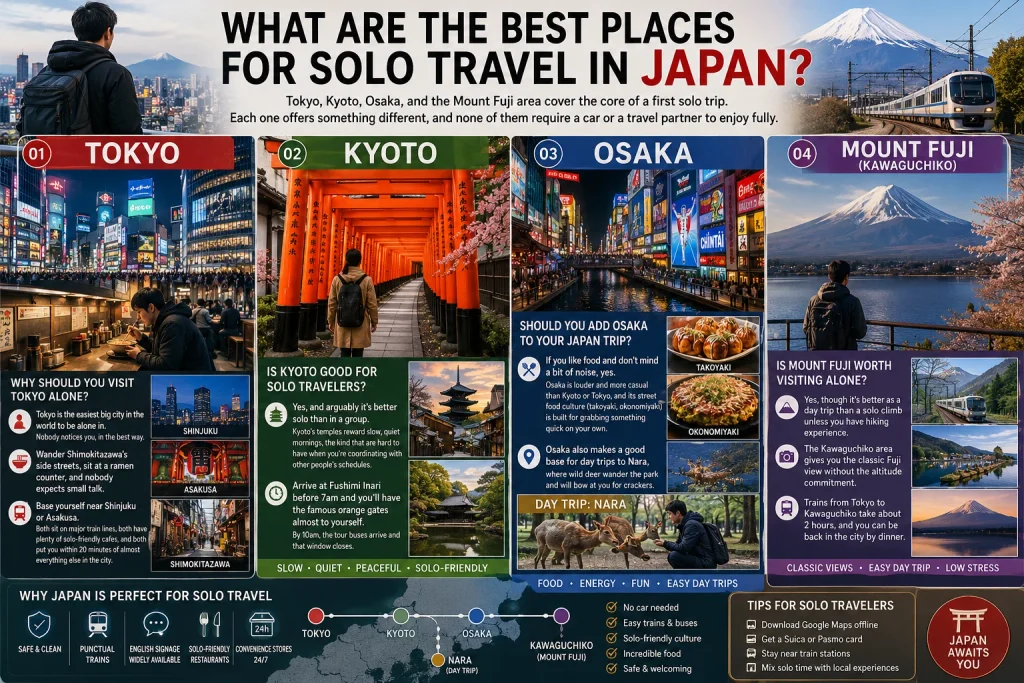
Tokyo, Kyoto, Osaka, and the Mount Fuji area cover the core of a first solo trip. Each one offers something different, and none of them require a car or a travel partner to enjoy fully.
Why should you visit Tokyo alone?
Tokyo is the easiest big city in the world to be alone in. Nobody notices you, in the best way. You can spend a whole day wandering Shimokitazawa’s side streets, sit at a ramen counter, and nobody expects small talk.
Base yourself near Shinjuku or Asakusa. Both sit on major train lines, both have plenty of solo-friendly cafes, and both put you within 20 minutes of almost everything else in the city.
Is Kyoto good for solo travelers?
Yes, and arguably it’s better solo than in a group. Kyoto’s temples reward slow, quiet mornings, the kind that are hard to have when you’re coordinating with other people’s schedules.
Arrive at Fushimi Inari before 7am and you’ll have the famous orange gates almost to yourself. By 10 am, the tour buses arrive, and that window closes.
Should you add Osaka to your Japan trip?
If you like food and don’t mind a bit of noise, yes. Osaka is louder and more casual than Kyoto or Tokyo, and its street food culture (takoyaki, okonomiyaki) is built for grabbing something quick on your own.
Osaka also makes a good base for day trips to Nara, where wild deer wander the park and will bow at you for crackers.
Is Mount Fuji worth visiting alone?
Yes, though it’s better as a day trip than a solo climb unless you have hiking experience. The Kawaguchiko area gives you the classic Fuji view without the altitude commitment.
Trains from Tokyo to Kawaguchiko take about 2 hours, and you can be back in the city by dinner.
When is the best time for solo travel in Japan?
Late March to early April (cherry blossoms) and October to November (autumn foliage) are the most beautiful windows, and also the busiest and priciest. If crowds bother you when you’re already navigating alone, avoid these two stretches.
June through August brings heavy heat and humidity, which is genuinely rough on a solo traveler carrying a backpack between stations. January and February are cold but quiet, with the cheapest flights and hotel rates of the year.
How much does solo travel in Japan cost?
A realistic mid-range solo budget runs about $110 a day, roughly $56 on accommodation, $27 on transport, $23 on food, and the rest on activities. A tighter backpacker budget can work on $45 to $65 a day.
Solo travel has one unavoidable cost penalty: hotel rooms don’t get cheaper because there’s one of you instead of two. Business hotel chains like Toyoko Inn and APA Hotel solve this well, running ¥8,000 to ¥12,000 a night for a small but spotless private room, which is the sweet spot for most solo travelers.
How can you save money while traveling alone in Japan?
Konbini meals (¥500 to ¥800) are genuinely good and quickly cut food costs. A basic ramen bowl runs about ¥1,000, and a single subway ride costs ¥170 to ¥320.
Skip the nationwide Japan Rail Pass unless you’re covering long distances between three or more cities. At ¥50,000 for 7 days (rising to ¥53,000 in October 2026), it only pays off if your route includes multiple Shinkansen legs, like Tokyo to Kyoto to Hiroshima and back.
How many days do you need in Japan alone?
Ten days is the minimum for a solo trip that doesn’t feel rushed: about 4 in Tokyo, 3 in Kyoto, 2 in Osaka, and 1 flexible day for Fuji or Nara. Two weeks lets you slow down and add a smaller town like Kanazawa or Nikko.
If you only have a week, stick to two cities. Trying to see five cities in seven days solo means spending your trip on trains instead of actually being anywhere.
Where should you stay when traveling solo in Japan?
Hostels with active common areas are the single best fix for loneliness while traveling solo in Japan. You’ll meet more people over one shared breakfast at a Tokyo hostel than in three days of solo sightseeing.
Business hotels are the better choice on nights you want privacy and a proper bathroom. Booking a mix of both across your trip, rather than committing to one style the whole time, tends to work best.
How do you get around Japan alone?
Japan’s train system is the most solo-friendly transit network in the world. Stations have English signage, ticket machines have an English toggle, and Google Maps transit directions are almost always accurate down to the minute.
Get a Suica or Pasmo IC card the moment you land. It works on nearly every subway, bus, and local train, and you never need to figure out fares in advance. Save the Japan Rail Pass decision for after you’ve mapped your actual route, since for many solo itineraries individual tickets end up cheaper.
What should you eat during solo travel in Japan?
Eat at counter-service restaurants; they’re built for solo diners and often cheaper than table-service spots. Ramen shops, standing sushi bars, and yakitori counters all expect you to walk in alone.
Depachika (department store basement food halls) are underrated for solo travelers. You can sample a dozen small dishes without committing to a full sit-down meal, and prices are clearly marked so there’s zero awkward menu guessing.
Is Japan safe for solo travelers?
Yes, Japan is consistently ranked among the world’s safest countries, placing 12th globally on the 2025 Global Peace Index with low violent crime and strict gun control. Solo travelers, including women, regularly report feeling safer walking alone at night in Tokyo than in most Western cities.
That said, “safe” doesn’t mean risk-free. Natural disasters like earthquakes and typhoons are real, and pickpocketing does happen in densely packed tourist areas like Dotonbori and Shibuya. Basic street awareness still applies.
Is Japan safe for solo female travelers?
Yes, Japan is regularly cited as one of the more comfortable countries for women traveling alone, thanks to low rates of violent crime and women-only train cars available during rush hour on many lines. Solo female travelers on Reddit’s travel forums consistently describe Japan as one of their easiest and least stressful destinations for solo travel.
Standard precautions still matter: avoid isolated areas late at night, keep your accommodation address saved offline, and let someone back home know your rough itinerary.
What should you know about Japanese culture and etiquette?
Bow slightly instead of shaking hands, remove your shoes before entering homes and many traditional restaurants, and never stick chopsticks upright in a rice bowl (it echoes a funeral ritual). Small gestures like these go a long way with locals.
Talking loudly on trains, especially phone calls, is one of the fastest ways to get side-eyed. Most train cars are noticeably quiet, and that quiet is part of what makes solo travel here feel so calm.
What should you pack for solo travel in Japan?
A portable WiFi device or eSIM sorted before you land, a portable phone charger, comfortable walking shoes, and cash. Japan is still more cash-reliant than people expect, especially outside major cities.
Pack layers regardless of season. Indoor heating and air conditioning run strong, so you’ll be adjusting your outfit between indoor and outdoor temperatures.
How can you plan the perfect solo itinerary in Japan?
Start with your must-see cities, then build in one buffer day per week for the things that always take longer than planned, like getting genuinely lost in a good way in a neighborhood you didn’t research. Book your first two nights of accommodation before you land, then leave the rest loose enough to follow what you actually feel like doing.
If solo travel becomes something you want to build into a longer habit, it’s worth spending a bit of time on why you’re drawn to going alone in the first place. Our piece on self love phrases that actually change how you feel is a decent place to start if solo trips keep pulling you back for reasons beyond sightseeing.
What are the biggest mistakes to avoid in Japan?
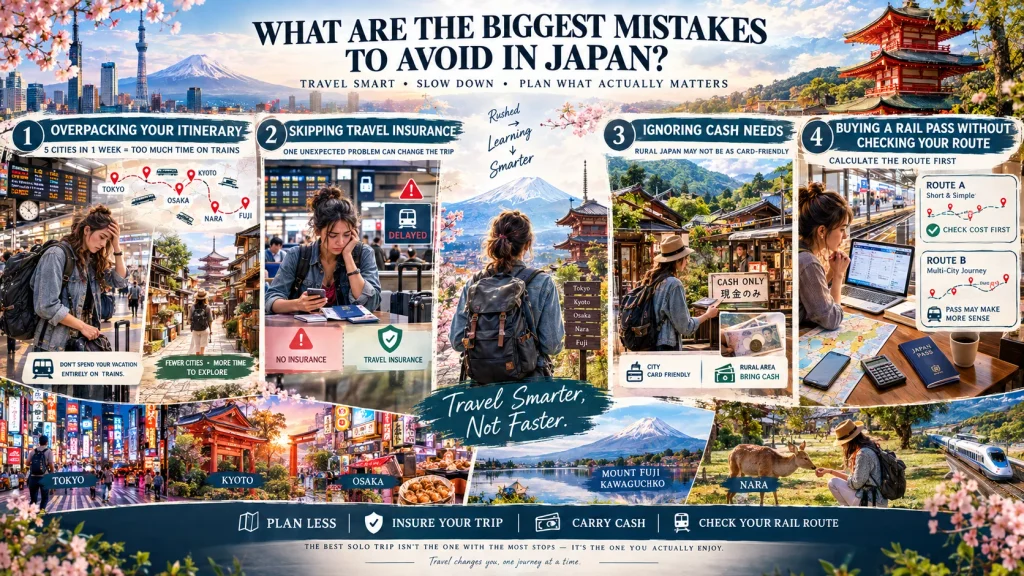
Overpacking your itinerary is the number one mistake. Trying to hit five cities in a week leaves you spending the trip on trains instead of in the places you traveled for.
Skipping travel insurance, ignoring cash needs in rural areas, and buying a Japan Rail Pass without checking if your route actually justifies the cost are the next three most common regrets solo travelers report after the fact.
Waqt ke sath jaise insan badalta hai, waise hi ek akela safar bhi aapko dheere dheere badal deta hai. Agar yeh khayal aapko pasand aaya, hamari waqt ke sath badalna shayari isi ehsaas ko lafzon mein samet-ti hai.
FAQ’s:
Is Japan good for solo travel?
Yes. Low crime, reliable trains, and widespread English signage make Japan one of the easiest countries for a first solo trip, whether you’re there for a week or a month.
Is Japan safe for solo female travellers?
Yes. Japan ranks among the world’s safer countries for women traveling alone, with low violent crime and women-only train cars during rush hour, though standard night-time precautions still apply.
Do I need to speak Japanese to travel solo in Japan?
No. Major cities and train stations have English signage and staff used to helping tourists, though learning a few basic phrases and using a translation app makes daily interactions smoother.
How many days should a first solo trip to Japan be?
Ten days is a solid minimum, giving you enough time for Tokyo, Kyoto, and Osaka without rushing between cities every other day.
What is the best area to stay for solo travelers in Tokyo?
Shinjuku and Asakusa are the top picks, both sitting on major train lines with easy access to the rest of the city and plenty of solo-friendly dining nearby.
Final thoughts
Japan doesn’t need to be your first solo trip, but it makes a strong case for being exactly that. Between the safety data, the transit system, and a culture that treats solo diners as completely normal, most of the hard parts of traveling alone are already solved for you before you even land.
Book loosely, stay in at least one hostel with a common room, and let the trains do the navigating. For more solo travel guides and reflections on going it alone, browse the rest of VerseSoul.