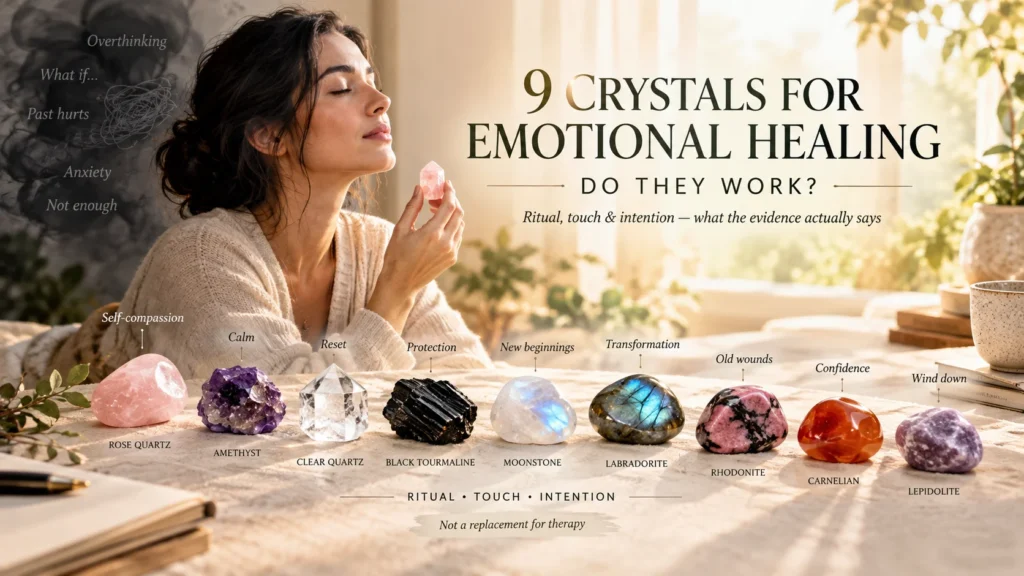
Most crystal healing claims fall apart the moment you run them through a real study. That’s not the whole story, though.
You’ve probably seen rose quartz sitting on someone’s desk, or a chunk of amethyst tucked next to a diffuser at a spa. Crystals for emotional healing have moved from niche spiritual shops into gift stores, wellness boxes, and half the self-care shelves on your feed. Millions of people use them. Almost none of that use is backed by anything a lab could measure. This guide covers what these stones actually are, which ones people reach for most, what research says about whether they help, and how to use one honestly and still useful.
Crystals for emotional healing are stones people hold, wear, or place nearby during meditation, journaling, or hard moments to support calm and reflection. No study has found the crystals themselves cause this. The ritual around them, especially with intention and touch, does have real psychological effects.
What are crystals for emotional healing and how are they used?
People use crystals for emotional healing in a few simple ways: holding one during meditation, wearing it as jewelry, placing it on a nightstand or desk, or gripping it during a hard conversation. Each stone gets assigned a different job: calm, confidence, letting go, based on tradition rather than testing.
The practice isn’t new. Ancient Egyptian burial sites included lapis lazuli and carnelian, and Greek soldiers reportedly carried hematite into battle for protection. Interest in it hasn’t faded either. A 2018 Pew Research Center survey found that 42% of Americans believe spiritual energy can be found in physical objects such as crystals, trees, or mountains.
That’s a big number for a practice with no proven mechanism. It says less about the crystals and more about how much people want a physical object to hold onto when things feel out of their hands.
Do crystals for emotional healing actually work, or is it the placebo effect?
Mostly placebo, and the research on this is fairly consistent. No peer-reviewed study has found that a crystal itself changes anxiety, mood, or stress beyond what a person’s own belief already does.
In 2001, psychologist Christopher French and colleagues at Goldsmiths, University of London, had people meditate while holding either a real quartz crystal or a fake one they believed was real. The reported effects- warmth, tingling, calm- showed up equally in both groups. The crystal wasn’t doing the work.
A more recent study published in CNS Spectrums in 2025 tested this directly for anxiety. 138 adults were divided into believers and non-believers, then randomly assigned to use either a rose quartz stone or a visually matched placebo stone daily for 14 days. Anxiety scores on the Beck Anxiety Inventory dropped, but only for people who already believed crystals worked, and the drop was no bigger than a typical placebo response.
The National Center for Complementary and Integrative Health (NCCIH), part of the NIH, groups crystal healing under energy therapies alongside Reiki and therapeutic touch: practices without an identified biological mechanism and without strong evidence they outperform placebo.
Why do people still feel calmer holding a crystal, even without a proven mechanism?
Because the calm is often real, even if the crystal isn’t the reason for it; what’s actually working is touch, focus, and a small, repeated moment of intention.
Ted Kaptchuk, a professor of medicine at Harvard Medical School who has spent decades studying placebo, has found that placebo responses can be genuine and measurable, sometimes even when people know they’re taking a placebo. Believing something will help changes how your body responds to it, and that’s not the same as being tricked.
There’s also a simpler mechanism at play: touch. Worry stones, smooth, thumb-sized stones rubbed between finger and thumb, trace back to ancient Greek and Tibetan practices. The repetitive motion pulls attention out of a spiraling thought and toward a physical sensation, the same principle behind grounding techniques used in trauma-informed therapy.
Self-compassion researcher Kristin Neff, at the University of Texas, has linked higher self-compassion to measurably lower anxiety, depression, and stress. Holding a crystal and pausing to set an intention is, functionally, a small self-compassion ritual. That’s likely doing more than the mineral content.
Which crystals for emotional healing are people using most?
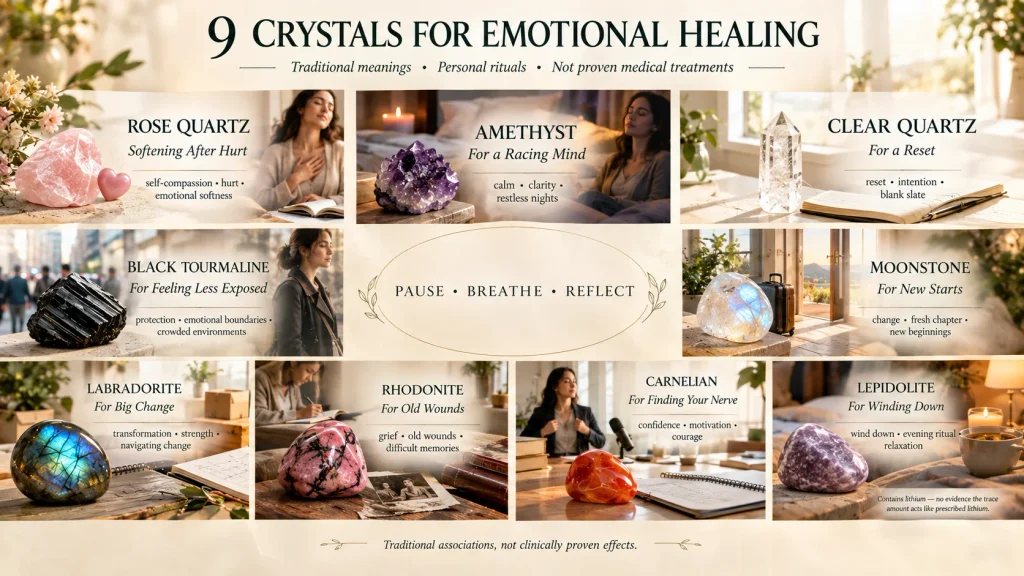
Rose quartz, amethyst, and clear quartz top the most-searched list, followed by black tourmaline, moonstone, labradorite, rhodonite, carnelian, and lepidolite. Each one carries a different traditional meaning. None of these meanings have been tested in a lab, so treat them as folklore worth knowing, not instructions.
Rose quartz, for softening after hurt
Traditionally linked to the heart and self-compassion. People often reach for it after a breakup, a falling out, or when they’re being unusually hard on themselves.
Amethyst, for a racing mind
Associated with calm and clarity. Common uses include keeping it by the bed for restless nights or holding it during a stressful commute.
Clear quartz, for a reset
Called a “master stone” in crystal circles, believed to amplify whatever intention you pair it with. People use it as a blank slate when they’re not sure what they need yet.
Black tourmaline, for feeling less exposed
Believed to absorb negative energy and offer protection. Often chosen by people who feel emotionally raw in crowded or high-stress environments.
Moonstone, for new starts
Tied to change and new beginnings. A common pick during a breakup, a move, or any moment that feels like a fresh chapter.
Labradorite, for steadying big change
Associated with strength through transformation. People often carry it during a job change, a diagnosis, or any period that feels destabilizing.
Rhodonite, for old wounds
Linked to healing from past trauma and grief. It’s a common choice for people actively working through a difficult childhood or a recent loss.
Carnelian, for finding your nerve
Associated with confidence and motivation. People use it before a hard conversation, an interview, or anything that requires showing up as yourself.
Lepidolite, for winding down
A lithium-bearing mica mineral, which is a real geological fact and part of why lepidolite is associated with calm in crystal folklore. There’s no evidence the trace lithium in the stone affects your body; that’s not the same as a prescribed dose. People still use it in the evening as part of a wind-down routine.
How do you actually use a crystal for emotional healing?
Keep it simple: hold the stone for five minutes of slow breathing, carry it in a pocket during a hard day, or place it somewhere you’ll actually see it, like a desk or nightstand.
The stone works best paired with something else you’re already doing. Hold it while journaling. Set it next to you during a short meditation. If anxiety is the main thing you’re managing, our guide on 15 natural remedies for anxiety and stress relief covers other daily habits with more research behind them, so you’re not relying on one tool alone.
A crystal isn’t a replacement for therapy, medication, or an actual conversation with someone you trust. It’s a small, physical prompt to pause. Treat it that way and it tends to hold up.
What if crystals for emotional healing aren’t for you?
That’s completely fine. The stone is just one possible prompt for pausing and feeling something on purpose. Words, movement, or distance from your work just as well for many people.
If a crystal isn’t your thing, a poem that names exactly what you’re feeling can land the same way. Time Changes a Person, and its Urdu companion, Waqt Ke Sath Badalna Shayari, both sit with that same slow, quiet kind of change crystals are often chosen for.
Distance works too. Some people process big feelings best by physically stepping outside their routine. Even a short solo trip, like this guide to traveling from Lima to Machu Picchu, can do what a whole shelf of crystals can’t: prove you can handle something new, alone, on your own terms.
How do you cleanse and care for your crystals?
Most people cleanse a crystal with Moonlight, a few minutes of running water, or the sound of a bell or a singing bowl. None of this is chemically necessary. It’s a reset ritual, much like relighting a candle or changing your sheets can feel like a fresh start.
One real caution: some stones, like selenite and halite, dissolve or flake in water. Check before you rinse anything you’d be upset to lose.
Can you use more than one crystal at once?
Yes. There’s no rule against pairing stones, and plenty of people combine two or three based on what they need that day, like rose quartz for the heart and amethyst for the mind. The only real limit is your own attention. Too many objects with too many jobs get confusing fast.
What should you keep in mind before buying crystals for emotional healing?
Sourcing is the part most guides skip. Crystal mining in places like Madagascar is largely artisanal and unregulated, and the US Department of Labor has flagged crystals, quartz, and tourmaline mined there as goods linked to child labor, with one 2019 study estimating over 10,000 children involved in related mica mining and sorting alone.
Ask where a shop sources its stones before you buy, the same way you’d ask about a coffee bean or a diamond. If a seller can’t answer, that’s worth noting.
And keep expectations honest. A crystal can be a nice object to hold during a hard moment. It’s not treatment for anxiety, depression, or trauma. If those symptoms are affecting your daily life, that’s worth bringing to a therapist, not a rock.
FAQ’s:
What are the best crystals for emotional healing?
Rose quartz, amethyst, and rhodonite come up most often for emotional support, based on both tradition and what people report in online crystal communities. None of them has clinical evidence behind it, so pick based on what genuinely draws you rather than what’s trending.
Which crystal is best for emotional peace?
Amethyst is the most common pick for emotional peace, since it’s traditionally linked to calm and clarity rather than a specific feeling like grief or confidence.
Can crystals help with stress and anxiety?
Not directly. Crystals haven’t been shown to reduce stress or anxiety beyond a placebo effect. The touch and pause involved in using one can still help as part of a wider routine that includes evidence-backed habits.
How should I use crystals for emotional healing?
Hold it during a few minutes of slow breathing, keep it somewhere you’ll see it daily, or carry it during moments you know will be hard. Consistency matters more than the exact method.
How do I cleanse my emotional healing crystals?
Moonlight, a quick rinse under running water, or a few minutes near a bell or singing bowl are the most common methods. Skip water on stones like selenite or halite, since they can dissolve or flake.
Can I sleep with crystals for emotional healing?
Yes, many people keep one on a nightstand or under a pillow, often lepidolite or amethyst, as part of a wind-down routine. There’s no safety issue with this, just personal preference.
Can I use several healing crystals together?
Yes. Pairing two or three stones based on what you need that day is common practice. Keep it simple enough that you can still remember why you picked each one.
How do I choose the right crystal for my emotions?
Start with what the feeling actually is. Grief, anxiety, and low confidence are traditionally paired with different stones, rhodonite, amethyst, and carnelian respectively, so match the stone to the specific thing you’re working through rather than picking at random.
What can you take from using crystals for emotional healing?
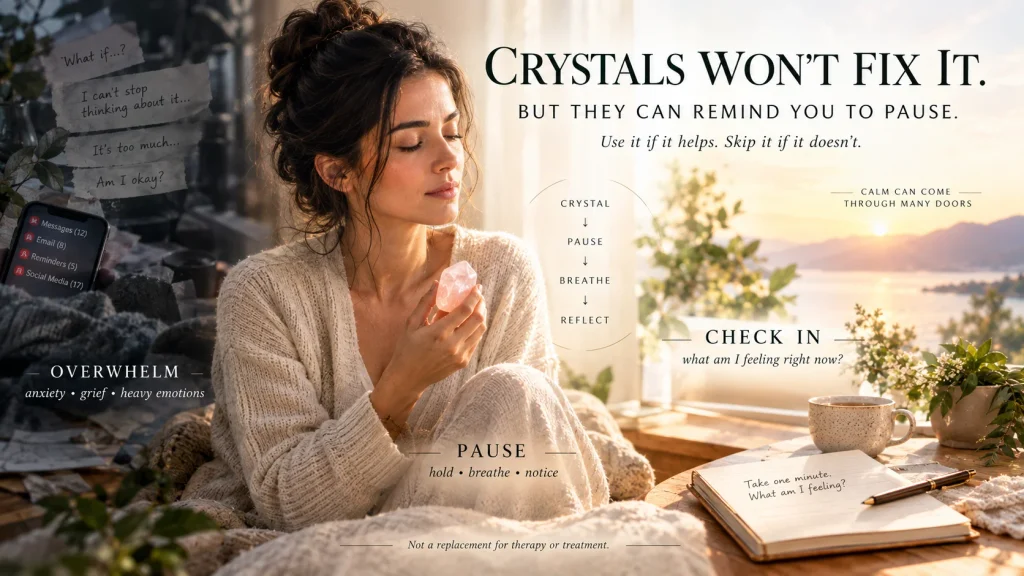
A crystal won’t fix anxiety or grief on its own, and no honest guide should tell you otherwise. What it can do is give you a small, physical reason to stop, breathe, and check in with yourself for a minute you might have otherwise skipped.
Use one if it helps. Skip it if it doesn’t. Either way, the calm you’re after is available through more doors than one small stone; explore more healing and wellness guides on VerseSoul, from grounding routines to finding inner peace when everything feels like too much.