
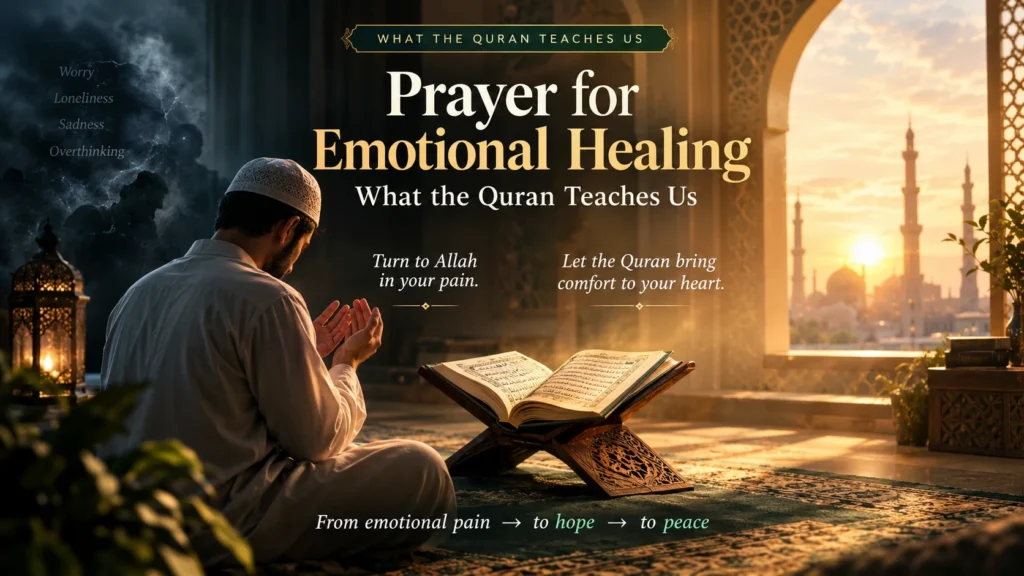
Your heart feels heavy, and you can’t quite explain why to the people around you. That’s usually the exact moment someone starts searching for a prayer for emotional healing.
Islam has never treated the heart as something you just have to survive on your own. The Quran describes itself as shifa, a cure, made specifically for the kind of pain sitting in your chest right now.
This guide walks through what the Quran actually says about healing the heart, real duas you can say today, and how prayer works alongside real-world support, not instead of it. You won’t find Bible references here, just what the Quran and the Sunnah teach about a hurting heart.
What Does Emotional Healing Mean in Islam?
Emotional healing in Islam means restoring calm to the qalb, the heart, through dhikr, sabr (patience), and honest dua. It doesn’t mean pretending the pain never happened.
Islamic scholars split heart sickness into two broad categories: physical and spiritual. Grief, betrayal, anxiety, and heartbreak all sit in the spiritual category, and the Quran was revealed to treat exactly that kind of illness.
Imam Al-Ghazali grouped these spiritual diseases into things like fear, envy, anger, and sorrow. The Quran doesn’t just name them. It offers a direct response to each one, and that response usually starts with turning back toward Allah instead of away from Him.
Which Quran Verses Talk About Healing the Heart?
Six verses in the Quran are known together as Ayat ash-Shifa, the verses of healing. Surah Yunus (10:57) is the most quoted of them, calling the Quran itself a cure for what troubles the heart.
Surah Ar-Ra’d (13:28) adds another piece: hearts find real rest through the remembrance of Allah, not through distraction or avoidance. Surah Al-Isra (17:82) describes the Quran as mercy and healing sent down specifically for believers, and Surah Fussilat (41:44) repeats nearly the same promise.
These aren’t vague comfort lines written to sound nice. Classical scholars like Ibn Kathir read Surah Yunus (10:57) as Allah’s direct promise that His words treat the heart the same way medicine treats the body, gradually, and only with consistent use.
Can Dua Really Help You Heal Emotionally?
Yes, research backs this up, though prayer tends to work best alongside real support rather than replacing it.
A systematic review published in BMC Psychiatry looked at dozens of long-term studies and found that regular religious practice, including prayer, was linked to lower rates of depression and anxiety in young people. Separately, researchers at Baylor University found that people who prayed to a God they trusted reported fewer anxiety symptoms than people who prayed without that same sense of security and closeness.
A study in the journal Psychiatric Services also found that prayer was the single most common coping method among people managing long-term mental health struggles, and the ones who stuck with it consistently over the years showed lower symptom levels. A separate review in Frontiers in Psychology found that the way people relate to God during prayer often mirrors how humans form secure attachments with each other, which may explain why it helps so many people feel steadier.
None of this replaces therapy or medication when you actually need them. Think of dua as the anchor, and professional care as the rest of the boat.
What Should You Say in a Prayer for Emotional Healing?
Keep it honest and simple. You don’t need formal Arabic or memorized lines for Allah to hear you.
“O Allah, You know what’s in my heart before I even say it. Heal what hurts inside me, replace this sadness with peace, and let this pain bring me closer to You, not further away.”
Say it in your own words if that feels more natural to you. Reciting Surah Yunus or Surah Ar-Ra’d right after adds the weight of the Quran’s own promise of shifa on top of whatever you’ve already said.
How Do You Pray When Your Heart Feels Broken?
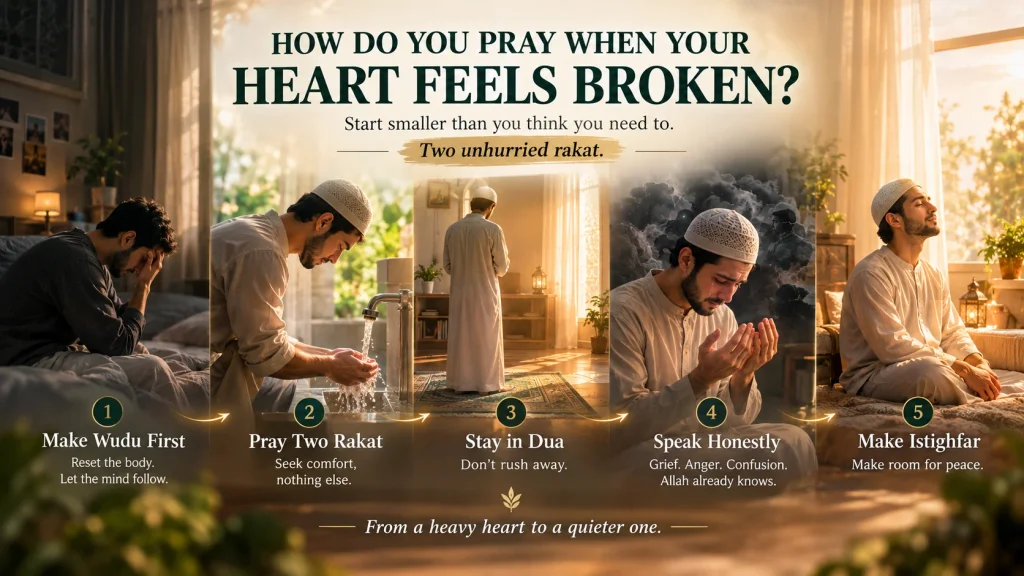
Start smaller than you think you need to. Two unhurried rakat usually help more than ten rushed ones.
- Make wudu first. It resets the body before the mind follows.
- Pray two rakat with the clear intention of seeking comfort, nothing else.
- Stay seated in dua afterward instead of rushing to stand up and move on.
- Say what you actually feel. Anger, confusion, and grief are all fair game here. Allah already knows.
- Add istighfar, asking forgiveness. It tends to clear space in a heart that feels too full to hold anything else.
What’s a Short Dua for Someone Else Who’s Hurting?
Praying for someone else’s healing counts as an act of worship in itself, not just a kind gesture on the side.
“O Allah, ease their heart, lift their distress, and grant them a peace that nothing else in this world can give them.”
The Prophet Muhammad ﷺ regularly made dua for companions who were grieving or afraid, and he encouraged the people around him to do the same for one another. A dua said quietly for a friend can matter just as much as one said out loud for yourself.
How Can You Ask Allah for Emotional Strength?
Ask directly, and don’t downplay what you’re asking for. Surah Al-Baqarah (2:286) reminds believers that Allah does not burden a soul with more than it can carry, which is worth repeating to yourself on the hardest days.
“O Allah, grant me the strength to carry what I cannot change, and the patience to wait for what You have already planned for me.”
Pair this with small, consistent actions. Praying on time, even on the days you really don’t feel like it, tends to rebuild inner strength faster than waiting around to feel motivated first.
Is It Normal to Still Feel Pain While You’re Healing?
Yes, and that doesn’t mean the healing isn’t working. Emotional healing rarely moves in a straight line, no matter how much we wish it did.
People often ask how they’ll know they’ve truly healed. The honest answer is that healing usually shows up as smaller waves spaced further apart, not one single moment where the pain disappears completely. Some days will still feel heavy even months into the process, and that’s part of sabr, not a sign that you’re doing something wrong.
If the pain stays constant, sleep and appetite are badly affected, or daily life feels genuinely impossible to manage, that’s worth bringing to a therapist or counselor alongside your prayers. VerseSoul’s guide on prayer for stress and anxiety walks through what that ongoing tension can look like and how to work through it day by day.
How Can You Make This a Daily Habit?
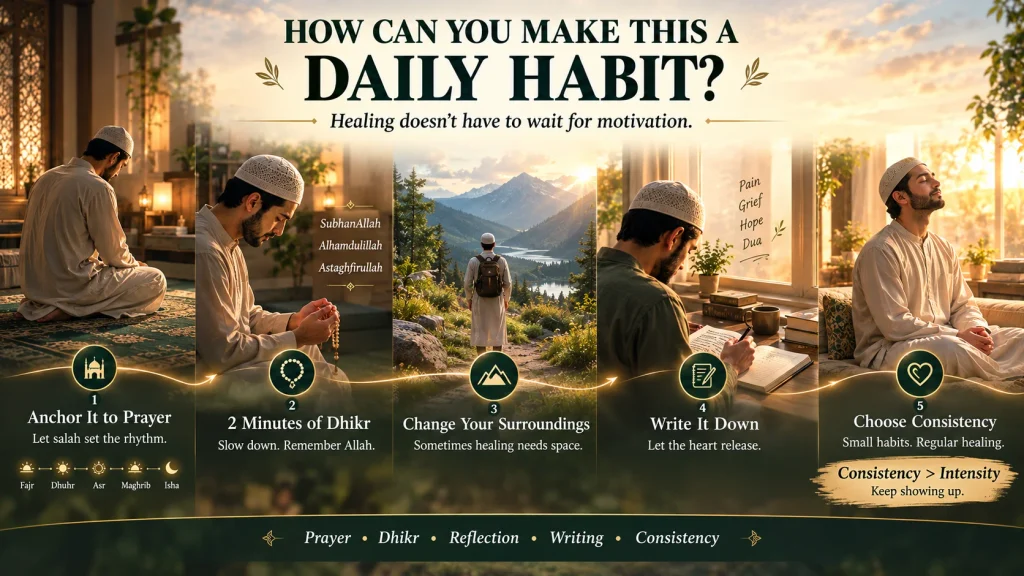
Anchor it to something you already do every day, like the five daily prayers, so healing doesn’t depend on motivation you might not have that day.
Add two minutes of dhikr after each prayer. Saying “SubhanAllah,” “Alhamdulillah,” and “Astaghfirullah” slowly, even just a few times, keeps the heart in regular contact with Allah instead of only reaching out during a crisis.
Sometimes the heart needs more than words, too. A change of scenery, even a short solo trip like the one covered in our Costa Rica solo travel guide, can give a tired mind room to actually breathe. Others process pain through writing instead. Our collection of English healing poetry and this Urdu Islamic poetry on dua and hidayat both sit with grief the same way prayer does, just in a different language.
Whatever combination works for you, keep showing up. Healing tends to respond better to consistency than to intensity.
FAQ’s:
What is the most powerful prayer for emotional healing in the Quran?
Surah Yunus (10:57) is usually considered the strongest, since it directly calls the Quran a cure for what’s troubling the heart. Surah Ar-Ra’d (13:28) is a close second, reminding you that hearts find rest specifically through the remembrance of Allah.
Can dua alone heal emotional pain, or do I need therapy too?
Dua genuinely supports healing, but it isn’t a substitute for professional help once pain becomes constant or starts affecting daily life. Prayer and therapy work well together, not against each other.
How long does emotional healing usually take?
There’s no fixed timeline for this. Research on grief and trauma recovery shows healing usually moves in waves over months, sometimes longer, rather than stopping on a set date.
What's a short dua I can say every day for emotional healing?
‘O Allah, heal what hurts inside me, and replace it with peace’ works well as a short daily line you can repeat quietly after any prayer.
Can I make dua for someone else's emotional healing?
Yes, and it’s actually encouraged. Praying for someone else’s healing while they’re not present with you is considered especially sincere in Islam.
Is it okay to pray for emotional healing in my own words instead of Arabic?
Yes. Sincerity matters more than the language you use, and Allah understands dua in any language you speak comfortably.
Final Thoughts
Emotional healing isn’t about erasing what hurt you. It’s about learning to carry it differently, with Allah, with sabr, and with the people around you who can genuinely help.
If today’s dua helped even a little, VerseSoul has more reflections on healing, poetry, and prayer waiting for you on the homepage.