

You can recite every self love quote you’ve ever read and still flinch at your own reflection. That gap between knowing you should love yourself and actually feeling it is exactly where self love meditation steps in.
Self love meditation is not another wellness trend you’ll forget by next month. It’s a short, repeatable practice that trains your mind to treat you the way it treats people you actually like. Give it 10 minutes and you’ll notice the difference in how you talk to yourself for the rest of the day.
Self love meditation is a focused practice, usually 5 to 20 minutes, that combines breathing, body awareness, and kind self-talk to reduce self-criticism and build a steadier sense of self-worth. It borrows heavily from loving-kindness meditation but points the warmth inward first.
What is self love meditation?
Self love meditation is the practice of sitting quietly and directing kindness toward yourself the same way you’d direct it toward a close friend. It usually pairs slow breathing with short phrases like “I am enough” or “I am allowed to rest.”
Most people come to it after burnout, a breakup, or just months of running on autopilot. It’s not about forcing positive thoughts. It’s about noticing the harsh ones and choosing not to believe every one of them.
Unlike general mindfulness, which just asks you to observe, self love meditation asks you to actively soften your inner voice. That distinction matters more than most guides admit.
What does self love actually mean before you meditate on it?
Self love meaning gets thrown around so often it’s lost its edge. At its core, it means treating your own needs, mistakes, and limits with the same patience you’d offer someone you cared about.
It’s not about bubble baths or telling yourself you’re perfect. Real self love includes setting a boundary you’re scared to set, or resting when you’d normally push through and call it laziness.
Meditation gives that definition somewhere to live. Reading about self love changes your opinions. Sitting with it, breath by breath, changes your habits.
How do beginners start a self love meditation practice?
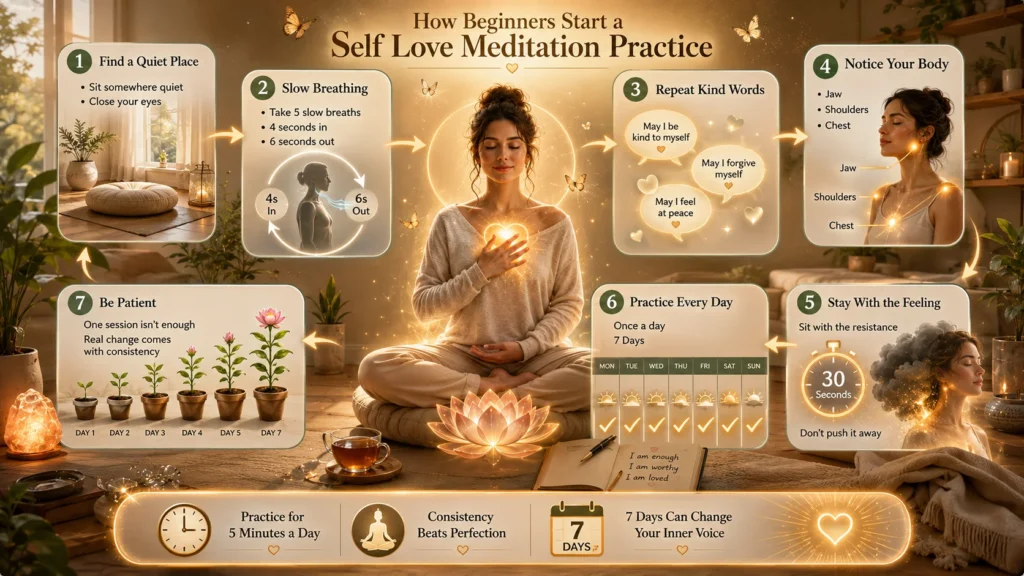
Start with 5 minutes, one hand on your chest, and permission to feel awkward. That awkwardness fades faster than most beginners expect, usually within the first week.
Here’s a simple starting sequence:
- Sit somewhere quiet and close your eyes.
- Take 5 slow breaths, counting 4 seconds in and 6 seconds out.
- Silently repeat: “May I be kind to myself. May I forgive myself. May I feel at peace.”
- Notice where the resistance shows up in your body, jaw, shoulders, chest.
- Sit with that resistance for 30 seconds instead of pushing it away.
Do this once a day for a week before judging whether it “works.” One session rarely moves the needle. Seven days almost always does.
If you want a gentler entry point first, these 15 real ways to practice self love pair well with the breathing work above.
What should a self love meditation script include?
A good script has four parts: a settling breath, a body check-in, kind phrases repeated slowly, and a soft close. Skip any part and the meditation feels rushed instead of restorative.
Here’s a short one you can read aloud or record yourself saying:
“Breathe in for four, out for six. Notice your shoulders drop. Say to yourself: I am doing the best I can with what I know right now. I don’t have to earn rest. I don’t have to earn kindness. Let that settle for three more breaths before you open your eyes.”
Keep your own script under 3 minutes when you’re starting out. Long scripts make beginners restless before the calming effect even kicks in.
Can a 5 minute self love meditation really work if you’re busy?
Yes, a 5 minute self love meditation genuinely helps, especially if you do it consistently instead of occasionally. Short sessions build the habit; the depth comes later once the habit sticks.
Five minutes is enough to lower your heart rate, interrupt a spiral of self-criticism, and reset your tone for the next hour. It won’t undo years of harsh self-talk in one sitting, but nothing does that in one sitting.
Set a timer, use one phrase, and stop apologizing for keeping it short. A regular 5-minute habit beats an occasional 30-minute one every time.
Is self love meditation good to do before sleep?
Yes, bedtime is one of the best times for it, since your body is already winding down and your mind is more open to gentler self-talk. Pair it with slow breathing and you’ll likely fall asleep faster too.
Try lying flat, hands resting on your stomach, and softening each part of your body from your feet up to your face. Add one kind phrase per body part instead of racing through the whole scan.
Skip your phone during this one. A guided recording is fine, but scrolling right after breaks the calm you just built.
Which self love meditation techniques actually work?
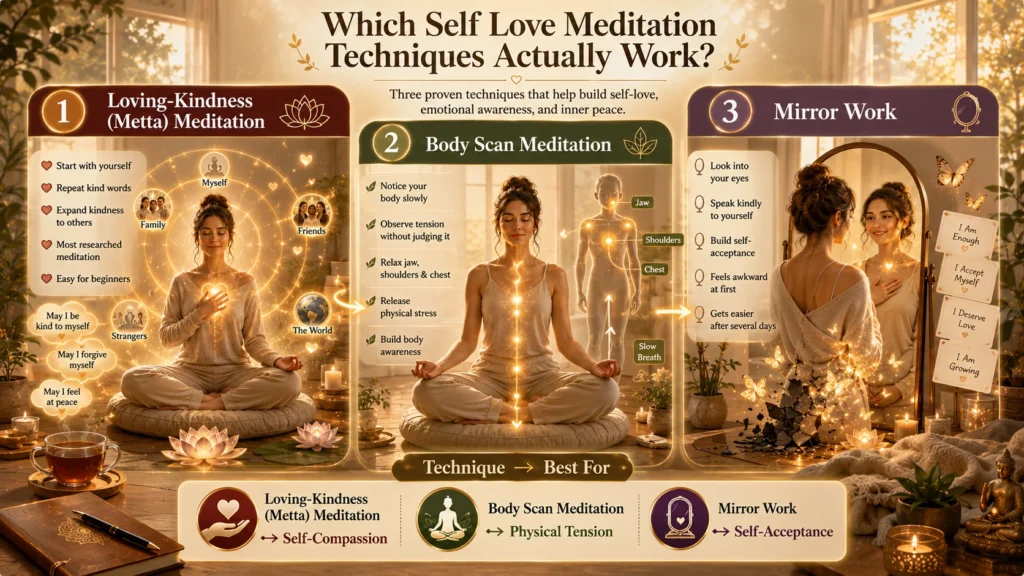
Loving-kindness meditation, body scans, and mirror work are the three techniques people stick with longest, based on what actual practitioners report in meditation communities online. Each targets a different kind of resistance.
Loving-kindness (metta) meditation repeats phrases of goodwill toward yourself first, then widens outward to others. It’s the most researched form and the easiest to learn from a guided audio.
Body scan meditation moves your attention slowly through your body, noticing tension without judging it. It works especially well if your self-criticism shows up as physical tightness rather than thoughts.
Mirror work means looking at your own reflection and saying something kind out loud. It feels strange the first few times. Most people report it stops feeling strange by day four or five.
Pairing any of these with writing afterward helps the shift stick. These self love journal prompts work well right after a meditation session, while the calm is still fresh.
What does science say about self love meditation?
The research on self-compassion and meditation is no longer thin. Multiple controlled studies now back what practitioners have said for years: this actually changes how you feel day to day.
A few findings worth knowing:
- Meditation use among US adults more than doubled between 2002 and 2022, rising from 7.5% to 17.3%, according to the National Health Interview Survey tracked by the NCCIH.
- A 2018 NCCIH-supported analysis covering more than 12,000 participants found mindfulness-based approaches worked as well as cognitive behavioral therapy and antidepressants for treating anxiety and depression.
- Kristin Neff and Christopher Germer’s randomized controlled trial of their Mindful Self-Compassion program found it significantly increased self-compassion, mindfulness, and life satisfaction, while lowering depressive symptoms, anxiety, and stress.
- A 2008 study by Barbara Fredrickson and colleagues found that employees who practiced loving-kindness meditation for 7 weeks showed measurable increases in daily positive emotions, which in turn built lasting personal resources like purpose and social connection.
- A 2020 NCCIH-supported review of adults using opioids for pain found meditation practices were strongly associated with reduced pain levels.
None of that means meditation replaces therapy when you need it. It means the practice has actual evidence behind it, not just good marketing.
What mistakes make people quit self love meditation early?
Most people quit because they expect to feel instantly better, then feel guilty when they don’t. That guilt convinces them the practice “isn’t working,” when really it just hasn’t had time yet.
A few other common mistakes:
- Trying to force positive thoughts instead of just noticing the negative ones without judgment.
- Meditating only on bad days, so the practice becomes tied to crisis instead of routine.
- Comparing their session to a polished 20-minute guided audio and feeling like they’re doing it wrong.
- Skipping the body check-in and going straight to affirmations, which usually feel hollow without it.
Consistency beats intensity here. A messy 3-minute session every day outperforms a perfect session once a month.
How can you turn self love meditation into a daily habit?
Attach it to something you already do without thinking, brushing your teeth, making coffee, or getting into bed. That’s the fastest way any new habit actually sticks.
Keep your first month low-pressure: same time, same short script, no pressure to feel a certain way afterward. After 30 days, you’ll likely notice you’re reaching for it on hard days without needing a reminder.
If mornings feel too rushed, some people find they think more clearly with distance and quiet, the same reason solo trips work so well for resetting your head. If that sounds like you, this guide to planning a solo escape pairs surprisingly well with a self love practice you can carry home with you.
FAQ’s:
Do you need an app for self love meditation?
No. Apps help with structure, but a quiet room and five slow breaths work just as well when you’re starting out.
Can self love meditation help with healing after heartbreak?
Yes. It won’t erase the pain, but it interrupts the self-blame loop that usually makes heartbreak drag on longer than it needs to.
Is loving-kindness meditation the same as self love meditation?
Not exactly. Loving-kindness meditation widens outward to others, while self love meditation stays focused inward first. Many people practice both together.
What if your mind keeps wandering during self love meditation?
That’s normal, not failure. Gently bring your attention back to your breath or your phrase every time it drifts, as many times as it takes.
How long before you feel a real difference?
Most people notice a shift in tone within 1 to 2 weeks of daily practice, though deeper changes in self-worth tend to build over a few months.
Final thoughts
Self love meditation won’t fix everything in one sitting, and anyone promising that is selling you something. What it does offer is a few honest minutes a day where you stop treating yourself like a project that needs fixing.
Start small, stay consistent, and let the rest follow. If you’re building a fuller self-love routine, these self love poems and this Urdu poem on quiet reflection both make gentle companions for the quiet minutes after you meditate. You can explore more grounded reflections like this over on VerseSoul.