
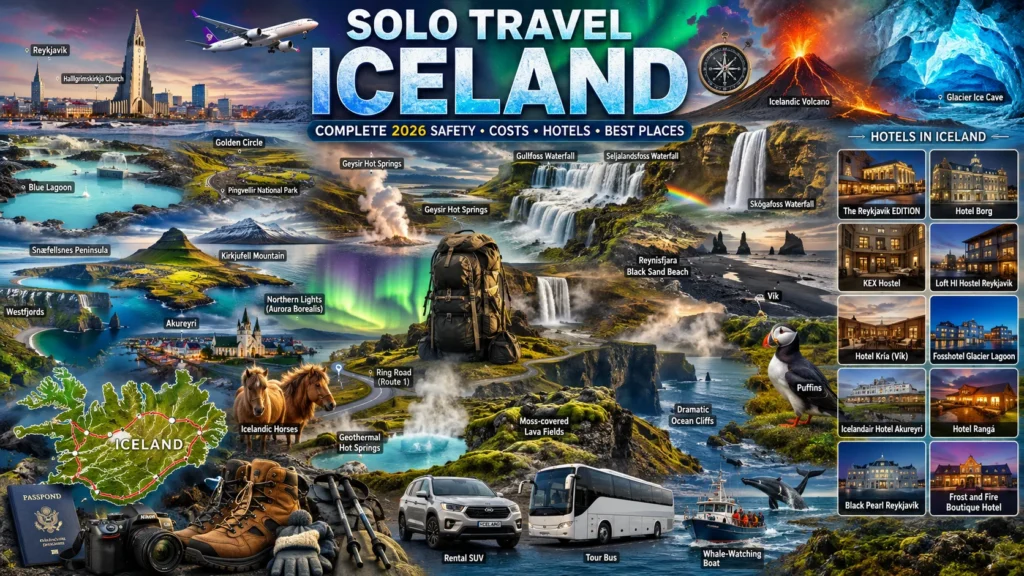
You could get mugged in a busy city, or you could stand alone at 2 AM in a country where police don’t even carry guns, watching green light rip across the sky. Iceland picked the second option for itself, and somehow it also became one of the easiest places on Earth to travel completely alone.
Quick answer: Solo travel in Iceland is safe, affordable if you plan smart, and doable without a rental car. Iceland has topped the Global Peace Index as the world’s safest country for 18 years straight, and the entire country runs on cards, so a solo traveller rarely has to worry about cash, scams, or being an easy target.
Why is solo travel in Iceland having a moment right now?
Iceland isn’t just pretty on Instagram. The numbers behind the hype are real, and they explain why solo travellers keep choosing it over “safer” sounding destinations.
Iceland welcomed close to 2.3 million tourists in 2025, in a country with only about 380,000 residents. That’s a remarkable figure for a nation this small, and tourists now outnumber Icelanders by roughly six to one. Iceland Data
The country tops the 2025 Global Peace Index for the eighteenth year running, and its reputation for safety, low crime rates, and a welcoming atmosphere continues to make it a top pick for global travellers. For someone travelling alone, that single fact does more for peace of mind than any packing list ever will. Travel And Tour World
If a landscape this raw pulls something out of you emotionally (and it usually does), you’re not the first solo traveller to come home and try to put it into words. This English poetry on soul, courage and God’s mercy captures that exact feeling of standing somewhere far bigger than yourself.
Is Iceland actually safe for solo female travellers?
Yes, and it’s not just a marketing line. Iceland is repeatedly ranked the safest country in the world, and that safety extends fully to women travelling alone.
An Icelandic native told the BBC that you can walk alone at night mostly without worry, with babies left sleeping peacefully in prams outside cafes while parents run errands nearby. Local police don’t carry guns, and no one has been killed in a police shooting since 2013. GoodGoodGood
The real risks in Iceland come from weather, not people. Sudden wind gusts and icy roads cause far more trouble for solo travellers than crime does. Check road and weather conditions daily through Iceland’s official safe travel app, and you’ll dodge most of the problems people actually run into here.
When should you plan solo travel to Iceland?
There’s no bad season, but each one changes your trip completely. Pick based on what you want more of: daylight, savings, or northern lights.
June to August gives you close to 24-hour daylight and every highland road open, but it’s also the busiest and most expensive stretch of the year. June to August is genuinely the peak season, with July and August each pulling over 250,000 visitors a month. Road Genius
May and September are the quieter middle ground: fewer crowds, softer prices, and a real shot at the aurora without dealing with winter’s harsher driving conditions. Winter (November to February) cuts hotel costs dramatically but comes with short daylight and closed highland routes.
One thing worth flagging for anyone booking a 2026 trip: a total solar eclipse crosses Iceland on 12 August 2026, and hotel prices in that path are already spiking hard. Skip that week unless the eclipse is the whole point of your trip.
How much does solo travel Iceland really cost?
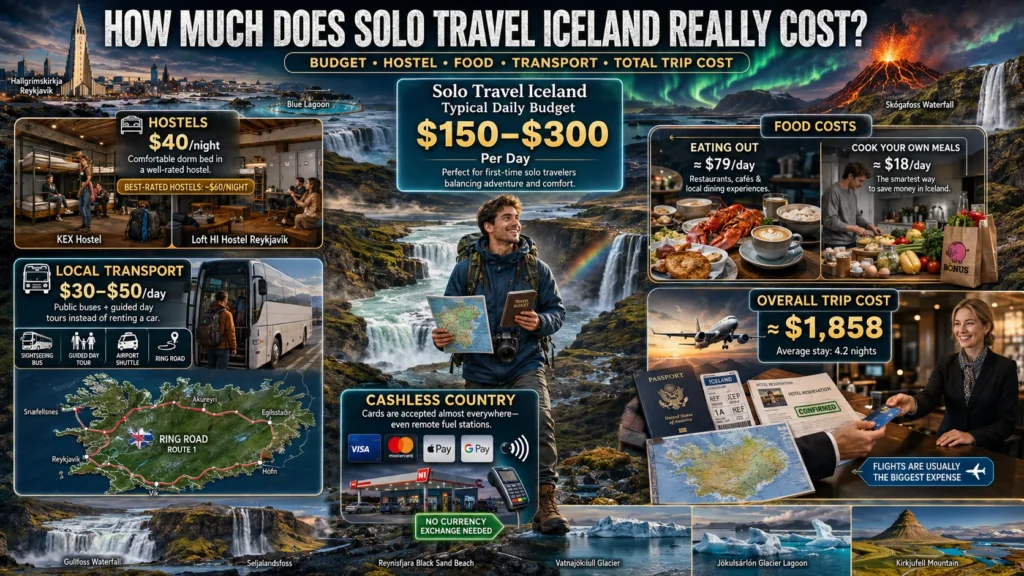
Budget solo travellers can manage Iceland for roughly $150 to $300 a day, though solo trips always cost more per person than trips split between two people.
Here’s where your money actually goes:
- Hostels: around $40 a night for a dorm bed in a well-reviewed hostel, closer to $60 for the best-rated ones
- Food: the average cost of eating out is about $79 a day, while cooking simple meals at home costs about $18 a day. NeverEnding Footsteps
- Local transport: skipping a rental car and relying on buses plus day tours usually lands between $30 and $50 a day
- Overall spend: international tourists spend about $1,858 per trip, with a typical stay of 4.2 nights. Road Genius
Flights to Iceland usually eat up the biggest single chunk of your budget, so lock them in early. Icelandair and Play both fly direct from several major hubs, and prices swing hard by season.
One thing that actually saves solo travellers money: Iceland runs almost entirely on cards, and cards are accepted everywhere, including remote fuel stations, so you rarely need to use cash at all. Slice of Iceland
Where should solo travellers stay in Iceland?
Base yourself in Reykjavik for your first and last nights, then let the rest of your route decide your stays.
Hostels, guesthouses, or hotels? Hostels are the easiest way to meet fellow solo travellers, and Reykjavik’s hostel scene (KEX and Loft come up constantly in solo traveller recommendations) is genuinely social. Guesthouses outside the capital are often family-run and sometimes cheaper than a hostel dorm bed if you don’t mind sharing a bathroom.
Which areas suit solo travellers best? Reykjavik gives you nightlife and the easiest access to day tours. Vik and the South Coast put you close to black-sand beaches, though at a Premium. Akureyri in the north is quieter and cheaper if you’d rather skip the tourist crowds entirely.
Can you travel to Iceland solo without a car?
Yes, and plenty of solo travellers do exactly this every year. It just takes a bit more planning than jumping in a rental car.
Public transportation is limited in Iceland, and renting a vehicle unlocks waterfalls, glaciers, and geothermal springs that are otherwise accessible only by car. As a solo traveller, though, you’re covering that entire rental cost alone, which changes the math compared to a couple splitting it. Radical Storage
Buses run along the Ring Road, though stops are limited without extra planning. Day tours from Reykjavik cover the Golden Circle, South Coast, and glacier walks without you touching a steering wheel, which is exactly why an Iceland group tour or solo travel package earns its price tag for a lot of first-timers.
Which places should solo travellers never skip?
The Golden Circle is the obvious starting point, and for good reason. It links Geysir, Þingvellir National Park, and the Gullfoss waterfall, all within a few hours of Reykjavik and easily covered by bus tour with zero driving required.
Push a little further, and the Westfjords reward you properly. Locals themselves point to this region for its dramatic coastal mountains and near-empty fishing villages. The Snaefellsnes Peninsula packs a mini version of the whole country (volcano, glacier, coastline) into a single day trip that most tour buses skip entirely.
What should you pack for solo travel in Iceland?
Layers beat any single “perfect” jacket. Pack a proper waterproof outer shell, a warm mid-layer, wool socks, and waterproof hiking boots, even if you’re going in summer.
Bring a reusable water bottle, too, since Iceland’s tap water is among the cleanest on Earth and refilling from the tap is completely normal. Winter solo travellers should add microspikes for icy pavements, because Reykjavik’s sidewalks get properly slick once temperatures drop. Slice of Iceland
How can you save money travelling solo in Iceland?
Cook most of your own meals using the Bonus supermarket chain (look for the pink pig logo), which runs noticeably cheaper than convenience stores. Buy alcohol at the Keflavik duty-free shop on arrival, since bars mark drinks up three to four times the retail price. Slice of Iceland
Travel in May or September instead of peak summer for softer prices across the board. And book accommodation early. Iceland’s hostel supply is limited, and the good rooms sell out fast once summer bookings pick up.
Should you book a group tour or go fully independent?
Both work well, and the right choice depends on how much planning you actually enjoy doing.
An Iceland solo travel package or group tour removes the logistics headache entirely: transport, a guide, and an itinerary are all handled, plus instant company on excursions like glacier hikes that genuinely feel safer in a group. Independent travel by buses and a loose itinerary gives you more freedom to slow down, but they also mean more time spent planning transfers yourself.
Most first-timers land somewhere in the middle: independent for Reykjavik and the Golden Circle, guided for anything that requires specialised gear, like glacier walks or ice caves.
What are real solo travellers saying about Iceland on Reddit?
The r/solotravel community is one of the most useful places to check before you book, and a few patterns repeat constantly across real traveller threads. Budget worries come up a lot, and experienced posters point out that a week can be done cheaper than most blog guides suggest if you cook your own meals and skip the rental car.
Transport questions dominate too, especially whether a car is really necessary. The consensus from people who’ve actually done it: not required, but genuinely helpful if your budget allows it. That lines up almost exactly with the official cost and transport data above.
What mistakes should first-time solo travellers avoid?
Don’t skip travel insurance. Mountain rescue and medical evacuation costs in Iceland are steep, and you’re on your own to handle them if something goes wrong.
Don’t underestimate the weather either, even in July. Pack for four seasons no matter when you fly out. And don’t over-schedule your days, since Iceland’s roads close without warning during storms, and a rigid itinerary falls apart the moment that happens.
How do you plan a 7-day solo itinerary in Iceland?
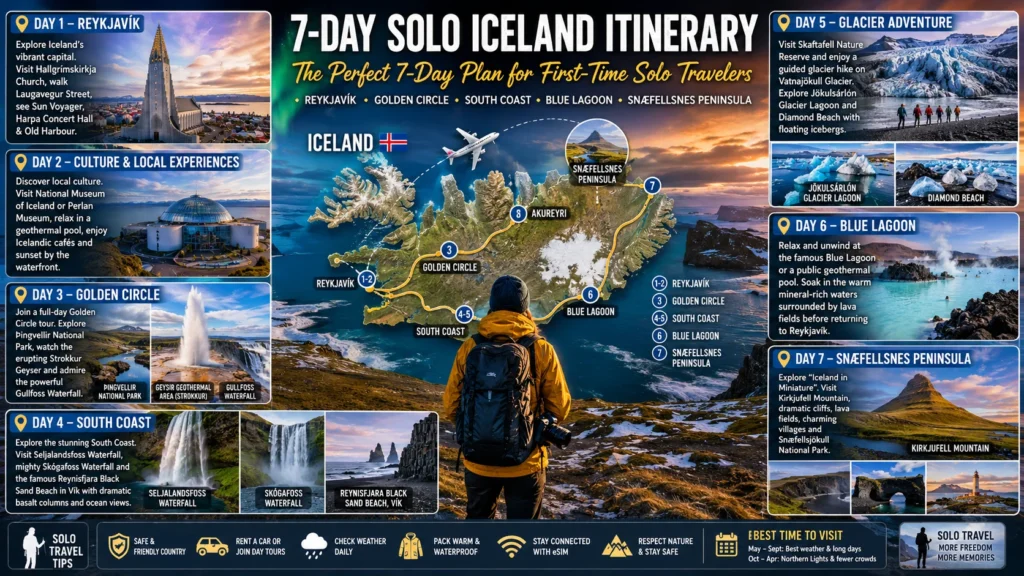
A week is the sweet spot most first-time solo travellers land on. It’s enough time for the Golden Circle, the South Coast, and one slower day actually to breathe
- Days 1 to 2: Reykjavik, city walking, Hallgrímskirkja church, one museum
- Day 3: Golden Circle day tour
- Days 4 to 5: South Coast, black sand beaches, guided glacier walk
- Day 6: Blue Lagoon or a public geothermal pool for the same water at a fraction of the cost
- Day 7: Snaefellsnes Peninsula or a slow final morning before your flight home
If you’re heading into this trip carrying something heavier than just luggage, a breakup, burnout, or simply needing space to think, that stretch of quiet Icelandic road can do more for you than a spa day ever could. A lot of readers working through something similar find real comfort in understanding mental health and wellness, and it pairs surprisingly well with the reset a solo trip like this offers.
And if the silence out there gets loud in the good way, the kind that makes you want to sit with your own thoughts a little longer, that feeling has a name in khamosh raaton me, in Urdu poetry on divine closeness, where stillness says more than words ever could. If Iceland isn’t quite your first solo pick, our Costa Rica solo travel guide covers a completely different kind of solo adventure at a gentler price point, and you can browse every pillar we cover at versesoul.com if you’re still deciding where to go first.
FAQ’s:
Is Iceland safe for solo female travellers?
Yes. Iceland is consistently ranked the world’s safest country, with low crime rates and an unarmed police force.
Is Iceland good for solo travel?
Yes. Its safety, small size, and easy-to-navigate capital make it one of the most beginner-friendly solo destinations in Europe.
Can you visit Iceland without renting a car?
Yes, through a mix of buses and guided day tours, though a car gives you more flexibility for remote routes.
How many days do you need for solo travel Iceland?
Most first-timers find 5 to 7 days enough to cover Reykjavik, the Golden Circle, and the South Coast without rushing.
What is the best month for solo travel to Iceland?
May and September offer the best mix of good weather, lower prices, and a real chance at the northern lights.
Final thought: Is solo travel in Iceland worth it?
Yes, without much hesitation. Few countries hand a solo traveller this much safety, this much raw landscape, and this much ease of movement in a single trip.
It’s not the cheapest destination you’ll ever pick. But between the world’s safest streets, a country that runs on cards instead of cash, and scenery that makes you stop mid-sentence, Iceland gives back more per dollar than most places even try to.
If this is your first solo trip anywhere, Iceland is a forgiving place to start. If it’s your tenth, it’ll still surprise you somewhere along the Ring Road.
Pingback: Best Solo Travel Destinations in the World (2026)