
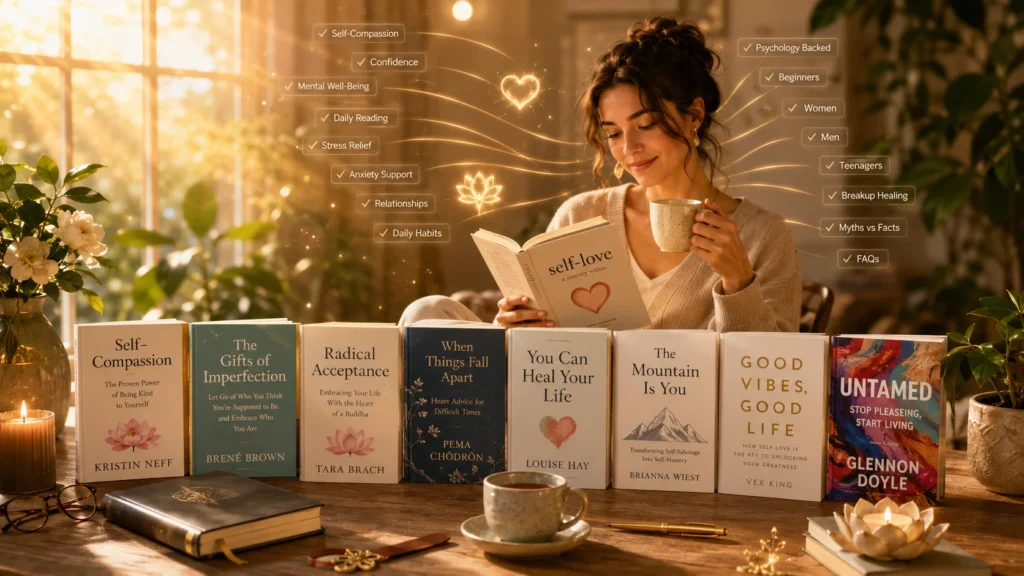
You don’t need to read 50 books about self-love to feel better about yourself. You need 2 or 3 that actually meet you where you are, and the discipline to sit with what they say. That’s the whole secret, and most articles won’t tell you that straight.
Self-love books get a bad reputation for being fluffy. Some are. But a good one works the same way therapy homework works: it gives you a structure for a feeling you didn’t know how to organize. Read for 6 minutes,and your stress can drop by 68%, according to a 2009 University of Sussex study on reading and relaxation. That’s more than a walk, more than tea, more than music.
Quick answer: the best self-love books for you depend on what you’re working through right now, whether that’s low confidence, a breakup, chronic self-criticism, or just wanting a gentler inner voice. Below is a working list, sorted by what each book is actually good at, plus the research behind why reading works on self-worth in the first place.
What are self-love books, and why are they so popular?
Self-love books are nonfiction (and sometimes fiction) titles built around one core skill: treating yourself the way you’d treat someone you love. They’re popular because talk therapy is expensive and often has a waitlist, and a $15 book doesn’t.
The global personal development market hit $48.4 billion in 2024, and books are the fastest-growing segment, expanding at over 7% a year. People aren’t buying these books to feel productive. They’re buying them because the price of admission for feeling okay about yourself has gotten cheaper and more private than ever.
Goodreads data show that 62.5% of self-help book readers are women, a higher share than in the overall reading population. That skew shapes which titles get published and marketed, something worth knowing before you assume a “self-love book” is written with you specifically in mind.
How can self-love books improve your mental well-being?
They work by giving your inner critic a competing voice. Most people can be kind to themselves; they lack the habit. A book can build that habit through repetition, examples, and language you start borrowing in your own head.
Dr. Kristin Neff, the psychologist who pioneered self-compassion research, found something specific: self-compassion buffered people against anxiety during a stressful lab task even better than self-esteem did. Self-esteem depends on winning. Self-compassion doesn’t require you to win; it just requires you to be kind to yourself when you don’t.
That distinction matters more than most self-love content admits. A book that only hypes you up (“you’re amazing, believe in yourself”) is teaching self-esteem. A book that teaches you how to sit with a hard moment without turning on yourself is teaching self-compassion, and that’s the version backed by deeper research.
Why should you read self-love books every day?
You don’t need to, honestly. Reading one chapter a week and actually doing the reflection prompts beats speed-reading five books in a month.
What daily reading does give you is consistency. A meta-analysis by researcher Pim Cuijpers found bibliotherapy (structured self-help reading) produced effects comparable to individual therapy for improving low mood, with an effect size around 0.82, which researchers consider large. A follow-up review found those gains held for up to 3 years after people stopped actively reading.
Small, steady doses beat one intense binge weekend. Your brain needs repetition to actually rewire the self-talk pattern, not just hear a good line once.
What makes a self-love book worth reading?
A good one gives you something to do, not just something to feel. Look for reflection questions, journal prompts, or exercises, not just paragraphs of encouragement.
It should also name specific situations. “You are worthy” means nothing at 2 AM during a spiral. “Here’s what to say to yourself when you’ve made a mistake at work” actually helps. Specificity is what separates a book that changes behavior from one that feels nice for an afternoon.
Which self-love books are best for beginners?
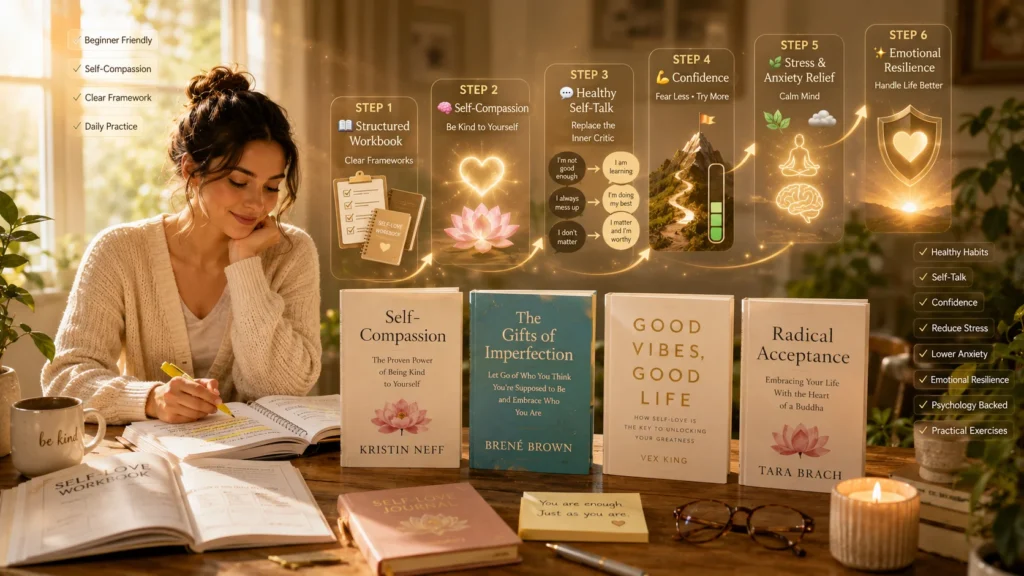
Start with something structured over something poetic. Beginners do better with workbooks and clear frameworks than with abstract, meditative writing, because there’s less guesswork about what actually to do.
Good starting points include Kristin Neff’s foundational work on self-compassion, Brené Brown’s writing on shame and imperfection, and any book focused on cognitive-behavioral techniques for self-talk. These give you a system, not just a feeling.
Are self-love books helpful for building confidence?
Yes, but indirectly. Most strong self-love books build confidence by lowering your fear of failure rather than hyping up your ego. When you’re less scared of messing up, you naturally take more chances, and that’s where real confidence comes from.
Can self-love books help reduce stress and anxiety?
They can, and there’s solid evidence to back it up. Beyond the general stress-reduction effect of reading itself, self-compassion practices specifically have been linked to lower anxiety, lower depression scores, and better emotional resilience across dozens of studies in Neff’s research alone.
Which self-love books have changed millions of lives?
A handful of titles show up again and again in reader recommendations and therapist reading lists: Kristin Neff’s research-based books on self-compassion, Brené Brown’s work on vulnerability, Pema Chödrön’s writing on sitting with difficulty, and Tara Brach’s work on radical acceptance. These aren’t hype titles. They’re built on decades of clinical and academic grounding.
What lessons can you learn from best-selling self-love books?
The recurring lesson across almost all of them is the same: the way you talk to yourself in private becomes the way you expect the world to talk to you. Change the private voice first, and everything downstream gets easier.
How do you choose the right self-love book for your goals?
Match the book to the specific problem, not the genre. If you’re recovering from a breakup, look for books on grief and rebuilding identity. If you’re dealing with perfectionism, look for books on self-compassion and tolerance for failure. A generic “feel-good” title won’t touch a specific wound.
Should you read physical books or audiobooks?
It depends on how you process reflection. Physical books and workbooks are better for exercises you’ll want to write in or revisit. Audiobooks work well for books that are more narrative or meditative, ones you’re absorbing rather than actively working through.
Can self-love books improve relationships?
Often, yes, because how you treat yourself tends to leak into how you let others treat you. People with more self-compassion report better conflict resolution and less defensiveness, since they’re not protecting a fragile self-image during every disagreement.
How does self-love affect friendships and family life?
When you stop needing constant reassurance from people around you, your relationships get lighter. You show up less anxious, less needy of validation, and more able to actually enjoy time with people instead of scanning for approval.
What daily habits can you learn from self-love books?
The habits that show up most often across serious self-love books are journaling, naming your inner critic out loud, practicing self-talk you’d actually say to a friend, and building small non-negotiable acts of care into your day. None of these is complicated. They’re just easy to skip.
If you want short daily lines to anchor these habits, our self-love quotes for women collection pairs well with any of the books above, especially on days when a full chapter feels like too much.
How can you apply the lessons from self-love books in real life?
Pick one concept per book, not five. Trying to apply an entire book’s philosophy overnight is how most people quit by week two. Choose the single idea that hit hardest, practice it for 2 weeks, then move to the next one.
What mistakes should you avoid while practicing self-love?
The biggest mistake is treating self-love as a mood instead of a skill. You won’t feel good about yourself every day just because you’re reading the right book. Some days the “practice” is simply not spiraling into self-attack, and that still counts as progress.
Does psychology back self-love books?
The strongest ones are. Research on self-compassion by Kristin Neff has been replicated in dozens of studies. It has even been shown to reduce burnout and secondary trauma among healthcare workers in structured training programs. That’s a much sturdier foundation than most wellness trends get.
Not every book on a bookstore shelf carries that weight, though. A quick way to check: does the author cite research, or just personal anecdotes? Both have value, but research-backed titles tend to hold up better over repeated reading.
What are the best self-love books for women?
Women’s self-love reading often centers on people-pleasing, body image, and boundary-setting, since these show up disproportionately in women’s lived experience. Books that directly address boundaries and saying no tend to resonate hardest here, more than generic affirmation-style titles.
What are the best self-love books for men?
Men often respond better to books framed around resilience, purpose, and stoicism-adjacent language rather than ones that lead with emotional vocabulary first. The content overlaps heavily with women’s self-love books; the entry point is just different.
Which self-love books are best for teenagers?
Teens do best with shorter, illustrated, or workbook-style formats rather than dense psychology writing. Confidence and body image books written specifically for teen readers, with age-appropriate language, tend to land far better than adult self-help handed down.
Can self-love books help you heal after a breakup?

Yes, and this is one of the strongest use cases for the genre. Breakup recovery often means rebuilding a sense of identity that got tangled up with someone else, and books focused on grief, self-compassion, and rediscovering your own voice can genuinely speed that process.
If poetry feels more honest than prose right now, this Urdu piece on belief and patience through hard seasons captures that same rebuilding process in verse, and sometimes a few lines land harder than a whole chapter. For the English version of that same quiet, steady hope, My Time Will Come is worth a read too.
What are the most common myths about self-love books?
The biggest myth is that self-love means never being hard on yourself. It doesn’t. Real self-compassion includes honest accountability; it simply removes the cruelty from how you hold yourself to account.
Another myth: that these books are only for people in crisis. Most readers pick them up during ordinary stretches of low confidence or burnout, not full breakdowns. You don’t need to be at your worst to benefit from reading one.
A third myth worth naming: that self-love books work the same for everyone. They don’t. Effectiveness depends heavily on whether you actually do the reflective work rather than just reading passively, which is one reason bibliotherapy research usually separates “guided” reading from passive reading when measuring results.
Sometimes the reset you need isn’t another chapter at all. A solo trip built around quiet, unstructured time can do what a book can’t: force you actually to sit with yourself with no distractions. Our luxury solo travel guide is a good starting point if that’s what you’re craving right now.
FAQ’S:
What is the best self-love book for beginners?
Start with a workbook-style title focused on self-compassion basics, since it offers clear exercises rather than abstract ideas to interpret on your own.
How many self-love books should I read each year?
There’s no fixed number. Reading 2 to 4 books a year and actually applying the exercises beats reading 20 and applying none.
Do self-love books really work?
Research on bibliotherapy shows real, measurable improvements in mood and self-criticism, especially when readers engage with reflection prompts rather than reading passively.
Can teenagers read self-love books?
Yes, though teens generally respond better to books written specifically for their age group rather than adult-oriented titles.
Are self-love books based on science?
The stronger titles are built directly on peer-reviewed research, particularly Kristin Neff’s decades of work on self-compassion. Weaker titles lean more on anecdote than evidence.
Where can I buy the best self-love books?
Most are available through major retailers, local bookstores, and libraries. Libraries are worth checking first since self-love titles are frequently in stock and free to borrow.
Conclusion: Which self-love book will you read first?
You don’t need the whole list. You need one book that speaks directly to whatever you’re carrying right now, and the willingness to actually sit with it instead of rushing to the next title. Start there, and let the rest wait until you need them.
For more reflections on rebuilding confidence and inner peace, explore the full Healing & Wellness collection on VerseSoul, or head back to the homepage to see what else is new.